This week's AGM is a goalie who was able to be a workhorse in the junior leagues, but was never able to stay healthy enough in the pros to show off his talents. Of course, it could be a harder transition for him, but he did what he could and then moved to a teaching role after learning so much. This week, the profile of Jacques Cloutier.
Cloutier started his trek in the QMJHL with the Trois-Rivieres Draveurs starting in the 1976-77 season, playing in 25 games and posting an 11-6-2 record. Starting in the 1977-78 season, Cloutier became a workhorse for Trois-Rivieres, playing in 71 games of the team's 72-- compiling a 46-17-7 record, then going 12-1 in the playoffs, helping them win the QMJHL Championship. Cloutier would go 1-3 in the Memorial Cup that season. Cloutier played all 72 games for Trois-Rivieres in the 1978-79 season and had a 58-8-6 record, then 12-1 in the playoffs again, then 2-2 in the Memorial Cup. After the Buffalo Sabres drafted Cloutier in 1979, he had his workload cut down, playing only 55 games in the 1979-80 season, finishing with a 27-20-7 record-- then 3-4 in the playoffs.
Turning pro for the 1980-81 season, Cloutier would head to the AHL with the Rochester Americans; getting into 61 games and coming up with a 27-27-6 record. In the 1981-82 season, Cloutier went 14-7-2 in 23 games in Rochester, while being called into duty for the Sabres and putting up a 5-1-0 record in seven games. Cloutier stayed with Buffalo for the bulk of the 1982-83 season as a back-up (10-7-6), but the Sabres traded for an experienced back-up; putting Cloutier back in Rochester-- where he would go 7-3-1 in 13 games, then posting a 12-4 playoff record lifting Rochester to the Calder Cup.
The 1983-84 season, Cloutier was back in Rochester playing in 51 games with a final count of 26-22-1 and then going 9-9 in the playoffs. In the 1984-85 season, Cloutier would play 14 games in Rochester (10-2-1) and one game in Buffalo (0-0-1) before he tore some of his knee ligaments, putting him out for the rest of the season. The injury would keep Cloutier out until midway through the 1985-86 season, but he would get into 14 games with Rochester (10-2-2) and then 15 for Buffalo (5-9-1); then playing five games for Canada in the World Championship, helping the country get bronze.
Thanks to injury and inconsistent play for Tom Barrasso, Cloutier was able to stay up with Buffalo for the 1986-87 season, going 11-19-5 in 40 games, but the 1987-88 season saw Cloutier get into a logjam in Buffalo, playing only 20 games and posting a 4-8-2 record in that time. In the 1988-89 season, Cloutier was still in the logjam, but injuries and a horrific moment to Clint Malarchuk would put Cloutier in the spotlight. Cloutier would have a 15-14-0 record in 36 appearances and would go 1-3 in the playoffs. Also, Cloutier spent 11 games in Rochester, but with a lackluster 2-7-0 record.
Before the 1989-90 season, Cloutier was traded to the Chicago Blackhawks, where Cloutier would be a starter in that season for 43 games and compile an 18-15-2, then going 0-2 in four playoff games. Cloutier was hung up in another logjam in Chicago during the 1990-91 season-- being pushed out by Ed Belfour and then Dominik Hasek-- only getting on 10 games with a 2-3-1 record.
During January 1991, Cloutier was traded to the Quebec Nordiques and would finish the season there, appearing in 15 games with a 3-8-2 record. As a back-up in 1991-92, Cloutier appeared in 26 games and posted a 6-14-3 record. Cloutier was the third goalie during the 1992-93 season for Quebec, only appearing in three games and going 0-2-1. The 1993-94 season, brought more games for Cloutier-- but finishing with a 3-2-1 record in 14 appearances. After that season, Cloutier would retire from playing.
Cloutier stuck to hockey, but hired by the Nordiques as an AHL assistant coach with the Cornwall Aces from 1994 until 1996, then being promoted to assistant/goalie coach of the Colorado Avalanche-- winning Stanley Cup rings in 1996 and 2001. He was let go by the Avalanche in 2009, but would go over to Switzerland to help coach with Bob Hartley and help the Zurich Lions win a league championship and moved with Hartley from Switzerland to Calgary to be the assistant coach of the Flames whenever the lockout ends.
Junior stand-out that got hampered by injury and during a time where goalies were plentiful, Cloutier was part of the casualties that, but did make a good enough name for himself and had his mind for hockey-- transitioning it to a solid coaching career.
Showing posts with label Quebec Nordiques. Show all posts
Monday, December 24, 2012
Monday, May 07, 2012
Absurd Goalie Monday: Scott Gordon
From humble begins to a decent college career and a scrambled pro career, this week's AGM could be more notable for his coaching career than his playing career. In fact, many may forget his playing time-- which I wouldn't blame many for as he may not be the most recognized former player turned coach. This week, the profile of Scott Gordon.
Gordon started his career in Boston high schools with the Oliver Ames Tigers and then moving onto New Hampshire prep academy Kimball Union Academy.
After his prep career was done, Gordon moved on to the Boston College Golden Eagles for his college days, starting in the 1982-83 season, going 3-3-0 in nine games. The 1983-84 season saw Gordon get plenty of time in next, playing 35 games and finishing with 21-13-0 record. Gordon was again the starter for BC in the 1984-85 season, going 23-11-2 in 36 appearances. During the Frozen Four of 1985, Gordon and former AGM Chris Terreri were the first pair of goalies to put water bottles on the top of their net during the triple-overtime game, seeing Providence beat BC 4-3. Gordon's senior year in 1985-86 had a 17-8-1 record in 32 games, to which Gordon got named to the Hockey East First All-Star Team.
Before the 1986-87 season, Gordon was signed by the Quebec Nordiques, but spent that season toiling in the AHL for 32 games with the Fredericton Express finishing with a 9-12-2 record. In the 1987-88 season, Gordon stayed in the AHL, but with the Baltimore Skipjacks, going 7-17-3 in 34 games. However, the 1988-89 season had Gordon play the majority of the season with the ECHL's Johnstown Chiefs, going 18-9-3 in 31 games, then 7-4 in 11 playoffs games; which helped Gordon get named to the ECHL First All-Star Team. Gordon also spend two games back in the AHL with the Halifax Citadels that season, both losses.
The 1989-90 season is where Gordon got some better footing in Halifax and putting up a 28-16-3 record, then 2-4 in the playoffs. Also, Gordon would get called up to Quebec in mid-season for 10 games, going only 2-8-0 in those games. The 1990-91 season was a bit dismal, as Gordon would play only 24 games in Halifax with a 12-10-2 record and appear in 13 games with Quebec, sporting a 0-8-0 record. Gordon would play for the US in the World Championships, losing his only appearance.
For the 1991-92 season, Gordon spent the start of it with the United States National Team in hopes of playing in the 1992 Olympics. He played 28 games with the touring team, putting up a 13-12-3 record, while playing on one games in the Olympics, but did not factor in the decision. Once he returned, Gordon played seven games for Halifax (3-3-1) and four games for the New Haven Nighthawks of the AHL (3-1-0).
Gordon was a free-agent by the 1992-93 season, opting to play in the ECHL with the Nashville Knights, putting together 13-9-1 record in 23 games, then going 5-4 in nine playoff games. Gordon would move to the Knoxville Cherokees for the 1993-94 season, finishing with a 15-10-1 record in 26 games, while also getting a call to the IHL's Atlanta Knights to play in five games, finishing with a 0-1-3 record.
In 1994, Gordon retired and began coaching with the Atlanta Knights as an assistant and would be with the team from 1994 until 1998, when the team was then the Quebec Rafales. Starting in 1998, Gordon got a head coaching job in the ECHL with the Roanoke Express, a post he would hold for two seasons. From the 2000-01 season until the 2007-08 season, Gordon would coach the AHL's Providence Bruins, winning the Louis A. R. Pieri Memorial Award for Coach of the Year in his last season. In the 2008-09 season, Gordon became the head coach of the New York Islanders, but after a couple dismal seasons-- he would be dismissed as the head coach in the middle of the 2010-11 season. Currently, Gordon is an assistant coach with the Toronto Maple Leafs. Gordon has also helped USA Hockey as an assistant in the 2009 World Championships and 2010 Olympics and the 2011 Worlds as the head coach.
While he didn't do much for some lackluster teams, the knowledge picked up and the international experience that Gordon was able to pick up was something that is invaluable. With the amount of situations he's been in, it has helped Gordon adapt to whatever is thrown his way.
Labels:
Absurd Goalie Monday,
AHL,
Baltimore Hockey,
College Hockey,
ECHL,
IHL,
Olympics,
Quebec Nordiques,
Scott Gordon,
Team USA,
World Championships
Monday, January 09, 2012
Absurd Goalie Monday: Markus Mattsson
When the WHA came into the landscape in the 1970s, it gave me chances for players, mostly goalies, as well as giving the chance for international players to start off their career. That's what happened with this week's AGM, who broke in with the WHA from his native Finland before making a push at a NHL career. This week, the profile of Markus Mattsson.
Mattsson started is career off in his homeland, Finland, playing for Ilves Tampere from the 1973-74 season until the 1976-77 season. During that time as well, Mattsson played for Finland in international competitions, like the European Junior Championships (1974 and 1976), the World Junior Championships (1975), and in the inaugural Canada Cup in 1976 before moving his career forward.
In the summer of 1977, Mattsson was drafted by the New York Islanders in the NHL Draft and the Houston Aeros in the WHA Draft. Mattsson chose the WHA route, but he would be traded from Houston to the Winnipeg Jets in June and play a total of ten games (4-5-0) with the Jets in two stints-- as Mattsson was traded to the Quebec Nordiques, playing there for six games (1-3-0) before being traded back to Winnipeg at the end of the 1977-78 season. Also that season, Mattsson played two games for the Central League's Tulsa Oilers, going 1-1-0 in that brief time. The 1978-79 season settled down for Mattsson, who stuck with the Jets to play for 52 games that season, going 25-21-3.
As the Jets moved to the NHL, Mattsson moved with them, even though he was reclaimed by the Islanders, but then re-reclaimed by the Jets. For the 1979-80 season, Mattsson played 21 games for the Jets with a 5-11-4 record, while going into the Central League with Tulsa going 10-7-2 in 20 games. Mattsson would spend more time with Winnipeg in the 1980-81 season, but with a worse record-- finishing with a 3-21-4 record in 31 games, while playing five games in Tulsa with a 3-2-0 record. Though, Mattsson played in the 1981 Canada Cup, but he went 0-2-0 in two games before the 1981-82 season, where he's played in Tulsa all season, compiling 26-23-0 record in 50 games.
Mattsson signed with the Minnesota North Stars before the 1982-83 season, going 1-1-0 in two games. He'd spend most that season with the Central League's Birmingham South Stars, playing in 28 games and finishing with a 17-10-0 record of that season.
In February of 1983, the North Stars traded Mattsson to the Los Angeles Kings for a Draft pick. To close out the 1982-83 season with the Kings, Mattsson played in 19 games with a 5-5-4 record. Mattsson would split the 1983-84 season with the Kings and their AHL affiliate, the New Haven Nighthawks. In Los Angeles, Mattsson went 7-8-2 in 19 games, while in New Haven, Mattsson finished with a 16-10-1 record while appearing in 31 games.
After that, Mattsson would move back to Finland to play for Tappara Tampere from the 1984-85 season until he retired after the 1986-87 season.
While he still is the goalie who stopped Wayne Gretzky's 51-game point streak, he never seemed to get a chance to make a mark in front of a big audience. Mattsson played behind some of the worse defenses and offenses out there, which didn't help him much. Yet, luckily, because of the WHA, he was able to get his break in North America and leave his mark in the hockey aspect of things.
Labels:
Absurd Goalie Monday,
AHL,
Finland,
Los Angeles Kings,
Markus Mattsson,
Minnesota North Stars,
Quebec Nordiques,
WHA,
Winnipeg Jets
Monday, December 26, 2011
Absurd Goalie Monday: Mario Brunetta
This week's instalment has quite the interesting route to gain some kind of success. While he did have a chance in the the pros, he plied his trade more over in the Europe-- while helping grow sport in one of the unknown spots of European hockey. This week, the profile of Mario Brunetta.
Brunetta started his career off in the Quebec Midget AAA ranks with the Ste-Foy Gouverneurs starting in the 1982-83 season, playing in 22 that season with a 17-4-1 record and 4-1 in five playoff games, while in the 1983-84 season, Brunetta went 11-23-4 in 39 games, but 8-3 in the playoffs.
Brunetta made the move to the QMJHL in the 1984-85 season with the Quebec Remparts, going 20-18-1 in 45 appearances, then 0-2 in the playoffs. Brunetta was drafted by the Quebec Nordiques in the 1985 NHL Draft, but the 1985-86 season moved Brunetta to the Laval Titan, playing in 63 games and finishing with a record of 30-28-1 while going 9-5 in 14 playoff games. Back with Laval in the 1986-87 season, Brunetta compiled a 27-25-4 record in 59 games and an 8-6 record in 14 playoff games.
The 1987-88 season bumped Brunetta to the pro ranks, mainly with the Nordiques, finishing with a 10-12-1 record in 29 games that season, while also spending time in the AHL with the Fredericton Express going 4-1-0 in five games there. The bulk of the 1988-89 season for Brunetta was spent in the AHL with the Halifax Citadels, going 14-14-5 in 36 games while going 1-3-0 in five games with the Nordiques. Brunetta stucks with Halifax for the majority of the 1989-90 season, finishing with a 8-14-2 record in 24 games, but then getting the called from the Nordiques to play in six games with a 1-2-0 record.
During the summer of 1990, Brunetta was released by the Nordiques. Without a contract in North America, Brunetta went overseas to Italy to play for HC Asiago, playing in 93 games from the 1990-91 season until the 1992-93 season. Brunetta went onto play for SG Milano Saima for the 1993-94 and 1994-95 season, spanning 29 games. The 1995-96 season had Brunetta play in 40 games for Varese Hockey.
Starting in the 1996-97 season, Brunetta went over to Germany to play for EHC Eisbaren Berlin for three season until the 1998-99 season for 111 games, getting them to the Finals in 1998, but losing in the championship game. Brunetta moved to Sweden for the 1999-2000 season, playing 28 games for Frolunda before he would go back to Germany in the 2000-01 season with ERC Ingolstadt, which would last for two seasons for 86 games, where he would put up seven shutouts in that time. Brunetta moved back to North America to play 10 games for the Quebec Semi-Pro League's Quebec Aces, going 3-4-0 before hanging up his pads.
During his playing tenure, Brunetta played for Italy in international competitions, as he got Italian citizenship when playing overseas. He played in three World Championships for Italy in 1995, 1998, and 2002-- going 1-3-1 in eight games played. He also played for Italy in the 1998 Olympics, losing the only game he played in.
Not the most orthodox career path, but Brunetta found a way to actually get himself into international play when he probably wouldn't have otherwise. While he did get pushed out of the way in Quebec, he didn't give up and probably helped out some of the programs in Italy grow because of his experience in the NHL.
Brunetta made the move to the QMJHL in the 1984-85 season with the Quebec Remparts, going 20-18-1 in 45 appearances, then 0-2 in the playoffs. Brunetta was drafted by the Quebec Nordiques in the 1985 NHL Draft, but the 1985-86 season moved Brunetta to the Laval Titan, playing in 63 games and finishing with a record of 30-28-1 while going 9-5 in 14 playoff games. Back with Laval in the 1986-87 season, Brunetta compiled a 27-25-4 record in 59 games and an 8-6 record in 14 playoff games.
The 1987-88 season bumped Brunetta to the pro ranks, mainly with the Nordiques, finishing with a 10-12-1 record in 29 games that season, while also spending time in the AHL with the Fredericton Express going 4-1-0 in five games there. The bulk of the 1988-89 season for Brunetta was spent in the AHL with the Halifax Citadels, going 14-14-5 in 36 games while going 1-3-0 in five games with the Nordiques. Brunetta stucks with Halifax for the majority of the 1989-90 season, finishing with a 8-14-2 record in 24 games, but then getting the called from the Nordiques to play in six games with a 1-2-0 record.
During the summer of 1990, Brunetta was released by the Nordiques. Without a contract in North America, Brunetta went overseas to Italy to play for HC Asiago, playing in 93 games from the 1990-91 season until the 1992-93 season. Brunetta went onto play for SG Milano Saima for the 1993-94 and 1994-95 season, spanning 29 games. The 1995-96 season had Brunetta play in 40 games for Varese Hockey.
Starting in the 1996-97 season, Brunetta went over to Germany to play for EHC Eisbaren Berlin for three season until the 1998-99 season for 111 games, getting them to the Finals in 1998, but losing in the championship game. Brunetta moved to Sweden for the 1999-2000 season, playing 28 games for Frolunda before he would go back to Germany in the 2000-01 season with ERC Ingolstadt, which would last for two seasons for 86 games, where he would put up seven shutouts in that time. Brunetta moved back to North America to play 10 games for the Quebec Semi-Pro League's Quebec Aces, going 3-4-0 before hanging up his pads.
During his playing tenure, Brunetta played for Italy in international competitions, as he got Italian citizenship when playing overseas. He played in three World Championships for Italy in 1995, 1998, and 2002-- going 1-3-1 in eight games played. He also played for Italy in the 1998 Olympics, losing the only game he played in.
Not the most orthodox career path, but Brunetta found a way to actually get himself into international play when he probably wouldn't have otherwise. While he did get pushed out of the way in Quebec, he didn't give up and probably helped out some of the programs in Italy grow because of his experience in the NHL.
Labels:
Absurd Goalie Monday,
AHL,
Italian Hockey,
Mario Brunetta,
QMJHL,
Quebec Nordiques
Monday, December 05, 2011
Absurd Goalie Monday: Goran Hogosta
This week's AGM is a guy who didn't get much of a chance or recognition for what he did in the NHL. However, when it comes to his homeland, he was much more well-known and appreciated. Even with all of that, he did make his mark in the NHL landscape for what he did. This week, the profile of Goran Hogosta. For his junior year, Hogosta played with HC Tunabro in his home country of Sweden. He played there from the 1971-72 season until the 1973-74 season in a total of 31 games. While in that time of playing for a junior club, he was elected to the Swedish National Team for the European Junior Championships for the 1972 and 1973 tournaments, where Sweden would capture silver in both with Hogosta getting top goaltender honors in the 1973 tournament.
In the 1974-75 season until the 1976-77 season, Hogosta played for Leksands IF in the Swedish League for 90 games, helping them boost up to the elite level of the Swedish ladder. Also in that time, Hogosta played in three World European Championships for Sweden, winning a silver and two bronze medals while going 12-5-0 combined in all three tournaments; being named top goaltender in the 1977 tournament and on the All-Star Team of that tournament, as well. Hogosta along with Hardy Astrom participated in the first Canada Cup tournament, where he would win one game in one appearance.
In the summer of 1977, Hogosta was signed by the New York Islanders and would make the team out of training camp. On November 1st, 1977-- Hogosta became the first European born and European trained goalie to play in the NHL, though he only played for nine minutes. Hogosta spent the bulk of the 1977-78 season in the AHL with the Hershey Bears, where he would play 23 games with a 6-13-2 record. Hogosta also spent time that season with the Central League's Fort Worth Texans, going 3-2-0 in five games. The 1978-79 season had Hogosta back with Fort Worth, playing in 61 games and going 25-29-4 in those games, then 1-2 in three playoff games.
In August 1979, Hogosta was traded to the Quebec Nordiques for Richard Brodeur. Hogosta played with the Nordiques for 21 games in the 1979-80 season going 5-12-3, while playing in 17 games with the Syracuse Firebirds and finishing with a 4-9-4 record there.
After that season, Hogosta went back to Sweden to play with Vastra Frolunda HC from the 1980-81 season until the 1983-84 season for a total of 116 games before he would retire at the end of 1984. Hogosta would make a short comeback in the 1986-87 season with Leksands IF for four games before retiring for good.
He may not be notable for much, but Hogosta was the man who paved the way for the European goaltenders of today. He didn't stay around for North America for long, but what he did in Sweden helped him cement his legacy in his home country by playing for them many times over and putting on a great display each time.
Labels:
Absurd Goalie Monday,
AHL,
European Hockey,
Goran Hogosta,
New York Islanders,
Quebec Nordiques,
Swedish Hockey
Tuesday, August 09, 2011
On the Topic Of Mascots
As the Draft is being revealed as heading to Pittsburgh for June 2012, there needed to be some shuffling of scheduling for the Consol Energy Center. One of which was a "Furries" Convention that needed to be pushed a week earlier. If you're not familiar with the "Furries" craze....then read up on it at the link.
Not only is that kind of amusing to me, but it made me wonder about mascots and how fun it would be if the mascots actually picketed outside during the FanFest wondering where the convention was and why they weren't notified.
In any case, since it's August and not much is going on out there-- this is a post on mascots that are my favorite-- sans Boomer, because I've already done something about him before.
1. Harvey the Hound-- You always got to love the first in any movement and Harvey is the first mascot in the NHL. Introduced in 1983, Harvey has been most noticeable for having his tongue ripped out by then Oilers' coach Craig MacTavish. Plus, the fact they use-- I guess-- a rescue dog for the Flames and he doesn't have a shirt on.....makes it even more interesting. Good on Harvey for being the first and most unusual-to-the-team-name mascot.
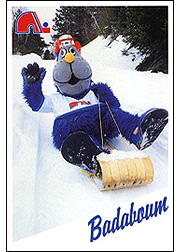
2. Badaboum-- This was the mascot of the Quebec Nordiques and it almost seemed like the starting for the Quebecors to actually have crazy muppet-esque mascots for their representation. Sadly, Badaboum did not make the trek to Colorado and could make a comeback (doubtful) if there's a team that relocates to Quebec City.
3. Youppi-- To continue with the Quebec theme, the Canadiens' mascot could be the most versatile, as Youppi was the iconic mascot of the Montreal Expos; but when they moved to Washington, DC-- the Habs picked up the pieces and kept the tradition of the Expos alive. They have the retired Expos numbers in the rafters and brought over Youppi in order to kept that tradition alive.
4. Stormy-- A hog shouldn't correlate with a hurricane, but it does in Raleigh. You see, the Hurricanes could have been called the Ice Hogs because of the all the hog farms in North Carolina. Yet, it still makes me laugh that a hog is the mascot of the Hurricanes-- but it's probably better than anything they could have come up with otherwise.
5. Nordy-- While I did say once that he was an odd looking mascot-- you have to respect the Wild's mascot. Not only is he half-bear, half-fox, half-man (ManBearFox??), but he has a mullet. Any mascot that can rock the mullet is alright in my books, even if they look freaky as hell and make people cock their heads to the sides wondering what it is.
That's my five-- and while these choices aren't like the NHL Guardians, it's a little more family friendly and unique to the team at each turn. Some have a lot to do with the team, some do not-- but the ones that do not are the best because of the guessing game of why they actually exist.
Monday, June 27, 2011
Absurd Goalie Monday: Manny Fernandez
Jumping back into the modern day this week with a guy who kind of has a tie-in to the past few weeks in the NHL. He made his name in the location where the NHL Draft was held this year, then he ended his career in the home of the new Stanley Cup Champions. This week, we look at the career of Manny Fernandez.The hike to the top for Fernandez began with playing Midget AAA with the Lac St-Louis Lions, while going 13-5-0 in 20 games. Fernandez would be bump up to the QMJHL in the 1991-92 season, playing with the Laval Titan and appearing in 31 games with a 14-13-2 record, then going 3-5 in nine playoff game. Fernandez would be drafted that summer by the Quebec Nordiques in the third round. The 1992-93 season would be a solid one for Fernandez, first going 26-14-2 in 42 games; then running off a 12-1 record in the playoffs-- helping the Titan to the QMJHL title and the Memorial Cup, where he'd go 2-3 in those five games. Fernandez would win QMJHL Playoff MVP for his solid record with the Titan. Fernandez had another solid season in 1993-94, going 29-14-1 in 51 games with Laval, then going 14-5 in 19 playoff games; though losing in the Finals. Even with the lose, they were the Memorial Cup host and again Fernandez would go 2-3, losing in the Final. Even with the playoffs; Fernandez was QMJHL's MVP and would be on the First Team All-Star squad.
During the 1994 trade deadline, Fernandez's right were traded from the Nordiques to the Dallas Stars for Shjon Podein and a pick that would turn out to be Chris Drury. With the change of scenery; Fernandez would jump into the pro ranks in the 1994-95 season with the IHL's Kalamazoo Wings and going 21-10-9 in 41 games, while going 10-2 in 14 playoff games. Fernandez would also appear in one game for the Stars, which was a loss. The 1995-96 season had Fernandez sticking with the now rename Michigan K-Wings, playing in 47 games with 22-15-9 record, but going only 5-1 in six playoff games. Again that year, Fernandez would move up to the Stars, but for five games and a 0-1-1 record. It was a shaky 1996-97 season for Fernandez, only posting a 20-24-2 record in 48 games, then 1-3 in four playoff games. Yet, the 1997-98 season was a bounce-back year, as Fernandez would go 27-17-5 with five shutouts; then going 0-2 in the playoffs. Again, Fernandez would play in Dallas for two games with a 1-0-0 record. Fernandez would shift to the Houston Aeros of the IHL for the 1998-99 season, going 34-6-9 in 50 games before going 11-8 in 19 playoff games; helping the Aeros win the Turner Cup. Fernandez had a loss in his only appearance for the Stars.
The Dallas Stars finally gave Fernandez a chance as a back-up for Ed Belfour in the 1999-2000 season, going 11-8-3 in 24 games, then having a no-decision in his only playoff appearance.
Fernandez would be pushed out by the up-and-coming Marty Turco, so Dallas trade Fernandez along with Brad Lukowich to the newly formed Minnesota Wild for some draft picks. The 2000-01 season had Fernandez split time with Jamie McLennan, but Fernandez was the better of the two with a 19-17-4 record in 42 games. Fernandez would split time with Dwayne Roloson in the 2001-02 season, getting in 44 games and finishing with a 12-24-5 record. With Roloson excelling, Fernandez would be relegated to back-up for 2002-03, compiling a 19-13-2 in 35 games, then appearing in nine playoff games with a 3-4 record. Yet again for the 2003-04 season, Fernandez was the "1b" and would get in only 37 games with a 11-14-9 record at the end of it all.
The lockout brought Fernandez to Lulea HF in Sweden for 19 games that year, but when the NHL returned, Fernandez would be the top goalie in Minnesota. The 2005-06 season was Fernandez's best yet finishing with a 30-18-7 record in 58 games. Even still, due to another goalie coming through the ranks (Niklas Backstrom), Fernandez had to split his time in 2006-07, finishing with a 22-16-1 record in his 44 appearances. With a solid team all around, Fernandez and Backstrom would win the William M. Jennings Trophy for fewest goals-against in the NHL.
Unhappy with the playing time, Fernandez would be traded by Minnesota to the Boston Bruins for Petr Kalus. However, the first season in Boston (2007-08) was a horrific one, as he would only play in four games with a 2-2-0 record, as he would have both back and knee surgeries, as he was recovering. Fernandez bounced back in the 2008-09 season, though a back-up to Tim Thomas; playing in 28 games with a 16-8-3 record, playing enough games to win the Jennings Trophy again. After that year, without a contract, Fernandez faded into the darkness without a formal retirement.
It seemed that he could never get a fair shake, with prolonged time in the minors and having to split the time with other goalies-- Fernandez never seemed to get the confidence boost to really show how he could perform. Even when he did, it seems he got undermined one way or another. Even still; there's a lot for him to remember and a lot of other trophies that came his way-- which can't be all that bad in the end.
Labels:
Absurd Goalie Monday,
Boston Bruins,
Dallas Stars,
IHL,
Manny Fernandez,
Memorial Cup,
Minnesota Wild,
Minor League Hockey,
QMJHL,
Quebec Nordiques
Monday, March 28, 2011
Absurd Goalie Monday: Ron Grahame
It's tournament time in NCAA hockey and what better way to talk about it than with a man who not only played college and held his own pretty well, but also went back when his career is done. While he did have a solid WHA career, his NHL career wasn't as tenured as he wanted. However, NHL success seemed to run in the family as his family has two Cup rings to their name. This week, a look at Ron Grahame.Starting in Junior A with the Victoria Cougars, Grahame decided against the major junior route, deciding to go to the University of Denver starting in the 1969-70 season. Grahame would play in 30 games that season, going 19-10-1 for those games. The 1970-71 season was one where Grahame would only see 17 games of playing time, finishing with a 9-7-1 record. Playing time would increase for Ron in the 1971-72 season, where he would play in 37 games, finishing with a 26-11-0 record; helping Denver to win the WCHA Playoff title. Grahame's performance allowed him to be drafted by the WHA's New York Raiders. However, Grahame would come back for his senior season in 1972-73, in which he would go 27-7-1 in 35 games, leading the Pioneers to another WCHA championship and getting them within one game of the NCAA title, but lost in the final to Wisconsin. Grahame's season was so great, he was named WCHA First-Team All-Star, NCAA West First Team All-Star, an WCHA Player of the Year.
That summer, Grahame's rights were traded to the Houston Aeros from the Raiders. Grahame would start out his pro career with the Macon Whoopee of the Southern Hockey League, playing 46 games and going 18-24-2 before getting a call-up to Houston for four games-- going 3-0-1 in those games. The 1974-75 season was a banner year for Grahame. Not only did he go 33-10-0 with four shutouts in 43 games, but he went a remarkable 12-1 in the playoffs-- helping the Aeros to win the AVCO Cup. Grahame was named WHA Playoff MVP, as well as taking WHA First Team All-Star honors along with the Bert Hatskin Trophy for Best Goaltender. Grahame saw his playing time increase in the 1975-76 season, playing 53 games and still putting up a decent 39-17-0 record for the Aeros, but a 6-8 playoff record was all he could muster. In 1976-77, Grahame would split time with Wayne Rutledge and only play 39 games, finishing with a 27-10-2 record, then putting up a 4-5 playoff record in his nine games in the cage.
For the 1977-78 season, Grahame made the jump to the NHL, signing with the Boston Bruins. Grahame would play in 40 games, topping out with a record of 26-6-7, while appearing in four playoff games-- going 2-1.
It was a short-stint in Boston, as Grahame was traded to the Los Angeles Kings for a First Round Pick, which turned out to be Raymond Bourque. Grahame shared time during the 1978-79 season with Mario Lessard, going 11-19-2 in 34 games. Again, Grahame played behind Lessard in the 1979-80 season, going only 9-11-4 in 26 games. Grahame only played six games in LA in the 1980-81 season, finishing with a 3-2-1 record.
In December of 1980, Grahame's rights were sold to the Quebec Nordiques for cash. Grahame only played eight games with Quebec, going 1-5-1, before he was sent to the AHL's Binghamton Whalers, where he would play 22 games and sport a 12-6-2 record before he would ultimately retire.
Currently, Grahame went back to his college roots, returning to the University of Denver in 1993 and now serves as the Assistant Vice Chancellor and Senior Associate Athletic Director. In that gig, Grahame oversees all the players and coaches to make sure they uphold the school's mission statement. Grahame has also served as a chairperson for the NCAA Hockey Tournament Committee, as well as being on server Local Organizing Committees for Hockey and Tournament Director for Denver volleyball, lacrosse, and hockey. He was inducted into the University of Denver Athletic Department Hall of Fame and named to the WCHA 50th Anniversary Team. In fact, Grahame and his son Jason were the first father/son tandem to play at Denver; while his other son John and his wife Charlotte were the first mother/son tandem to have their names on the Stanley Cup-- John as a member of the 2004 Tampa Bay Lightning team and Charlotte was on the Executive Management team for the 2001 Colorado Avalanche team.
An excellent college career yielded to a solid WHA career, but a so-so NHL career. Even with all of this, his choice of going to college rather than major junior turned out to be a solid one when it came to later on in life, outside of the rink. He made a dent during his college career-- but that recognition also helped him have the tenure he's had at the University of Denver.
Labels:
Absurd Goalie Monday,
Boston Bruins,
College Hockey,
Los Angeles Kings,
Quebec Nordiques,
Ron Grahame,
WHA
Monday, February 14, 2011
Absurd Goalie Monday: Clint Malarchuk
While we've had a lot of comebacks, this one could be more of the interesting ones-- especially because it was only a week until he played again. Yet, while it was only seven days-- the severity of his comeback made people sit there in amazement after what he had gone through. It's one moment that he will be infamously known for and many will never forget. This is the profile of Clint Malarchuk.Starting in Junior A with the Fort Saskatchewan Traders, Malarchuk went 23-9-1 in 33 games during the 1977-78 season, as the Traders would be the runner-up in the AJHL season. Overtaking the starting role in the 1978-79 season, Malarchuk would get 52 games in with a 36-15-1 record, helping the Traders actually win the Centennial Cup for the AJHL championship. That season also saw Malarchuk get his feet wet in the WHL, playing 2 games with a 1-0-1 record for the Portland Winterhawks. Malarchuk would stay in Portland for the 1979-80 season, splitting time with Darrell May-- getting in 37 games in with a 21-10-0 record. Malarchuk would split with May again for the 1980-81 season, playing in 38 games with a 28-8-0 record, then going 3-2 in the playoffs.
Malarchuk was drafted by the Quebec Nordiques in the 1981 Draft during the fourth round, and he would go to the Fredericton Express of the AHL for the 1981-82 season, gaining the starting role while playing in 51 games, though he sported a dismal 15-34-2 record; while he got a call-up to Quebec for two games, going 0-1-1 in those games. The 1982-83 season started the shuttle years for Malarchuk, as he would shift between Fredericton and Quebec. With Fredericton, he'd go 14-6-5 in 25 games, sharing the Hap Holmes Memorial Award for lowest goals-against with Brian Ford; while with Quebec, Malarchuk went 8-5-2 in 15 games. For the 1983-84 season, Malarchuk stayed up with the Nordiques for most of the season, playing in 23 games, going 10-9-2 overall-- then spent 11 games in Fredericton with a 5-5-1 tally. Due to a logjam in net, Malarchuk was relegated to only Fredericton in the 1984-85 season; going 26-25-4 for the season playing in 56 games, then going 2-4 in six playoff games.
There was a bit of a reprieve during the 1985-86 season, as Malarchuk would stay up with the Nordiques the entire season, while making a play for the starting gig. With a 26-12-4 record in 46 games, Malarchuk was priming himself for the long-haul. However, it came falling down, as he would go 18-26-9 in the 1986-87 season, which pretty much derailed his time in Quebec.
In June of 1987, Malarchuk and Dale Hunter were traded from Quebec to the Washington Capitals for Alan Haworth, Gaeten Duchense, and a first-round pick.....which turned out to be Joe Sakic. Malarchuk would get the starting gig in Washington, while he went 24-20-4 in 54 games, then going 0-2 in three playoff games. Yet-- thanks to the play of former AGM Pete Peeters, Malarchuk had to split time for the 1988-89 season and would go 16-18-7 in 42 games with the Caps before he was moving again.
At the trade deadline, Malarchuk, Grant Ledyard and a sixth-round pick was traded from Washington to the Buffalo Sabres for Calle Johansson and a second-round pick. Malarchuk played seven games to round out the year with a 3-1-1 record....but the year almost finished in tragedy.
Everyone knows the story, on March 22nd 1989-- the skate blade of St. Louis Blues forward Steve Tuttle hit Malarchuk's neck, severing the internal jugular vein. Malarchuk had blood gushing out of his neck and was very close to dying, and would have if he was at the other end of the ice. However, thanks to the quick thinking of then Buffalo trainer and former Army medic Jim Pizzutelli, Malarchuk was able to be saved. The doctors stitched up Malarchuk with over 300 stitches to close up the wound and didn't think he should play the rest of the season-- but he did. In later interviews, Malarchuk said that he left the ice as quick as possible so that his mother wouldn't see him die on the ice. It was bleak in his mind that he had the trainer call his mother and a Pastor was called in for him.
The 1989-90 season saw Malarchuk back in Buffalo to back-up another former AGM, Daren Puppa. Malarchuk would get in 29 games with a 14-11-2 record for the end of the season. Malarchuk would return for the 1990-91 season, but the record wouldn't be as forgiving-- finishing with a 12-14-10 record in 37 games. The 1991-92 season had Malarchuk behind the Puppa and another former AGM Tom Draper, as Malarchuk would 10-13-3 in 29 games and would spend two games with the AHL's Rochester Americans, going 2-0-0. Yet, the Sabres had too many goalies for the 1992-93 season and Malarchuk was loaned out to the IHL's San Diego Gulls and would play 27 games, in which he would regain his form with a 17-3-3 record, then going 6-4 in 10 playoff games, helping the Gulls get to the Turner Cup finals, despite losing. Malarchuk would share the James Norris Trophy for lowest goals-against with Rick Knickle.
That would mark the start of Malarchuk in the IHL, as he would stay in the league, but with the Las Vegas Thunder for the 1993-94 season. He would take the torch, playing in 55 games with a 34-10-7 record. Staying with Las Vegas in 1994-95 season, Malarchuk would see his time reduced, playing 38 games with a 15-13-3 record, as Malarchuk would retire after the season ended. However, it would be short-lived, as Malarchuk would come out of retirement to play four minutes in the 1995-96 season for the Thunder. Malarchuk would have a short retirement again, going 1-1-0 in three games for the 1996-97 season before he would be done for good.
After his playing career, Malarchuk would go into coaching-- first with the Las Vegas in the 1997-98 season, then moving to the Idaho Steelheads of the WCHL from 1998 until 2000. Malarchuk would get the call to the NHL to be a goaltending consultant to the Florida Panthers for the 2002-03 season, then getting on with the Columbus Blue Jackets from 2006 until 2010 before catching on with the Atlanta Thrashers this past summer.
Even after his throat incident, Malarchuk almost got into a fatal situation his farm in Nevada, as he had a self-inflicted gunshot wound to his chin after setting his gun between his legs when waiting to hunt. Malarchuk and his wife deny it was a suicide attempt; but he was consuming alcohol, which didn't blend well with his medication for OCD-- a condition he developed after the throat injury.
It's been a topsy-turvy career and life for Malarchuk, but he has been able to overcome things that most people probably couldn't do after it happened. He beat the odds in hockey and cheated death twice-- plus found a career after the game and stayed in the game thanks to it. You can't keep a good man down, and Malarchuk seems to be living proof.
Friday, February 11, 2011
Friday Five: Returns and Reunions
It's been quite the week.....and yet another goalie fight, so it just shows that I'm an idiot and really don't know anything about hockey and how it works. Why are you even reading this?? Oh well, time for the F5 because it's Friday.1. With the rabble-rousing of Carrie Underwood husband's being traded to her locale, how rough it is for the Ottawa Senators to get nothing in return??
If I'm playing on the Senators (and if things get bad, I actually may) I'd be a little disillusioned with the situation. Sure, you expect trades to happen and maybe some of the bigger named guys-- but getting an unknown in return is a bit disheartening. Fisher wasn't the flashiest guy, but got the job done and helped that team in any chance he could. With getting only picks back, coupled with an 11-game losing skid, as well as a regime that is almost guaranteed to be ousted at season's end (though it should be sooner), you almost have to think Eugune Melnyk is playing the role of Nero as his Rome burns (rack 'em).
That said, it seems par for the course for the Sens since they made it to the Stanley Cup finals in 2007 and nothing has seemed to get better or easier-- from goaltending, to coaching, to guys leaving-- it just snowballs into something worse; and you can't blame the fans for being rageful about the direction of this team.
2. With all these trades with some decent profile names, will this Trade Deadline Day be more about names moving or just upgrading role players on the roster??
This one could be all about upgrading the role players on the team. While there's decent UFAs for the summer, odds are you aren't willing to pay a lot to get them as a rental player. Basically teams are going to just tie up their loose ends when it comes to mucker and grinders, with maybe a decent size name going in the process. Yet-- I don't know if teams will wait for the 28th, as the gettings are good right now.
3. Ilya Kovalchuk is on a tear and the Devils continue their rise. Wishful thinking or was this a sign of waiting too long to replace John MacLean??
This was definitely something where they waited a bit too long to fire their coach, but they are showing they aren't the big bust many people thought they were. Kovalchuk, despite the minus-22, has been hot with five goals and five assists in the last eight games and showing he's worth his money. Even with Martin Brodeur dealing with injuries, the team has played well around Johan Hedberg recently, which is something they didn't do too much with MacLean behind the bench. While they're 13 points out of a playoff spot and have to keep an unimaginable pace to even keep up....some are keeping the faith.
4. Peter Forsberg returns tonight against the Columbus Blue Jackets-- injury happens...??
I'd say before the month of February ends. While it's a solid story if he does come back and plays well enough to get a contract for next year-- but the reality of the situation is he'll play a couple minutes tonight and in a few more games before he realizes he can't keep up with the speed and then retires for good....until October when it all starts again.
5. Quebec city is getting a $400M arena built. How much will this be like the Kansas City/Sprint Center fiasco??
With no team in sight for expansion or relocation (so they say) it could be a big deal for building such an expensive arena and not have anyone to house the arena after it's built. While hockey is very prevalent in Canada and a junior team could probably house that arena-- it's not what they want. The Canadian Olympic Committee President and former Quebec Nordiques' president and club owner said the NHL will be back in three years. Wishful thinking, but you may need that kind of over-the-top positive attitude in order to make something like this succeed.
---------
That's another week and if you want to get in contact with an idea for a topic-- Scotty.Wazz@Gmail.com is the place to send it over to. It'll be a riot if you see your topic here and you can tweet all your friends about it too....or not.
Monday, January 10, 2011
Absurd Goalie Monday: Steve Passmore
As we get more and more hard-up for AGMs, this one kind of jumped out because of the fact it's the second occurrence were a goalie had a mystery illness that turned out to be some kind of poisoning. Kind of an odd happenstance, but just made me wonder if it was the same person or not-- it wasn't. In any case, this AGM went from outhouse to penthouse to midhouse through his career. This week, Steve Passmore gets the AGM treatment.Passmore's career got off to a bit of a slow start, as he played in Midget AAA with the West Island Deltas for the 1988-89 and 1989-90 season, getting two call-ups to the Tri-City Americans in both seasons totaling five games and an 0-1-0 record.
Passmore would get a better chance to display himself when he was traded to the Victoria Cougars for the 1990-91 season. However, the team in front of him was a dismal one, as he would play 35 games, but compile a 3-25-1 record. The next season, Passmore would be the starter, but the result was still horrid. In 71 games, Passmore would finish with a 15-50-5 record, not seeing time in only one game that season. That season didn't seem to deter the Quebec Nordiques, who drafted him in the 9th Round of the 1992 Draft.
Passmore would be back in net for the 1992-93 season for Victoria, at least for 43 games (14-24-2), before he was dealt to the Kamloops Blazers for the last 25 games of the season (19-6-0), then going 4-2 in seven playoff games. The momentum for Passmore in Kamloops would continue, though he would play behind Rod Branch in the 1993-94 season, he would get in 36 games with a 22-9-2 record. Passmore had the hot hand heading into the playoffs, and would go 11-7 in the playoffs to help the Blazers win the WHL title, as well as the Playoff MVP award. The Blazers would go into the Memorial Cup, where Passmore would play all four games, winning them all and hoisting the Memorial Cup for the Blazers, on a team that had the likes of Jarome Iginla, Darcy Tucker, Brad Lukowich, and Hnat Domenichelli.
During that season, however, Passmore had been traded from Quebec to the Edmonton Oilers. Passmore would start his pro career with the Cape Breton Oilers of the AHL in the 1994-95 season, going 8-13-3 in his 25 games in his first pro-season. The next season, however, would see Passmore only play two games, going 1-0-0, but it was for a good reason.
During training, Passmore was dealing with severe muscle cramping and was forced to sit out. Not knowing what it was, he was tested and it was found that he had heavy metal poisoning. According to reports, there were unhealthy levels of copper, arsenic, magnesium, and antimony in his system that threatened his career. Luckily, a cure was found and he was able to continue playing.
The Oilers relocated their AHL team to Hamilton and renamed them the Bulldogs, but Passmore was still there for the 1996-97 season. Passmore would play 27 games with a 12-12-3 record and would get the call in the playoffs, going 12-10, where the Bulldogs would lose to the Hershey Bears in the Calder Cup finals. Passmore would also see time with the Raleigh Ice Caps of the ECHL for two games with a 1-1-0 record. The 1997-98 season saw Passmore start off with the IHL's San Antonio Dragons for 14 games, with a 3-8-2 record; before he was called up to Hamilton. With the Bulldogs, Passmore would put up a 11-10-6 record in 27 games. He would also get the call again in the playoffs, this time having a 0-2 record in three playoff games. The 1998-99 season saw Passmore back in Hamilton, where he would play in 54 games with a 24-21-7 record and he would finally get his call-up to Edmonton towards the end of the season, playing in six games, sporting a 1-4-1 record. Passmore would return to Edmonton for the playoffs, playing in 11 games with a 5-6 record.
Passmore would sign with the Chicago Blackhawks for the 1999-2000 season, where he would back-up Jocelyn Thibault. He would get in 24 games with a 7-12-3 record in Chicago, while playing in two games for the Cleveland Lumberjacks of the IHL going 1-0-1 in conditioning stints.
For the 2000-01 season, Passmore would be moved to the Los Angeles Kings for a draft pick. Passmore would be bounced around the minor leagues, playing in the IHL with the Chicago Wolves for six games (2-2-2), then to the AHL for the Lowell Lock Monsters for six games (2-4-0), then to the Kings for 14 games (3-8-1).
Yet, Passmore would go back to the Chicago Blackhawks at the trade deadline, playing in six games at the end of the 2000-01 season, going 0-4-1. Passmore would remain in Chicago for the 2001-02 season, again playing behind Thibault and getting in 24 games with an 8-5-4 record and an 0-2 playoff record in three games. Passmore would also be sent to the AHL with the Norfolk Admirals for two games, both wins. The 2002-03 season had Passmore start with the Blackhawks, but spend time in Norfolk during the middle of the season. Passmore would play 14 games in Norfolk (4-7-2) and 11 in Chicago (2-5-2). It would be another year back-and-forth in the 2003-04 season, as Passmore would spend 15 games in Norfolk (3-10-2) and only nine in Chicago (2-6-0), but would have his season cut short with a hip injury late in the year.
With no NHL in 2004-05, Passmore would go overseas and play for Alder Mannheim in Germany, playing in 21 games with a 2.59 GAA. The Phoenix Coyotes would sign Passmore for the 2005-06 season, but would play in the AHL with the San Antonio Rampage, going 4-6-0 in 11 games before leaving the team and heading to Finland to play for Jokerit Helsinki, where he would win five in his 15 games played. Passmore would stay over in Europe for the 2006-07 season, playing in Austria for Graz EC for 25 games, then moving to Italy to play for Milan for eight games before finally hanging up the pads.
After his playing career, Passmore went back to Kamloops to become the goaltending coach for the Blazers, but has since been relieved of his duties.
For a guy who went from a craptastic team in junior to a Memorial Cup champion, to blood disease that threatened his career to a solid job in the minors, coupled with a so-so NHL career, you can't say Passmore's career in retrospect lacked roller-coaster moments. In fact, he also has a few fights to his resume against Steve Shields, Garth Snow, and Dan Cloutier, so that's something, too. Those fights and the blood disorder shows the kind of fight that Passmore had in him when all is said and done.
Monday, November 22, 2010
Absurd Goalie Monday: John Garrett
With the "Mo-vember" celebration almost at an end, I figured I go with a guy who is known for his moustache during the hey-day in the 70's and in even now as we see him appear on TV for broadcasts. In the end, his aura of being a quick-witted, light spirited fella allowed him to be a friend in the media and then dive right into that fraternity afterwords. This week, we'll look at the career of John Garrett.The first exposure of Garrett is when he started in the OHA with the Peterborough Petes, which was headed by Roger Nielson starting in the 1969-70 season. Between that season and the next, Garrett played 99 games with the Petes and would be loaned out to the Montreal Jr. Canadiens for the 1970 Memorial Cup, which he would go 7-1 in nine games played on way to helping Montreal to a Memorial Cup championship.
Garrett was picked in the third round of the 1971 Draft by the St. Louis Blues and would spent the 1971-72 season with the Kansas City Blues of the Central League. Garrett would get most of the time in net with 35 games over the season, but sported a mediorce 13-14-7 record in the process. For the 1972-73 season, Garrett would go over to the Western League with the Portland Buckaroos for 17 games (6-8-2) before he would be moved to the AHL and play 35 games with the Richmond Robins, as well as three playoff games-- all losses.
Not seeing much of a chance of getting to the NHL in the 1973-74 season, Garrett tried his luck with the WHA after getting picked up by the Minnesota Fighting Saints. Garrett would split time with Mike Curran in the year, playing 40 games with a 21-18-0 record as well as going 4-2 in seven playoff games. Remaining Minnesota for the 1974-75 season, Garrett would get increased time, with 58 games under his belt and a 30-23-2 record on the season and 6-6 in the post-season, losing out in the semi-finals. In the 1975-76 season, Garrett would play 58 games with the Saints, going 26-22-4 before the Saints folded mid-season.
To finish out the 1975-76 season, Garrett signed with the Toronto Toros, where he would go 3-6-0 in his nine games there. The Toros would move to Birmingham, Alabama and become the Bulls for the 1976-77 season, which saw Garrett play 65 games and go 24-34-4. Garrett would have the most losses by a goalie that year and give up the most goals at 224, even though he led the league in shutouts with four. It wouldn't get much better in the 1977-78 season, with Garrett playing 58 games, going 24-31-1, which was the most losses again and gave up 210 goals-- another league high. The Bulls would only be in the first round of the playoffs, losing in five games with Garrett playing all five games (1-4).
Garrett was traded from Birmingham to the New England Whalers, and although he was claimed by the Chicago Cougars in the expansion draft, the Whalers got him back as a priority selection before the 1978-79 season. Garrett would play 41 games with the Whalers that season, going 20-17-4 and then 4-3 in eight playoff games, losing in the semi-finals.
The Whalers would be one of the team absorbed by the NHL when the WHA closed up shop and Garrett would make the move over. Garrett would have the starting gig for the 1979-80 season, playing in 52 games with a 16-24-11 record and losing the only playoff game he played. Garrett would continue with the Whalers in the 1980-81 season, playing in 54 games sporting a disappointing 16-24-11. Garrett would go over to the World Championships with team Canada, playing in three games and giving up eight goals, as Canada finished 4th. The 1981-82 season saw Garrett play with the Whalers for 16 games, going 5-6-4 before his departure.
Garrett was traded from Hartford to the Quebec Nordiques for Michel Plasse and a fourth-round pick in the Draft. Garrett would play 12 games behind Dan Bouchard, with a 4-5-3 record. He would also get five games in the playoffs, going 3-2. Garrett would stay with Quebec for the 1982-83 season, playing 17 games with 6-8-2 record before he was on the move again.
Garrett was traded from Quebec to the Vancouver Canucks for Anders Eldebrink, as Garrett would play 17 games in the 1982-83 season and go 7-6-3 and play one playoff game, which was a win.
However, that 1982-83 season had an interesting twist, as Garrett played in the 1983 All-Star Game to replace the Canucks only representative, Richard Brodeur-- who was injured. Garrett played lights-out and was about to be named the MVP of the game. However, Wayne Gretzky scored four time in the last 10 minutes of the game, which caused a re-vote and Gretzky taking over the MVP honors.
The 1983-84 season had Garrett playing behind Brodeur, getting in 29 games and going 14-10-2 for the season, though he would get only relief duty in the playoffs. Garrett would start out with Vancouver in the 1984-85 season, playing only ten games and going 1-5-0.
Garrett was then sent to the AHL's Fredericton Express for the 1985-86 season, though he would only play three games (2-1-0) before hanging up the pads. He wasn't out for long, as Garrett was named the assistant GM of the Canucks for the remainder of the season; but would get out of the management game after that.
After hockey, Garrett went into broadcasting; first with CBC's Hockey Night In Canada from 1986 until 1998 and then onto Rogers Sportsnet, color commentating on the Calgary Flames and Vancouver Canucks, which is where he stays to this day.
A guy who was always good for a quote and put in interesting situations, but would always step up to the table. One story is that when the Canucks had injury issues, a player chimed in that Garrett (oddly nicknamed Cheech, for....I can only imagine) could fill-in for the deplete Canucks front line, though it never came to be. While many people are hot-and-cold to Garrett commentary (mostly cold), but he's been through a lot of aspect of the hockey lexicon and has a lot of stories to tell....even if people don't want to hear it.
Labels:
Absurd Goalie Monday,
AHL,
Broadcasting,
Hartford Whalers,
John Garrett,
Memorial Cup,
Quebec Nordiques,
Vancouver Canucks,
WHA
Monday, September 20, 2010
Absurd Goalie Monday: Michel Plasse
There are few times were the AGM can be listed amongst the "firsts" of something, but this week's AGM did something in the minors before the any NHL goalie had a sniff of it. Plus, this AGM has been on three teams that now no longer exist, which could be a record in this category. In any case, this week, we look at the career of Michel Plasse.Plasse started out his venture to the NHL with the Junior A Drummondville Rangers. He would play in Drummondville from 1965 until 1968, getting the Rangers to a Memorial Cup play-down in the 1967-68 season, though they would lose in the Quebec Finals to Verdun.
Plasse was picked first overall in the 1968 NHL Amateur Draft by the Montreal Canadiens, but would start out his pro career with the IHL's Cleveland Barons for the 1968-69 season going 2-4-0 in his seven games of action. For the 1969-70 season, Plasse would go south to the Jacksonville Rockets of the Eastern Hockey League, where he would play 61 games with a 4.87 GAA to show for it in the regular season, while getting swept in four games and sporting an 8.75 GAA in those four games. The Canadiens loaned out Plasse to the Kansas City Blues of the Central Hockey League for the 1970-71 season, where he would actually get a dubious distinction during his 16-game tenure there.
On February 21, 1971, Plasse would cement himself in the history books. While playing against Oklahoma City, Plasse would intercept a pass across the crease, batting the puck down the ice, where it could go into an open-net. Plasse became the first goalie in modern era history to be credited with a goal. Billy Smith of the New York Islanders would be the first NHLer to be credited with a goal in the NHL while Ron Hextall would be the first to shoot and score in the NHL.
Someone saw something in Plasse, as he was trade from Montreal to the St. Louis Blues for a cash prize. While he would see mostly back-up duty to Ernie Wakely, he would play one game during the 1970-71 season and get a win during it.
Plasse would be traded by St. Louis back to Montreal for cash...again. However, Plasse would be headed to the AHL and the Nova Scotia Voyageurs. Plasse would finally come into his own during the 1971-72 season. Plasse would play 36 games behind Wayne Thomas and would go 17-13-4, but would get the call for most of the Calder Cup Playoffs, going 12-3-0 in those playoffs, though the Voyageurs would lose in the Calder Cup finals in five games.
Plasse would get the call up to the Montreal Canadiens for the 1972-73 season, seeing 17 games in his first season behind Ken Dryden and would go 11-2-3 and get a Stanley Cup ring despite not seeing any game time. Plasse would play second fiddle again to Dryden, playing 15 games in the 1973-74 season, going 7-4-2.
Plasse was left unprotected by the Canadiens for the 1974 Expansion Draft, which lead him to be claimed by the Kansas City Scouts. The 1974-75 season was a mixed bag for Plasse, who would get 24 games of action in and would go 4-16-3 for his troubles with the expansion team before getting a bit of a reprieve.
Plasse would be on the move again, as the Scouts would trade Plasse to the Pittsburgh Penguins for Denis Herron and Jean-Guy Lagace in January of 1975. Plasse would play 20 games behind former AGM Gary Inness and improve to a 9-5-4 record. Plasse would stay in Pittsburgh for the 1975-76 season playing 55 games in a starting role for the Penguins, going 24-19-10 and getting the Penguins to the playoffs-- where they would be outed in three games with Plasse going 1-2. Plasse would also play with the Hershey Bears for five games in the 1975-76 season, losing four of the five games there.
In some bizarre turn of events, there was a condition to the trade to Pittsburgh for Plasse, as he was return to the Kansas City Scouts as Herron re-signed with Pittsburgh in the summer of 1976. The Scouts, however, would move and become the Colorado Rockies for the 1976-77 season. Plasse would be the starter for the Rockies, playing 55 games for the still terrible team going 12-29-10 with the Rockies for the season. Plasse would only player 20 games (3-12-8) for the Rockies in the 1977-78 season, as Doug Favell would step up. Plasse would also be sent to the AHL and the Hampton Gulls for two games, going 0-1-1. Plasse would get more time in the 1978-79 season with the Rockies, playing 41 games, but the record was more of the same for the horrid Rockies, with Plasse ending with a 9-29-2 record. Also, Plasse would spend time with the Philadelphia Firebirds AHL team, playing seven games, going 0-6-1. Plasse would start the 1979-80 season with the Rockies, but after six games (0-3-2), he would be sent to the Fort Worth Texans of the Central League. Plasse went 9-13-3 in 32 games with the Texans, but would have a decent post-season, going 8-5 in the 14 games he played in.
Plasse would sign on with the Quebec Nordiques for the 1980-81 season, seeing 33 games as a starter before getting replaced by Dan Bouchard. Plasse would go 10-14-9 in his 33 games. At the start of the 1981-82 season, Plasse would start with the Nordiques, but would only play eight games (2-3-1) before being traded.
Plasse was traded to the Hartford Whalers for John Garrett in January of 1982 and would be sent down to the AHL's Binghamton Whalers. He would play eight games for Binghamton, going 3-3-1 before deciding to retire from the game.
Plasse didn't seem to be a part of the game much after retiring. Sadly, Plasse would pass away due to a heart attack on December 30, 2006. He was only 58.
While he had his moments in the sun, Plasse was only as good as the team in front of him, which didn't seem to be the case in most of his travels. However, he didn't seem to give up, even when the going was tough. He played to the utmost of his ability and when he was on, he was on. Plus, he was the first goalie to score a goal in the modern era, which no one can take away from his legacy.
Labels:
Absurd Goalie Monday,
AHL,
CHL,
Colorado Rockies,
Expansion Draft,
Kansas City Scouts,
Memorial Cup,
Michel Plasse,
Montreal Canadiens,
Pittsburgh Penguins,
Quebec Nordiques,
St. Louis Blues
Monday, June 21, 2010
Absurd Goalie Monday: Stephane Fiset
As much as you don't think-- these AGMs are a little hard to do when you don't have some inspiration. Luckily, I went to Twitter to get some options on at least a team that the AGM should come from. This pick closed out one franchise and opened up another, but knee injuries would hamper the closing years of his career. This week, we look at Stephane Fiset's career.Fiset's career got off to a bumpy start in Midget AAA, going 8-21-1 in his time with Montreal-Bourassa. Even with that, he moved onto the QMJHL with the Victoriaville Tigres and was thrown into the starting role right away, playing 40 games with a 15-19-4. Even with a so-so record, the Quebec Nordiques took Fiset in the second round of the 1988 Draft. With a better team in front of him for the 1988-89 season, Fiset was able to play better with a 25-14-0 record; as well as an appearance in the World Junior Championship and went 3-2-1 as the Canadians finished out of the medals. Fiset would capture the CHL Goaltender of the Year honors, as well. In the 1989-90 season, Fiset started out with the Nordiques, but went 0-5-1 and was sent back to Victoriaville as he went 14-6-3 made a return to the World Juniors, where he would go 5-1-1 and take home tournament top goaltender honors as the Canadians took home the Gold.
After a quick NHL stint, Fiset made a step past junior and went to play for the Halifax Citadels of the AHL for the 1990-91 season. Fiset would fight Scott Gordon and Mike Bishop for time, but would get 36 games in, going 10-15-8. Fiset would get a call-up to Quebec late in the season, going 0-2-1 in his three games. Fiset would start the 1991-92 campaign in Halifax, with occasional call-ups to Quebec due to injuries. In Halifax, Fiset would compile a 8-14-6 record while he would sport a 7-10-2 record while with the Nordiques. After spending three games in Halifax to start off the 1992-93 season (2-1-0), Fiset would get the call-up to Quebec to back-up Ron Hextall. It was a quite a success in Quebec, as Fiset would go 18-9-4 in his 37 games behind Hextall. With that showing, the Nordiques were able to get rid of a disgruntled Hextall and put Fiset at the forefront.
The Fiset Era began at the start of the 1993-94 season, but would see Fiset sidelined for 18 games due to a slipped disc in his back. Even so, Fiset got 50 games in and would 20-25-4. The season would also include one game in Cornwall with the Aces of the AHL (one loss) and a trip to the World Hockey Championships where Fiset would win a Gold Medal and go 2-0 with the Canadians. The shortened 1994-95 season saw the Nordiques and Fiset blossom, as the team would have first seed in the East and see Fiset go 17-10-3, though he would fight off rookie Jocelyn Thibault for playing time. After Fiset slipped in the playoffs, Fiset would be benched for Thibault. However, Thibault did no better and Fiset would be put in for the last half of Game Six to close out the Nordiques organization. The Quebec team moved to Colorado and became the Avalanche in the 1995-96, which had Fiset as the starter for a time. Fiset would go 14-3-2 before the Avalanche moved Thibault for Patrick Roy. The acquisition of Roy would put Fiset to the bench and would see him go 7-3-5 to round out the year, a year the Avalanche would win the Stanley Cup and see Fiset get a ring in the process.
Fiset didn't have long to celebrate, as he was traded with a first round pick to the Los Angeles Kings for Eric Lacroix (son of Colorado GM Pierre Lacroix) and a first round pick. This was two days after the Avs won the Cup. Fiset would split time with Byron Dafoe in the 1996-97 season, but it would also start his injury issues-- as he would be hampered with groin injuries during the season. Fiset would play only 44 games with a dismal 13-24-5 record. Fiset stayed healthy in the 1997-98 season, as he would play 60 games and have a 26-25-8 record, but would only play two games in the four-game playoff sweep; as Jamie Storr took over for the other two games. The injury bug would haunt Fiset in the 1998-99 season, missing 23 games due to groin issues, but would still get 42 games in with a 18-21-1 record. Because of his injuries, the 1999-2000 season would see Fiset battle with Storr for playing time, with Fiset seeing 47 games with a 20-15-7 record. As bad luck would have it, Fiset's 2000-01 NHL campaign would be a swift one, as he would severely sprain his left knee in the pre-season, missing the first 25 games of the season. He would come back, first to play three games with the Lowell Lock Monsters of the AHL, going 1-0-2, before getting called back up to Los Angeles. He would play seven games (3-0-1) with the Kings before he would severely sprain his left knee again and miss the rest of the season, sans one 12-second stint in the playoffs.
With all his injuries, Fiset was out of the fold for the Kings in the 2001-02 season, which saw him in the AHL with the Manchester Monarchs, playing behind Travis Scott and Marcel Cousineau. Fiset would play 23 games with the Monarchs, going 7-7-6 before he was traded by the Kings to the Montreal Canadiens for future considerations. Fiset would play two games for the Habs with a one-loss record to show for it. After that season, and thanks to injuries; Fiset announced his retirement from hockey.
Fiset has dropped from the limelight, but still participates in events around the Montreal area, like the Norman Leveille Golf Classic to support the Norman Leveille Center, which supports people with a light or moderate deficiency on a physical and intellectual level.
Fiset seemed to get better as his time in one place went onward. While he did get a lot of accolades like his Cup ring and Gold Medals, it always seemed that bad luck was on his side. Whether it was because of trades to bulk up at his position or injuries that set him back when he was getting better-- he could never catch a break. Yet, at the same time-- he had a pretty good go at it, even if bad breaks came along.
Monday, May 10, 2010
Absurd Goalie Monday: Bob Mason
There's not much else to say about why this week's was chosen for the AGM. However, I do remember back in the day, I did have the buttons of both Capitals goalie that the booster club was giving out. One was Don Beaupre and the other was this week's inductee, who has plenty of success as a 1b or back-up and then in the minors-- but he'll be remembered mostly for being the goalie who was the loser in one of the longest overtime playoff games ever. This week, we give to you-- Bob Mason.Mason started off his career path with the University of Minnesota-Duluth Bulldogs in the 1981-82 season, where he overtook the starting role over Jon Downing and played 26 games 9-15-3 for his freshman year, but got a bigger role in his sophomore year, where he came into his own. Mason played 43 games games going 26-16-1 with a 3.49 GAA . Mason was able to get the Bulldogs into the NCAA tournament, but couldn't get out of the first round. His season was able to get Mason WCHA MVP and First-Team All-Star honors for his year.
Mason got noticed by the United States National Team, who was preparing for the 1984 Olympics. Since the team had to be full of amateurs, Mason couldn't sign on with anyone and leave school to take the position. Mason took the call and played on the National Team for the 1983-84 season, going 17-10-5 with a 2.82 GAA in 33 games. In Saravejo, Mason backed-up Mark Behrend and played three games and went 1-0-1. After his strong college and international performance, Mason got signed as a free agent in late February of 1984 by the Washington Capitals. Mason played two games for the Capitals at the end of the season going 2-0-0, then was sent to the AHL's Hershey Bears going 1-4-0 in five games.
At the start of the 1984-85 season, Mason started off with the Binghamton Whalers of the AHL, but got a solid call-up in November of 1984 for the Capitals. Mason won eight game straight during his call-up and 8-2-1 with a 2.81 GAA for the season. With the Whalers, Mason went 10-6-1 in 20 games. The 1985-86 season saw Mason back in Binghamton, as the Capitals had too many contracted goalies on the big club. With the Whalers, Mason went 20-11-2. Mason went up to the Caps for one game and got a win in replacing Al Jensen. Mason finally got the call up to the big club for the 1986-87 season, though he spent two more games in Binghamton, going 1-1-0. When he got the call-up to Washington, he had to battle former AGM Pete Peeters for playing time; but Mason was able to get a majority of the starts when all was said and done, playing 45 games and going 20-18-5 with a 3.24 GAA.
However, Mason's shining moment with the Capitals came during the first round of the 1987 NHL Playoffs. The Capitals took on the Islanders and Mason was put to the back-up role for Peeters. After Game Two, Mason was the guy who got the call for the Caps, as he won Games Three and Four and replaced Peeters in Game Five. The Caps lost Game Six, which set up one of the most epic Game Sevens the Playoffs. The game started on April 18th and didn't end until Easter Sunday on the 19th. The game saw many chances in overtime, 132 shots total by the teams, which resulted in Pat LaFontaine scoring on Mason to end it deep into the fourth overtime. Mason stopped 54 shots and went through 10 bottles of water throughout the course of the game. The Easter Epic will forever live in Caps fans minds as a testament to their snake bitten history. (YouTube Highlight Pack)
It would be Mason's last game for the Caps (for now), as he signed on as a free agent with the Chicago Blackhawks. Mason would battle for time with last week's AGM Darren Pang for time, which helped when they came out with almost a split. It saw Mason go 13-18-8 for the 1987-88 season. It was short timing in Chicago, as the Hawks traded Mason to the Quebec Nordiques for Mike Eagles. Mason would spent the first part of the season in Quebec, going 5-14-1 (that includes on loss at the end of the year) and would be sent to the Halifax Citadels in the AHL because of his poor play and being pushed out by another former AGM Mario Gosselin and Ron Tugnutt. With Halifax, Mason got better with a 11-7-1 record.
Mason was traded back to where it all started for him in the summer of 1989, as the Nordiques sent him to Washington for future considerations. Mason book ended the 1989-90 season with stints with the Baltimore Skipjacks of the AHL, but had a stint in the middle of the season with the Caps, going 4-9-1 in 16 games, but went 8-2-2 in 13 games with the Jacks.
The 1990-91 season was rough, as Mason was a free agent without a team. He would keep training until the Vancouver Canucks signed him as an insurance policy in December of 1990. Mason would go to the IHL and the Milwaukee Admirals. With Milwaukee, Mason went 8-12-1 in 22 games, but got a short stint with Vancouver, going 2-4-0 in his six games with the Canucks.
Mason stayed with the Admirals for the 1991-92 season, getting the starting time over Troy Gamble and Corrie D'Alessio. Mason played 51 games and went 27-18-4, but only 1-2 in the playoffs. The Canucks moved their affiliate to the AHL and the Hamilton area. Mason continued to get starters time, but this time had to fight off the youngsters like Gamble, Mike Fountain, and Jason Fitzsimmons. Mason would see 44 games with a respectable 20-19-3 record, but saw no playoff time.
With his contract up, Mason returned to Milwaukee for the 1993-94 season, as he would team with with Larry Dyck for the Admirals tandem, seeing each of them get equal time. Mason had 40 games under his belt with 21-9-8 record for his troubles. Mason would spend 13 more games with the Admirals, going 7-4-1 after going 0-1-0 with the Fort Wayne Komets to start the 1994-95 campaign. It would be the last Mason would play hockey.
Nowadays, Mason has gotten into the coaching aspect of things. He started off with the Atlanta Thrashers in their first two years of existence, but has since moved onto the Minnesota Wild, helping the likes of Niklas Backstrom and Josh Harding ply their craft and deal with the barrage of shots they are facing. He also mentors young goalies during the summer camps he holds along with Islanders goalie Dwayne Roloson.
While the lasting mark of Mason will be the four overtime epic in 1987, he also will be seen as another story of logjams getting in the way of his playing prowess. While his minor league records show he had potential, and while he had some success in the NHL; he couldn't keep the NHL success constant, which really was his demise. Though, that seems to the case for most of the AGMs; lack of consistency really ruining promising careers.
Labels:
Absurd Goalie Monday,
Atlanta Thrashers,
Back-Up Goalies,
Bob Mason,
Chicago Blackhawks,
College Hockey,
Minnesota Wild,
Minor League Hockey,
Quebec Nordiques,
Vancouver Canucks,
Washington Capitals
Monday, March 15, 2010
Absurd Goalie Monday: Mario Gosselin
While there are many common names in hockey (lest we forget about the two Petr Sykoras in the NHL at the same time), this one name is shared by a NASCAR Truck Series driver and at the head of a Quebec Governmental Position. While that is nothing more than a "factoid," it links up to this AGM as trying to find research on him is rather jumbled...as you see from the intro. Yet, this guy has plenty of history behind him, like playing for two now-defunct teams and having two teams still established. Whether it's a kiss-of-death or not-- another "factoid." This week, we welcome Mario Gosselin to the AGM ranks.Starting off in the midget ranks, Gosselin played for Montreal East in AAA, going 19-8-6 for them in the 1979-80 season. It was good enough for him to get the nod from the Shawinigan Cataractes of the QMJHL. His style was acrobatic and quick reflexes as an underager, which garnered him 21 games in his first year with a 4-9-0 record and got him bypassed in the 1981 Draft. With more time, Gosselin set his role with the Cataractes playing 60 games in 1981-82 with a 33-25-2 record, while going an even 7-7 in the 14 playoff games. That attention, along with his second-team All-Star nod, finally got Gosselin drafted by the Quebec Nordiques in the 1982 Draft. Gosselin went one more year with Shawinigan, playing 46 games and going a stellar 32-9-1, which was enough to get him on the First-Team QMJHL All-Star squad at season's end.
While the jump to the NHL seemed to be the next step, back in those days; professionals couldn't participate in the Olympics, so teams had national teams specifically for the Games. Gosselin was select to be a part of the Games and was pulling duty alongside of Darren Eliot and Wendell Young, for which Gosselin became the go-to goalie for the National Team. Pre-Olympics, Gosselin played 36 games, but almost didn't get to go to the Olympics because he signed a professional contract. The IOC had a dispute with the Canadian team, but got resolved before the Games. It was something that sparked Gosselin, who was the starter for the Canadians and got the underdog Canadians to win their first four games. Gosselin became the stand-out of the tournament and got him the nickname "Goose" which was coined by coach Dave King. Even though the Canadians lost the three games in the medal round, Gosselin was said to be the story for the Canadians.
After the Olympics, Gosselin went to the Nordiques to the end of the 1983-84 season going 2-0-0 with one shutout in his three appearances. The 1984-85 season brought about Gosselin's first full season, but he had to battle it out in a three way dance with Dan Bouchard and Richard Sevigny for time in the Nords net. Gosselin got the majority of starts in the end with a 19-11-3 record in his 35 games, as well as getting 17 games in the playoff run with the Nords, going 9-8. The 1985-86 season saw Gosselin batting for time with Sevigny and Clint Malarchuk, which also saw Gosselin being sent to the AHL's Fredericton Express for five games (2-2-1), while he got 31 games and getting a 14-14-1 record. That season, Gosselin was picked to play and started in the 1986 All-Star Game and got a no-decision for the Prince of Wales Conference in a 4-3 overtime win and only allowing one goal in his 31 minutes of play. The 1986-87 season saw Gosselin settle into the back-up role behind Malarchuk, playing 30 games goalie 13-11-1, but really shined in the playoffs. When Malarchuk faltered, Gosselin got in to play 11 games and went 7-4 in those games.
At the 1987-88 season, Malarchuk departed to the Caps in a trade which included a draft pick that would turn out to be Joe Sakic, and that gave Gosselin the starting job in Quebec. The Nords, however, didn't have the firepower they once had and Gosselin went 20-28-4 in his 54 games of the season, with the Nords missing the playoffs. The workload took its toll for the 1988-89 season, as Gosselin saw himself take some stints in the AHL with the Halifax Citadels for three games (3-0-0), thanks to the emergence of young Ron Tugnutt and newly acquired Bob Mason. However, Gosselin did play in 39 games, though he only went 11-19-3.
With a logjam in net, Gosselin was deemed expendable and we let go as a free agent. Gosselin was picked up by the Los Angeles Kings in the summer of 1989. Gosselin battled with Ron Scott in order to back-up Kelly Hrudey, but Gosselin got the best of Scott in the regular season, with 26 games, even though he went 7-11-1. One of his losses, though, was a peculiar one. You see, on November 30th, 1989; Gosselin replaced Kelly Hrudey when the score was 6-5 against the Edmonton Oilers due to an injury to Hrudey. Gosselin was pulled in favor off an extra-attacker and the Oilers scored into the empty-net. Gosselin got back in and the Kings scored a late-marker making the final 7-6. Gosselin was hung with the loss because he was the goalie of record when the Oilers scored their game-winner, even though he wasn't in net. He was the only goalie to lose a regulation game without giving up a goal.
The 1990-91 season saw Gosselin demoted to the IHL's Phoenix Roadrunners after the Kings got Daniel Berthiaume in the off-season. In his first full non-NHL season, Gosselin went 24-15-4 with the Roadrunners. It was his last season in the Kings organization.
The summer of 1991 saw the Hartford Whalers pick up Gosselin for depth. First, in the 1991-92 season, the Whalers placed Gosselin in the AHL with the Springfield Indians. With the Indians, Gosselin went 28-11-5 in his season. During the training camp before the 1992-93 season, Gosselin suffered a serious back injury, which could have ended his career. Gosselin battles and rehabbed his back in order salvage half of the season. He played for Spingfield for 23 games going 8-7-7, while being called up to the Whalers towards the end of the season for 16 games going 5-9-1. After being extended to another contract, the 1993-94 season would be Gosselin's last. Injuries to his knees forced him out of the game after seven games in Hartford (0-4-0) and two in Springfield (2-0-0) before calling it a career.
Currently, Gosselin resides in Quebec where he spends his time with his family and teaches at the Energie Hockey School in Quebec.
While he played on some really good team and some really bad teams-- Gosselin did what he could to make himself look better and carry his team along with him. Though, it's telling how your career is going when you get collared for a loss and didn't even let up a goal. Gosselin could have gone further if he didn't have the injuries he suffered, which really hampered what he could have done.
Thanks to the Unofficial Mario Gosselin Page for help in researching the career of the Goose.
Thursday, December 10, 2009
"Bett and Bals": French Quarters
I've been pondering what to do next with B&B and thankfully-- news of a Quebec City meeting has come out, as has rumors of the NHL wanting to move Atlanta to QC in the next five years, even if it is a Tweet from a random person. Now, I been pondering what is going to happen if I had $20 million....(We start out with Balsillie pacing in front of the couch, peeking at the TV waiting for Bettman to come back from wherever he went. Bettman has been gone for a week, never telling Balsillie where he was headed.)
Jim Balsillie: I hope Gary gets back soon. Man, do I have some questions for him.
Gary Bettman: (On phone) Merci, merci, ciao. (Hangs up) Oh, Jim....ummm....hi.
JB: Don't "hi" me, you're killing me here. I've got tons of questions and you bolt on me without telling me what's going on. You don't think I'm not onto you, you don't want me to have this do you??
GB: Look, Jim-- it's just business. But, I think you can ask and I'll be open with you.
JB: Fine-- where's the bottle opener??
GB: What?? Nothing about Quebec City?? Nothing about expansion or relocation??
JB: No, why the hell would I want to to know about that. I'm drinking tap water like a dog because I can't find the bottle opener for the liquor.
GB: I think most are twist offs....but I've been in Quebec City for the week talking to them about getting a team out there.
JB: HAHAHA-- that's a riot. Why would play a cruel trick on them like that?? I mean, honestly Gar; that's just mean. Everyone knows that I'm going to be the next guy to get something in Canada.
GB: Yeah....about that....
JB: You're serious?? What did those Frenchies do to you mind, Gary?? They had a team in Quebec City and you allowed them to move out of there. I mean, you look at Atlanta and they get a team back and looks like they'll be mind soon enough.
GB: Well, that's just it.....
JB: THEY'RE GOING TO BE MOVING TO QUEBEC??? SACRE BLEU!!!
GB: Funny, but there's rumors about them move up there if they can't get their asses in gear. But Quebec just failed due to the economy; because they had great fan support before they moved out. They just couldn't deal with a team due to money. If they want to get the Winter Olympics up there like has been rumored, they're getting a new arena in place, which could put them over the edge.
JB: Gary, Gary, Gary-- at what point do you think that this will all go down the crapper for them?? Do you think the economy will last for them up there and think they'll be viable?? They don't even speak English up there, what kind of chance do they have with all the Anglo folks we have around??
GB: You do know a lot of players speak French, right??
JB: Who, the real Frenchy Cristobal Huet-- he doesn't count-- he's from there.
GB: No, you moron-- there's plenty of French Canadians from Quebec who are playing in the NHL and can speak French. I mean, Montreal is a hub for French speakers who are a demanding market. I'm sure with you going to school in Canada-- you had French classes as well; it's a bi-lingual country, Jim.
JB: Whatever, Gary-- the only French I know is what I drop on game telecast. Fact of the matter is that they aren't going to be getting the government support if they start to fail-- which was shown back when they first had this issue. I don't think it's going to be a solid idea to give it to a troublesome place like that, which so much more political going on that meets the eyes. And so what if they have an arena being made-- look at Kansas City-- that things just sitting there looking like a giant disco ball with no one taking up residence.
GB: Kansas City is a great choice, but they aren't showing the interest like Quebec City. Plus, you get your seventh team like you marched for, right??
JB: But it's not MY team, Gary-- it's someone elses. And I mean, come on-- Quebec?? No one outside of Quebec cares about them or thinks of them as Canadian-- remember those separation votes??
GB: Politics, smolitics. They're putting out the money, they have an untapped market of QMJHL fans who have enjoyed the NHL in the past, and it's Canada. Mo' money, mo' money, mo' money!!
JB: That's the last time I buy you any early 90s sketch-comedy DVD sets. Look, just take your coat off and stay awhile-- we have more pressing issues; bottle opener.
GB: I told you, they're twist-off. (Opens up closet)
Judge Redfield T. Baum: (Jumps out) T-BOMBED!!!!!!
GB: AHH!!! (Passes out)
JB: God, I love that-- thanks RTB.
RTB: T-BOMBS AWAY!!!!!
Labels:
Atlanta Thrashers,
Bett and Bals,
Gary Bettman,
Jim Balsillie,
NHL Expansion,
NHL Relocation,
Quebec Nordiques
Tuesday, December 08, 2009
HHOF Discussion 1,245: Mats Sundin and Pierre Turgeon in the Same Breath??
In the industry I work in, there's a phrase that holds tried-and-true: "This one will get some letters." It's my believe that this could be one of those times.The reason I write about this is when I saw it in The Hockey News in their "Snapshots" section. For those not familiar, the section is a small blurb with some informative news from around hockey with possible some kind of zinger or smart-ass comment to it at the end. In this one blurb, they mention something along the lines of if Mats Sundin gets into the Hockey Hall of Fame, so should Pierre Turgeon. They cite Turgeon putting just as many points as Sundin in a shorter amount of time.
At first, I kind of laughed it off; but the more I thought about it-- the more I think it should be something seriously considered. Neither of them have a Cup, both were pretty consistent season-by-season, but of course the edge of the thing would go to Sundin for playing as well as he did in the market he did. Turgeon played consistent until his last few seasons, but aside from those-- he'd often be at the top of the team leaders in points, often being at the top of that list.
Yet, at the same time-- you look at where Turgeon played and where Sundin spent most his career. How much does the media exposure help out the player in situations like these?? You look at what was going on with Sundin and how well he played on a decent to subpar team, but would he get the same high-praise if he played in the markets that Turgeon did?? Granted, Turgeon did play in Montreal for a season and led the team for his full season, but it wasn't enough to get a gauge on whether he would get the treatment Sundin got in Toronto by the media, as well as the fans.
Sure, the International play is no-contest in favor of Sundin, who was amazing for Sweden, so the edge is obviously there. But look at points per game (Turgeon 1.03, Sundin 1.00) and goals per game (Turgeon 0.40, Sundin 0.42), the two are exactly the same in stats ratio. If you're going on stats alone, then you can actually mention both in the same breath and not be looked at as totally insane when it all boils down to it.
While Sundin should be assured to be in the Hockey Hall of Fame; you have to maybe put Turgeon into consideration. Not first-ballot, maybe-- but sometime before he loses his chance at it. There's a lot less deserving guys in the Hall (depending on who ask, of course), so why not throw a guy like Turgeon in there who did so much for teams that seemingly had little to help him out at the time. Of course, we all will remember the hit Turgeon took from Dale Hunter; so why not give us another reason to roll that footage once more??
Labels:
Buffalo Sabres,
Hall of Fame,
Mats Sundin,
New York Islanders,
Pierre Turgeon,
Quebec Nordiques,
Toronto Maple Leafs
Subscribe to:
Posts (Atom)