Showing posts with label Milwaukee Admirals. Show all posts

Monday, July 02, 2012

Absurd Goalie Monday: Danny Lorenz

This week's AGM set records in junior and was the face of a franchise who wasn't all that good, but made a decent name for himself. However, he was drafted to a team with a wealth of goaltending prospects, which stifled his movement upward, hitting a glass ceiling in the minors. However, he did make the most of the situation and travelled the world a bit to boot. This week, the profile of Danny Lorenz.

Lorenz started his trek with the Burnaby Hawks of the BCHL in the 1985-86 season for 25 games, but would move to the Seattle Thunderbirds of the WHL for the 1986-87 season; posting a 12-21-2 record in 38 appearances. Lorenz got the starting role in Seattle for the 1987-88 season, playing in 62 games and compiling a 20-37-2 record. Lorenz was drafted in the third round by the New York Islanders in the 1988 Draft, but would play in Seattle for the 1988-89 season, going 31-33-4 record in 68 games, which was enough to give him Goaltender of the Year honors in the WHL. Also in 1988-89, Lorenz played in four games for the AHL's Springfield Indians, going 2-1-0. The 1989-90 season saw Lorenz finish out his time in Seattle with a 37-15-2 record in 56 games and then going 6-7 in 13 playoff games.

Upon leaving the WHL, Lorenz held the all-time saves record during their WHL career with 6,958 (since broken by Seattle's Calvin Pickard in the 2011-12 season). Sadly, he also holds the record for most career goals given up with 974. With Seattle, Lorenz still holds most games played by a goalie, but behind Pickard in not only saves, but also minutes played.

In the 1990-91 season, Lorenz joined the Islanders organization splitting time between the AHL's Capital District Islanders (5-9-2) and the ECHL's Richmond Renegades (6-9-2), while spending two games with the New York Islanders, finishing with a 0-1-0 record. The 1991-92 season had Lorenz spend most of the time with Capital District, playing in 53 games and putting up a 22-22-7 record and 3-4 in the playoffs; while also going 0-2-0 in two games with New York. The 1992-93 season, Lorenz posted a 16-17-5 record in 44 games with Capital District (0-3 in four playoff games), while going 1-2-0 in four games on Long Island; while in the 1993-94 season, Lorenz split his season between the AHL's Springfield Indians (5-7-1) and the IHL's Salt Lake Golden Eagles (4-12-0).

In the summer of 1994, Lorenz signed with the Florida Panthers--who placed him in the IHL with the Cincinnati Cyclones for the 1994-95 season, where he would go 24-10-3 in his first season and 2-3 in five playoff games. In the 1995-96 season, Lorenz went 28-12-2 in 46 games, while going 1-2 in five playoff games.

Lorenz would move to the Milwaukee Admirals for the 1996-97 season, posting a 33-27-6 record in his first season, while going 0-3 in the playoffs. During the 1997-98 season, Lorenz compiled a 28-18-4 record in 54 appearances while going 5-5 in the playoffs.

For the first part of the 1998-99 season, Lorenz went to Germany to play in 22 games for Alder Mannheim, but would return late in the season to the IHL's Houston Aeros for seven games going 3-2-2 and then appearing in one playoff game, but no decision.

It was a globe-trotting season in the 1999-2000 campaign for Lorenz, who played the majority of his season playing in the ECHL with the Tallahassee Tiger Cats, going 15-12-2 in 33 games; as well as playing in the AHL for the Rochester Americans (0-2-1) and the West Coast League's Tacoma Sabercats (2-0-0). Lorenz would stay with the Tacoma Sabercats for the 2000-01 season, posting a 23-25-6 record , then 1-2 in the playoffs.

Starting in the 2001-02 season, Lorenz went across the pond to play in the British Leagues, starting in the Elite League with the Nottingham Panthers for 46 games, then moving to second-tier league with the Guildford Flames and Newcastle Vipers in the 2002-03 season. 


Lorenz moved back to North America for the 2003-04 season to play with the Central League's New Mexico Scorpions, playing in 32 games with a 17-10-3 record. After that season, he would hang up the pads for good. 


After his playing career, Lorenz went back to where his junior career began and is now the Director of Hockey in the Kent Valley Hockey Association in Kent, Washington; which is where the Seattle Thunderbirds actually play.


While he had a late charge in juniors, the fact he was in an organization where there was a surplus of young goalies made him expendable and lost in the shuffle. While he tried to get his game back in the minors, he could never reach the brass ring that was set out for him. However, he returned to his roots and his helping out the next wave of players coming out of the Pacific Northwest. 

Monday, December 27, 2010

Absurd Goalie Monday: Troy Gamble

The whole point of this project is to take into account the entire career of a goalie who was in the spotlight for 15 minutes and is often remembered at the most random times. This week's inductee does hit that mark, but like the others-- marred by injuries and happenstance, which halted his career going forward. This week, we look at the guy who almost overtook the Canucks' cage in the early 90s, which could have changed their history....or not. This week, we look at Troy Gamble.

Gamble's plight started out with the Hobberma Hawks of the AJHL Junior A level, where he would go 6-19-1. While it wasn't the best record to sport, he turned his fortune around the next season (1984-85) with the WHL's Medicine Hat Tigers, where he would play 37 games and have a stellar 27-6-2 record, while going 1-1 in two playoff games. That season afforded Gamble Eastern First Team All-Star and Goaltender of the Year honors after the season. It allowed Gamble to be drafted by the Vancouver Canucks in the 1985 Draft in the second round. The 1985-86 season saw another solid season for Gamble with the Tigers, going 28-11-0 in 45 games, with a 5-4 playoff record in 11 games in the post season.

The 1986-87 season had Gamble start off with the Tigers, going 7-3-0 in 11 games, before he would get a call-up for his first game in the NHL with the Canucks in late November, losing 5-2. The Tigers then traded Gamble to the Spokane Chiefs in December, where he would play 38 games and put a 17-17-1 record together before getting swept in five games in the semi-finals to the Portland Winterhawks. The 1987-88 season saw Gamble back in Spokane and he compiled another solid year with a 36-26-1 record in 67 games, but going 7-8 in 15 playoffs games; losing in the Division Finals. Yet, it was a good enough year for Gamble to take home another Goaltender of the Year and West First Team All-Star awards for the season.

Gamble would move onto the pro-ranks in the 1988-89 season, playing with the Milwaukee Admirals of the IHL for 42 games, with a solid 23-9-0 record, while getting a five game call-up with the Vancouver Canucks, going 2-3-0 in this stint. Gamble would get the Admirals to the playoffs, going 5-5 in 11 games of the post-season. It was back in Milwaukee for the 1989-90 season for Gamble, as he would play 56 games for the Admirals with a 22-21-4 record, then going 2-2 in five playoff games.

The 1990-91 season brought about an interesting situation for Gamble, who was in the running for the starting job for the Canucks, as incumbent starter, Kirk McLean, seemed to be having issues with consistency. Gamble got more games in than McLean that season, going 16-16-6 in 47 games, while going 1-3 in four playoff games. The 1991-92 season should have been a breakout season for Gamble, however-- he was to deal with concussion problems throughout the season-- only playing 19 games with Vancouver with a 4-9-3 record. Gamble would also play with the Milwaukee Admirals for nine games with a 2-4-2 record.

Gamble would split the 1992-93 season between the AHL's Hamilton Canucks and IHL's Cincinnati Cyclones. With Hamilton for 14 games, Gamble went 1-10-2, while in 33 games with Cincinnati, Gamble had an 11-18-2 record.

The 1993-94 season started the IHL years for Gamble, playing that first season with the Kalamazoo Wings; going 25-13-5 in 48 games, then going 0-1 in two post-season games. In 1994-95 season, Gamble would move south to Houston to play for the Aeros for 43 games that season; compiling an 18-17-5 record and going 1-3 in four playoff games. Gamble would stay in Houston for the 1995-96 season, but to less than desirable results-- playing 52 games with a 16-25-5 record. Gamble would retire after that season.

Gamble stayed in the Houston area, becoming color commentator for the Aeros for a few seasons after his retirement, but faded off into obscurity. Though, his name did come up recently-- however through the tragedy of his son being killed in Afghanistan.

If not for concussion issues, who knows what could have happened with Gamble's career with the Canucks. That said, he didn't seem to be the same after the concussions, as his records would show-- even though you cannot determine if that's from the concussions or if it's due to the teams around him. Yet, after an impressive junior career and promising NHL stint, you would have hoped that if not for the injuries-- he could have done something while up in the Canucks system, which could have changed everything about Kirk McLean that the Canucks fans come to know. But, no need to live in hypothetical, because we didn't have to deal with it one way or another.

Monday, September 13, 2010

Absurd Goalie Monday: Mark LaForest

While the theme of these AGMs are usually lost potential for goalies, this one is a story of a guy who had to deal with a lot of bad NHL teams, but a lot of great minor league teams. Each task, he took in stride; though-- happy to just be there in the show after going undrafted in the first place. Plus, he took all the time in the minor in stride. This week, we take a look at the career of Mark LaForest.

Laforest's first foray into the goaltending fraternity started in the Ontario Junior B ranks with the Welland Cougars, playing 23 games with a 5.56 GAA. That was able to take him into the OHL, playing with the Niagara Falls Flyers for the 1981-82 season. LaForest was part of a large goaltending contingent in Niagara, getting in 24 games-- the most of the five goalies used-- and went 10-13-1 in those games. LaForest moved with the team to North Bay and would see a lot more time in net, playing 54 games in the 1982-83 season with a solid 34-17-1 with a 3.73 GAA, but then went 4-4 in the eight playoff games.

After going undrafted, LaForest was signed by the Detroit Red Wings and would head to the IHL to start the 1983-84 season. LaForest would start with the Kalamazoo Wings and play for 13 games with a 4-5-2 record before getting a call up to the AHL's Adirondack Red Wings with a 3-3-1 record for his seven games of action. For the 1984-85 season, LaForest would play first back with Adirondack for 11 games with a 2-3-1 record, but would move to the ACHL's Mohawk Valley Stars for eight games at the end of the season. The 1985-86 season would be a changer for LaForest, who would start with Adirondack again, but only for 19 regular season games (13-5-1, 2.99 GAA) before getting a call up to Detroit to play for the Wings. LaForest would get 28 games in on a horrific Wings team, going 4-21-0; but at least have that for experience. LaForest was sent back to Adirondack in time for the AHL playoffs, where he went 12-5 to help Adirondack win the Calder Cup. LaForest won the Baz Bastien Award for Outstanding Goaltender award for the year in the AHL. LaForest would be back in Adirondack for the 1986-87, playing 37 games and going 26-8-2 with a 2.83 GAA and .911 save percentage. LaForest would get a mid-season call-up with Detroit, playing five games with a 2-1-0 record.

In June of 1987, LaForest was traded to the Philadelphia Flyers for a second round pick in the 1987 Draft. LaForest would start the 1987-88 season with the Flyers, playing four games before being sent to the AHL for the Hershey Bears for five games, going 2-1-2 in that time. LaForest would get called-up mid-season to Philadelpha and play 17 more games with a total record of 5-9-2; as well as getting two games of playoff time in, going 1-0 in his games. At the start of the 1988-89 season, LaForest would catch on with the Flyers for the first part, going 5-7-2 in 17 games before being sent down to Hershey, where he would go 2-0-0 in three regular season game and then 7-5 in 12 playoffs games.

In September of 1989, LaForest was traded from the Flyers to the Toronto Maple Leafs for a 6th and 7th Round Pick in the 1991 Draft. LaForest caught on with the Maple Leafs as a back-up to Allan Bester and former AGM Jeff Reese. LaForest got into a bit of injury trouble after injuring some knee ligaments slipping on some eyes outside of his house. He got sent to the AHL's Newmarket Saints for some rehab (6-4-0) before being called back up to Toronto to end the season with a 9-14-0 record in 27 games.

LaForest would be on the move again in June of 1990, as he and Tie Domi would get traded from Toronto to the New York Rangers for Greg Johnston. LaForest would be on AHL duty with the Binghamton Rangers for the 1990-91 season, splitting time with Sam St. Laurent. LaForest would go 25-14-2 in his 45 games, though he only went 3-4 in his nine playoff games. Even so, LaForest won the Bastien Award again for that season and named to the AHL's second All-Star team. LaForest would be back in Binghamton in the 1991-92 season, taking most of the time over Boris Rousson with 43 games played and a 25-15-3 record to show for it.

Left unprotected for the Expansion Draft, LaForest was claimed by the Ottawa Senators in the 1992 Draft. LaForest would stay in the AHL with the New Haven Senators to start off the 1992-93. He would play in 30 games with New Haven, sporting a 10-18-1 record. LaForest would also play 10 games in the Colonial Hockey League for the Brantford Smoke with a 5-3-1 record for his time there. The 1993-94 season saw LaForest on an island all his own-- Prince Edward Island, where the Senators took their affiliation. LaForest would get 43 games in for lowly PEI with an 9-25-5 record. Due to his loyalty or lack of other options, LaForest got a call up late in the season by Ottawa, playing in five games with an 0-2-0 record.

Without a team to sign him, LaForest signed with the Milwaukee Admirals of the IHL for the 1994-95 season. LaForest continued to play well in the minors, with a 19-13-7 record in the regular season and a 7-4 record in the playoffs. LaForest would stay in Milwaukee for the 1995-96 season, improving his game from the previous year. LaForest was able to get 53 games of action and come home with a 26-20-7 record and only a 2-3 playoff record. LaForest went back to the Binghamton Rangers for the 1996-97 season, but only for nine games with a 0-4-1 record. After being let go, LaForest would head to the Colonial League again with the Utica Blizzard for six games with a 1-2-2 record. With no other suitors, LaForest hung up his pads after the season.

LaForest's last known whereabouts was in Niagara Falls working for the Niagara Fallsview Casino Resorts. Though his record in the NHL wasn't what he thought it would be, considering that he did so well in the minors. Even so, LaForest looks back fondly on his career, mostly the Calder Cup championship season. Oddly enough, he follows the formula for the AGM somewhat, but giving the circumstances he was put in-- he could have done a lot more; though it doesn't seem like he regrets it.

Friday, August 27, 2010

Hockey Team Identity Project: Milwaukee Admirals

As going with this whole concept, The Girl and I always try to go in behind the name, which has more often than not worked. This one should also go along with the idea behind the concept of starting this up. This one is especially interesting considering the city of Milwaukee is not known as a big naval center, like Norfolk is.

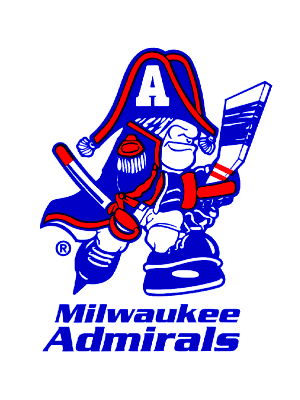
However, with it comes to the Admirals of Milwaukee, it really has nothing to do with the rank of Admiral. In fact, the name was brought about by one part of the original group of investors, Edwin Merar. Merar owned an appliance store and actually named the team after one of the appliances that was sold in his store. The first incarnation of the team started in the 1970 with a generic hockey player with a red, white, and blue background and "Milwaukee Admirals" around the border. The first "skating sailor" logo didn't come into play until 1977 when they moved into the IHL. As you see by this logo, the sailor does look a little dopey with the hat over his eyes, but it was beefed up in 1982 with the sailor looking a little meaner and bulkier.

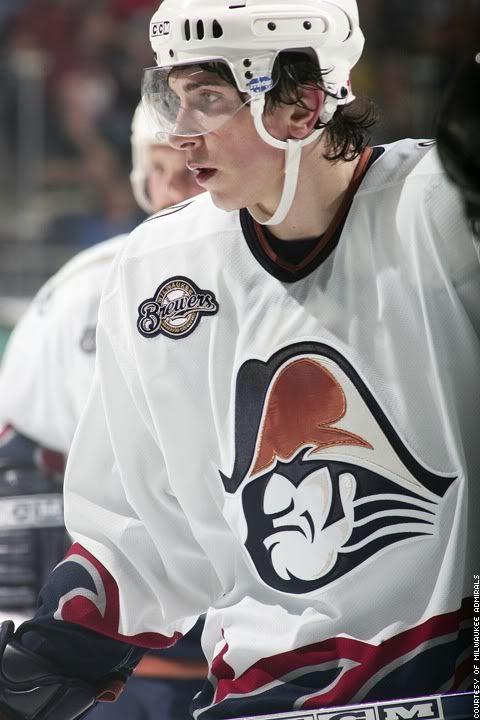
The color scheme stayed red, white, and blue until 1998, when the colors changed to a burgundy, bronze, and navy scheme. The logo itself was reinvented to just a head-shot logo, with a more pronounced hat onto of his strong-jawed head. While the jersey design prior was plain, the new colors brought in a new scheme with a wave design along the hem of the jersey, which was more solidly done than what the Islanders did with their fishermen gimmick.

One interesting thing about the Admirals happened when they came into the AHL in the 2001-02 season. The Admirals were a part of the IHL teams that moved to the AHL, but there was already an Admirals place in Norfolk who had arrived to the AHL one year beforehand. Both brands where strong in each of their markets, but was there going to be any pressure for the new Admirals to change or would there be a CFL situation where there were two teams with the same name at the same time??

"There was no pressure to change our Admirals name when we came into the AHL," said Tim Van Wagoner, Director of Marketing for the Milwaukee Admirals. "Maybe if we were in the same conference with Norfolk it might have been a different story."

So, there you go; the league could be able to co-exist with two teams with the same name around. And it worked well for the Admirals, as they saw success in the new league and it got them a Calder Cup championship within two seasons of being in the AHL.

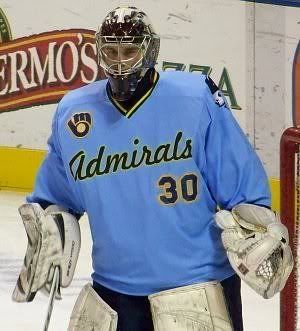
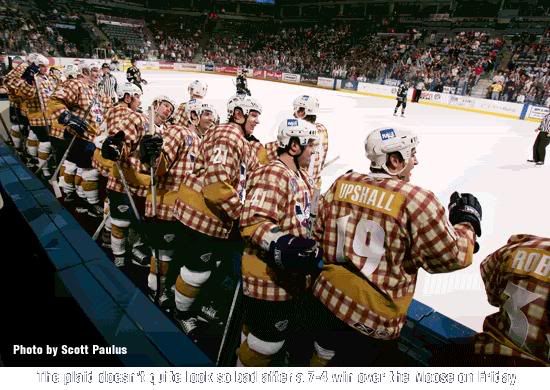
One interesting thing is the inclusion of the Milwaukee Brewers logo on the jersey seen here and here, with many Brewers themed nights, as seen in the second picture. That's because the investment group that owns of the Admirals consists of many in the Brewers organization, including Brewers owner Mark Attanasio, Brewers assistant GM Gord Ash, and former Brewers pitcher Ben Sheets. The Admirals got very much into the Brewers theme, having a night dedicated to Brewers announcer Bob Uecker, which brought about some of the most memorable jerseys ever to grace the ice.

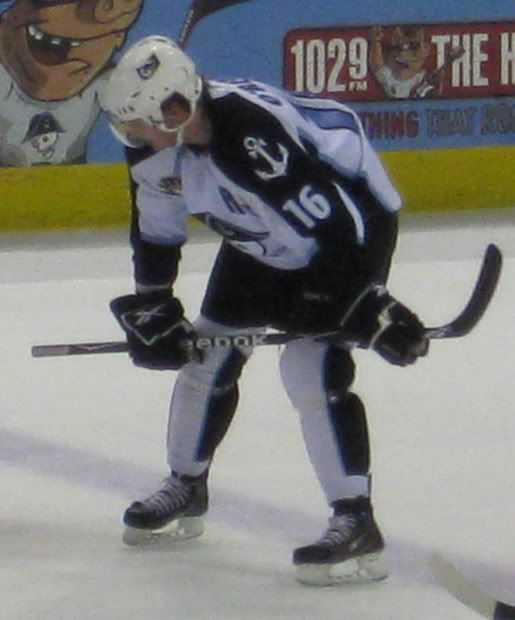
However, with the new ownership coming into play, there was a time for a dramatic change to happen for the team. For years after they went with a theme close to red, white, and blue; the colors changed to black, white, silver, and ice blue. Moreover, the logo went from the actual human Admiral, to a skeleton in full Admiral attire. While the change was one that was a bit of a head-scratcher, it was all boiled down by Tim Van Wagoner

"We felt like we needed a new logo when ownership changed. Our new look is meant to stand out and cut through clutter, and appeal to the merchandise buying public, like teens and tweeners," Van Wagoner stated. "We sold more in the first month than the entire previous year and see our stuff around town frequently."

To go from a pretty well established brand in Milwaukee for close to 30 years and see the change be accepted that quickly shows how a drastic change can appeal to another demographic as well as the demographic you had following you previously. Plus, their jerseys have quite fantastic appeal-- with a set in ice blue, silver, white, and recently black. While the jerseys are pretty snazzy, the one thing that does irk me a bit is the socks with the vertical stripe. Maybe because it's new, but I've never been a fan of the vertical striping on the sock, even when it comes to the national teams.

As a whole, the Admirals scheme is a solid one, even if they did pull of a drastic change from what built up their identity. It has worked for them and seems to garnered new attention from a new fan base, which is something that feeds the identities in the first place.

Thanks to Tim Van Wagoner, Director of Marketing for the Milwaukee Admirals for helping with this piece. Head to MilwaukeeAdmirals.com for all information for the Admirals.