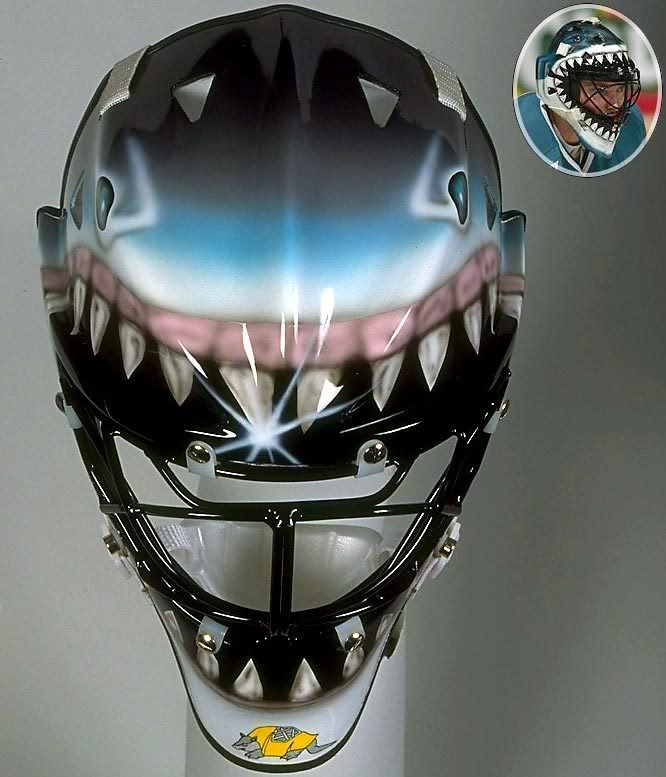
Showing posts with label Minnesota North Stars. Show all posts
Monday, November 19, 2012
Absurd Goalie Monday: Fern Rivard
This week's AGM is one who was able go use the juniors to get to the pros, then back to juniors, then back slowly into the pros. Though the expansion era did allow him to get some NHL time, the teams he played behind didn't do much to help him out in the long run. This week, the profile of Fern Rivard.
Rivard started in the Quebec Junior League with the Quebec Citadelles for parts of three seasons from the 1961-62 until the 1963-64 season (no record indicated), while playing one game in the AHL with the Quebec Aces, which was a win. Rivard was named to the QJHL's First All-Star Team in the 1962-63 and 1963-64 season.
The 1964-65 season saw Rivard play in the Quebec Juniors again with the Thetford Mine Aces and finish there with a 12-7-0 record before moving to the Ontario Hockey Association with the Montreal Junior Canadiens for 26 games and then seven in the playoffs (no records provided). The OHA was where Rivard was again in the 1965-66 season, playing 15 games for the Peterborough Petes.
Rivard went professional full-time in the 1966-67 season with the IHL's Muskegon Mohawks for 68 games (no record), while in the 1967-68 season, Rivard went back to the Quebec Aces and played 46 games, compiling a 19-16-7 record together.
The Flyers held Rivard's rights, but would lose them to the Minnesota North Stars in the 1968 intra-league draft held in the summer. Rivard would play for the North Stars for 13 games in the 1968-69 season, but would not fair well with a 0-7-4 performance. Rivard spent the rest of that season in the Central League with the Memphis South Stars for 29 games. The 1969-70 season saw Rivard back in Minnesota, but he would only appear in 14 games and put up a 3-5-5 record, while he went back to the CHL with the Iowa Stars and go 9-5-4 in 18 games there, then 3-4 in seven playoff games.
Rivard went to the AHL with the Cleveland Barons in the 1970-71 season, finishing with a 15-14-4 record in 36 games and lost his only playoff game he was in. The 1971-72 campaign had Rivard play in 40 games, but would finish 12-19-5 and then he would go 1-2 in four playoff games. The Barons would move to Jacksonville and Rivard would play 65 games, but no record is available.
For the 1973-74 season, Rivard would play in Minnesota for 13 games and finish with a 3-6-2 record, while he would also play for the New Haven Nighthawks in the AHL for 12 games and post a 7-3-2 record. It was another split season for the 1974-75 season, where Rivard would play in 15 games for Minnesota (3-9-0) and seven games for New Haven (1-4-1) before he would hang up the pads for good.
Though with an expansion team, Rivard tried to stick around, but was unable to have a good foothold on the NHL. Though he would get some kind of minor league recognition, but even then it was a breeze by at the best for more casual historians.
Monday, September 10, 2012
Absurd Goalie Monday: Carl Wetzel
While many of these AGMs would move around towards the end of their career, this week's installment was on the go from the start. Over his 15 season career, he played in 14 different cities for 16 different teams. He was well-travelled, but not well recognized. So, that's what will happen now-- this week, the profile of Carl Wetzel.
Wetzel started his trek, literally, with the only team he had stability with-- the Hamilton Tiger Cubs of the OHA Junior "A" league starting in the 1956-57 season, playing in 48 games and finishing with a 24-22-2 record; the 1-3 in four playoff games. The 1957-58 season had Wetzel play in 50 games compiling a 26-17-7 record, then going 8-6-1 in 15 playoff appearances, losing in the finals to the Toronto Marlboros. He would also play 25 games in the 1958-59 season with Hamilton, but no record is indicated. Wetzel would also play one game that season with the WHL's Edmonton Flyers, which was a loss.
The nomadic side of Wetzel started with the 1959-60 season playing 62 games with the Omaha Knights of the IHL, but no record is given; then in the 1960-61 season-- Wetzel played 52 games for the IHL's Indianapolis Chiefs (no record), then played in the WHL with the Spokane Comets for five games (0-5-0), then was loaned out to the IHL's Fort Wayne Koments for eight playoff games (3-3). In the 1961-62 season, Wetzel played in the EPHL with the Sudbury Wolves, going 25-26-10 in 61 games and 1-4 in five playoff contests.
After that season, Wetzel would put his career on hold due to military services (likely due to the US Draft) and would only suit up once in the 1963-64 season as an emergency back-up to the WHL's San Francisco Seals.
Upon his return in the 1964-65 season, his hometown team, the Detroit Red Wings, picked him up-- but he would only play two games for them (0-1-0), while also spending four games with the AHL's Pittsburgh Hornets (1-3-0).
The Montreal Canadiens claimed Wetzel in the Reverse Draft before the 1965-66 season and would place him in the CPHL with the Houston Apollos; where he would play 51 games with a 21-24-6 record. Wetzel would also play one game for the AHL's Quebec Aces-- a loss.
Wetzel left the Canadiens organization to play for the USA National Team in the 1966-67 season. He would play 12 games throughout the season, as well as seven games in the World Hockey Championships. In the World Championships, Wetzel went 3-3-1 in seven games and be named Best Goaltender in the tournament and named to the All-Star Team.
In the summer of the 1967, the Canadiens traded Wetzel to the expansion Minnesota North Stars for cash. Wetzel, along with Bill Masterton, were the first two signed to the North Stars. Wetzel would play five games in the 1967-68 campaign with the North Stars finishing with a 1-3-1 record; but would spend most of the season with the CPHL's Memphis South Stars for 20 games, finishing with a 8-9-2 record. A more masterful memory for Wetzel was bring loaned to the AHL's Rochester Americans for ten games (3-3-1) and then 2-1 in the playoffs, helping them win the Calder Cup championship. The 1968-69 season had Wetzel back with the Memphis South Stars for 39 games, while also playing two games for the AHL's Cleveland Barons, winning the game he was in on the decision for.
The 1969-70 season had Wetzel play four games for the USHL's Rochester Mustangs, but would go back to play with the US National Team for 17 games. In the 1970-71 season, Wetzel stayed with the US National Team, playing in the World Championship again-- but wouldn't fair as he did in 1967-- finishing with a 1-6-0 record in eight games of the tournament.
Wetzel would cross over the Europe for the 1971-72 season with KAC Kitzbuhel in Austria, playing in 44 games before returning to North America and the WHA in the 1972-73 season with the Minnesota Fighting Saints, losing the only game he played. He would retire after that last season.
After taking time off, Wetzel did return to be an assistant coach for the North Stars in the 1987-88 season, but would drop off the map after that until he came back for the Minnesota Wild hosting the "Back on Home Ice" reunion for the North Stars March 29-31, 2012.
He went everywhere and Wetzel tried to make the most out of it. He saw a lot of North America and some parts of Europe when playing with the National Team. He served his country in military duties and in hockey duties. He was a hustler in order to sell himself off as an option to teams and he would do what he could to get some playing time.
Wetzel started his trek, literally, with the only team he had stability with-- the Hamilton Tiger Cubs of the OHA Junior "A" league starting in the 1956-57 season, playing in 48 games and finishing with a 24-22-2 record; the 1-3 in four playoff games. The 1957-58 season had Wetzel play in 50 games compiling a 26-17-7 record, then going 8-6-1 in 15 playoff appearances, losing in the finals to the Toronto Marlboros. He would also play 25 games in the 1958-59 season with Hamilton, but no record is indicated. Wetzel would also play one game that season with the WHL's Edmonton Flyers, which was a loss.
The nomadic side of Wetzel started with the 1959-60 season playing 62 games with the Omaha Knights of the IHL, but no record is given; then in the 1960-61 season-- Wetzel played 52 games for the IHL's Indianapolis Chiefs (no record), then played in the WHL with the Spokane Comets for five games (0-5-0), then was loaned out to the IHL's Fort Wayne Koments for eight playoff games (3-3). In the 1961-62 season, Wetzel played in the EPHL with the Sudbury Wolves, going 25-26-10 in 61 games and 1-4 in five playoff contests.
After that season, Wetzel would put his career on hold due to military services (likely due to the US Draft) and would only suit up once in the 1963-64 season as an emergency back-up to the WHL's San Francisco Seals.
Upon his return in the 1964-65 season, his hometown team, the Detroit Red Wings, picked him up-- but he would only play two games for them (0-1-0), while also spending four games with the AHL's Pittsburgh Hornets (1-3-0).
The Montreal Canadiens claimed Wetzel in the Reverse Draft before the 1965-66 season and would place him in the CPHL with the Houston Apollos; where he would play 51 games with a 21-24-6 record. Wetzel would also play one game for the AHL's Quebec Aces-- a loss.
Wetzel left the Canadiens organization to play for the USA National Team in the 1966-67 season. He would play 12 games throughout the season, as well as seven games in the World Hockey Championships. In the World Championships, Wetzel went 3-3-1 in seven games and be named Best Goaltender in the tournament and named to the All-Star Team.
In the summer of the 1967, the Canadiens traded Wetzel to the expansion Minnesota North Stars for cash. Wetzel, along with Bill Masterton, were the first two signed to the North Stars. Wetzel would play five games in the 1967-68 campaign with the North Stars finishing with a 1-3-1 record; but would spend most of the season with the CPHL's Memphis South Stars for 20 games, finishing with a 8-9-2 record. A more masterful memory for Wetzel was bring loaned to the AHL's Rochester Americans for ten games (3-3-1) and then 2-1 in the playoffs, helping them win the Calder Cup championship. The 1968-69 season had Wetzel back with the Memphis South Stars for 39 games, while also playing two games for the AHL's Cleveland Barons, winning the game he was in on the decision for.
The 1969-70 season had Wetzel play four games for the USHL's Rochester Mustangs, but would go back to play with the US National Team for 17 games. In the 1970-71 season, Wetzel stayed with the US National Team, playing in the World Championship again-- but wouldn't fair as he did in 1967-- finishing with a 1-6-0 record in eight games of the tournament.
Wetzel would cross over the Europe for the 1971-72 season with KAC Kitzbuhel in Austria, playing in 44 games before returning to North America and the WHA in the 1972-73 season with the Minnesota Fighting Saints, losing the only game he played. He would retire after that last season.
After taking time off, Wetzel did return to be an assistant coach for the North Stars in the 1987-88 season, but would drop off the map after that until he came back for the Minnesota Wild hosting the "Back on Home Ice" reunion for the North Stars March 29-31, 2012.
He went everywhere and Wetzel tried to make the most out of it. He saw a lot of North America and some parts of Europe when playing with the National Team. He served his country in military duties and in hockey duties. He was a hustler in order to sell himself off as an option to teams and he would do what he could to get some playing time.
Labels:
Absurd Goalie Monday,
AHL,
Carl Wetzel,
Detroit Red Wings,
IHL,
Minnesota North Stars,
Montreal Canadiens,
Team USA,
WHA,
World Championships
Monday, May 21, 2012
Absurd Goalie Monday: Steve Guenette
As the Memorial Cup is going on in Shawinigan, Quebec; this week's AGM was able to capture the Memorial Cup after an unlikely road to the junior championship after a rocky first couple of seasons, However, he was able to get into the NHL for a short time, then build his way to a career after hockey. This week-- the profile of Steve Guenette.
Guenette started off his career with the Gloucester Rangers for 31 games in the 1981-82 and 1982-83 season. In the 1983-84 season, Guenette would move onto the OHL's Guelph Platers, going 9-20-1 in 38 appearances. The 1984-85 season saw Guenette play in 41 games and compile a 16-22-4 record. The breakout year for Guenette was the 1985-86 season, where he would finish with a 26-20-1 record in 50 games, then going 15-3 in the playoffs-- helping Guelph win the J. Ross Robertson Trophy for league champion. Moving onto the Memorial Cup, Guenette went 3-1 in four games, taking home the Hap Emms Trophy for top goalie in the Memorial Cup and All-Tournament team.
After that last season, Guenette was signed by the Pittsburgh Penguins. In the 1986-87 season, Guenette spent most of the season playing in the AHL for the Baltimore Skipjacks, going 21-23-0 in 50 games, while getting called up to Pittsburgh and lose both his appearances. The Pens moved their primary affiliation to the IHL's Muskegon Lumberjacks, playing in 33 games with an impressive 23-4-5 record, then getting called up to Pittsburgh for 19 games and putting up a 12-7-0 record. That season, Guenette captured the James Norris Trophy for fewest goals against in the IHL. Guenette spent the first part 1988-89 season as a back-up in Pittsburgh, getting into only 11 games (5-6-0), while spending 10 games with Muskegon (6-4-0).
The second half of the season would be after Guenette was traded to the Calgary Flames for a draft pick. Guenette stayed in the IHL, but with the Salt Lake Golden Eagles and go 24-5-0 in 30 games to round out the season. The 1989-90 season had Guenette stay in Salt Lake, playing 47 games and finishing with a 22-21-4 record, while spending two games in Calgary-- going 1-1-0. Guenette would be back in Salt Lake again for the 1990-91 season, finishing with a 26-13-4 record in 43 appearances, as well as winning the only game he played in Calgary that year.
During the summer of 1991, Guenette was traded to the Minnesota North Stars for a draft pick, but he would be put back in the IHL with the Kalamazoo Wings. He would play 21 games and finish with a 7-9-3 record before finally hanging up his pads for good.
Currently, Guenette has dipped his hand into home improvement, working as a partner for Roofers World, which manufactuers and distributes roofing products across North America. Guenette is also a part of the Ottawa Senators Alumni team, as he lives in the Ottawa region and is accepted into the team's alumni group.
After a slow start, then a quick rise to the top in the juniors-- the struggles on the pro teams and the logjam that happened made Guenette bounce around from team to team, mostly getting stuck in the minors. However, he's still active with the Sens alum and made a great career choice outside of the game.
Guenette started off his career with the Gloucester Rangers for 31 games in the 1981-82 and 1982-83 season. In the 1983-84 season, Guenette would move onto the OHL's Guelph Platers, going 9-20-1 in 38 appearances. The 1984-85 season saw Guenette play in 41 games and compile a 16-22-4 record. The breakout year for Guenette was the 1985-86 season, where he would finish with a 26-20-1 record in 50 games, then going 15-3 in the playoffs-- helping Guelph win the J. Ross Robertson Trophy for league champion. Moving onto the Memorial Cup, Guenette went 3-1 in four games, taking home the Hap Emms Trophy for top goalie in the Memorial Cup and All-Tournament team.
After that last season, Guenette was signed by the Pittsburgh Penguins. In the 1986-87 season, Guenette spent most of the season playing in the AHL for the Baltimore Skipjacks, going 21-23-0 in 50 games, while getting called up to Pittsburgh and lose both his appearances. The Pens moved their primary affiliation to the IHL's Muskegon Lumberjacks, playing in 33 games with an impressive 23-4-5 record, then getting called up to Pittsburgh for 19 games and putting up a 12-7-0 record. That season, Guenette captured the James Norris Trophy for fewest goals against in the IHL. Guenette spent the first part 1988-89 season as a back-up in Pittsburgh, getting into only 11 games (5-6-0), while spending 10 games with Muskegon (6-4-0).
The second half of the season would be after Guenette was traded to the Calgary Flames for a draft pick. Guenette stayed in the IHL, but with the Salt Lake Golden Eagles and go 24-5-0 in 30 games to round out the season. The 1989-90 season had Guenette stay in Salt Lake, playing 47 games and finishing with a 22-21-4 record, while spending two games in Calgary-- going 1-1-0. Guenette would be back in Salt Lake again for the 1990-91 season, finishing with a 26-13-4 record in 43 appearances, as well as winning the only game he played in Calgary that year.
During the summer of 1991, Guenette was traded to the Minnesota North Stars for a draft pick, but he would be put back in the IHL with the Kalamazoo Wings. He would play 21 games and finish with a 7-9-3 record before finally hanging up his pads for good.
Currently, Guenette has dipped his hand into home improvement, working as a partner for Roofers World, which manufactuers and distributes roofing products across North America. Guenette is also a part of the Ottawa Senators Alumni team, as he lives in the Ottawa region and is accepted into the team's alumni group.
After a slow start, then a quick rise to the top in the juniors-- the struggles on the pro teams and the logjam that happened made Guenette bounce around from team to team, mostly getting stuck in the minors. However, he's still active with the Sens alum and made a great career choice outside of the game.
Labels:
Absurd Goalie Monday,
AHL,
Calgary Flames,
IHL,
Memorial Cup,
Minnesota North Stars,
Pittsburgh Penguins,
Steve Guenette
Monday, April 23, 2012
Absurd Goalie Monday, Garry Bauman
From stand-out to stand-in to stand-up man, this week's AGM went through the usual turn most AGMs on here have done. However, in the end-- he taught the youth that came after him nothing about pucks and sticks and more applied knowledge that may occur in everyday life. This week, the profile of Garry Bauman.
Starting out his trek, Bauman played the Saskatchewan Junior League for the Prince Albert Mintos, playing 80 games over the 1958-59 and 1959-60 seasons. After not going the Major Junior route, Bauman moved onto the NCAA system, playing for the Michigan Tech Huskies starting in the 1961-62 season, where he would go 24-1-0 in 25 games, helping the Huskies win the NCAA National Championship. Bauman also earned NCAA West First-Team All-American honors, NCAA All-Tournament Team, and WCHA First All-Star Team honors. After a big start to his career, Bauman hoped to keep up the amazing play, but would fall short in the 1962-63 season, finishing with a 16-9-1 record, while ending out his college career with a 12-12-0 record in 24 games in the 1963-64 season. Bauman's save percentage (.916) and longest winning-streak (16 wins) still stand as record for Michigan Tech.
After college, Bauman signed with the Montreal Canadiens, who placed him in the Central League's Omaha Knights for the 1964-65 season, where he would attain a 22-16-5 record in 43 games, as well as going 2-4 in six playoff matches. The 1965-66 season saw Bauman move up to the AHL with the Quebec Aces, getting ample playing time with 52 appearances and a 36-11-4 record to show for it, going 2-4 in the playoffs again. Bauman played most of the 1966-67 season with the Aces, going 21-15-4 in 40 appearances, but would also get time with the Canadiens, going 1-1-0 in his two games there.
However, the best part about Bauman's call up is that he was afforded the chance to play in the All-Star Game that season, which was held for the first time mid-season since the original All-Star Game, which was to benefit Ace Bailey. Also, the previous Stanley Cup champions played a team of stars from other teams, which meant that Bauman got to play. Though it was only for 20 minutes, he stopped all 10 shots he faced. He and his goaltending partner Charlie Hodge are the only goalies to record a shutout in an All-Star Game.
Over the summer, six more expansion teams came into the NHL. Bauman was picked up in the Expansion Draft by the Minnesota North Stars, where he would play in the 1967-68 season, going a dismal 4-13-5 in 26 games, while also seeing time in the AHL with the Rochester Americans, losing two games in only three appearances. The 1968-69 season wasn't as stellar for Bauman either, as he would only play seven times for the North Stars (0-2-1), before being sent to the Central League's Memphis South Stars-- playing in six games there.
After taking a year off from hockey, Bauman returned to his native Alberta, playing for the Calgary Stampeders of the Alberta Senior League. He would play there for two season (1970-71 and 1971-72) before retiring for good.
With his hockey career done, Bauman went into teaching, at the Strathcona-Tweedsmuir School in Okotoks, Alberta. He stayed there until his retirement in 1999. He taught math and sciences at the school. However, cancer would claim Bauman's life in 2006, but the memory of his good deeds off the ice will live on.
His career was short, but left a lasting memory in some circles. While going on a scholarship to college to having a cup of coffee in the NHL, moving onto teaching children how achieve their academic best-- Bauman would probably remember more fondly onto the off-ice side than any achievements on the ice.
Starting out his trek, Bauman played the Saskatchewan Junior League for the Prince Albert Mintos, playing 80 games over the 1958-59 and 1959-60 seasons. After not going the Major Junior route, Bauman moved onto the NCAA system, playing for the Michigan Tech Huskies starting in the 1961-62 season, where he would go 24-1-0 in 25 games, helping the Huskies win the NCAA National Championship. Bauman also earned NCAA West First-Team All-American honors, NCAA All-Tournament Team, and WCHA First All-Star Team honors. After a big start to his career, Bauman hoped to keep up the amazing play, but would fall short in the 1962-63 season, finishing with a 16-9-1 record, while ending out his college career with a 12-12-0 record in 24 games in the 1963-64 season. Bauman's save percentage (.916) and longest winning-streak (16 wins) still stand as record for Michigan Tech.
After college, Bauman signed with the Montreal Canadiens, who placed him in the Central League's Omaha Knights for the 1964-65 season, where he would attain a 22-16-5 record in 43 games, as well as going 2-4 in six playoff matches. The 1965-66 season saw Bauman move up to the AHL with the Quebec Aces, getting ample playing time with 52 appearances and a 36-11-4 record to show for it, going 2-4 in the playoffs again. Bauman played most of the 1966-67 season with the Aces, going 21-15-4 in 40 appearances, but would also get time with the Canadiens, going 1-1-0 in his two games there.
However, the best part about Bauman's call up is that he was afforded the chance to play in the All-Star Game that season, which was held for the first time mid-season since the original All-Star Game, which was to benefit Ace Bailey. Also, the previous Stanley Cup champions played a team of stars from other teams, which meant that Bauman got to play. Though it was only for 20 minutes, he stopped all 10 shots he faced. He and his goaltending partner Charlie Hodge are the only goalies to record a shutout in an All-Star Game.
Over the summer, six more expansion teams came into the NHL. Bauman was picked up in the Expansion Draft by the Minnesota North Stars, where he would play in the 1967-68 season, going a dismal 4-13-5 in 26 games, while also seeing time in the AHL with the Rochester Americans, losing two games in only three appearances. The 1968-69 season wasn't as stellar for Bauman either, as he would only play seven times for the North Stars (0-2-1), before being sent to the Central League's Memphis South Stars-- playing in six games there.
After taking a year off from hockey, Bauman returned to his native Alberta, playing for the Calgary Stampeders of the Alberta Senior League. He would play there for two season (1970-71 and 1971-72) before retiring for good.
With his hockey career done, Bauman went into teaching, at the Strathcona-Tweedsmuir School in Okotoks, Alberta. He stayed there until his retirement in 1999. He taught math and sciences at the school. However, cancer would claim Bauman's life in 2006, but the memory of his good deeds off the ice will live on.
His career was short, but left a lasting memory in some circles. While going on a scholarship to college to having a cup of coffee in the NHL, moving onto teaching children how achieve their academic best-- Bauman would probably remember more fondly onto the off-ice side than any achievements on the ice.
Monday, February 27, 2012
Absurd Goalie Monday: Paul Harrison
While we've had previous AGM's that went into a completely different line of work when it comes to their post playing career-- this week's profile is one that sort of follows that path. Though is career may not be as memorable on the ice, what he's done off the ice has done wonders for the youth of Canada. This week, the profile of Paul Harrison.
The 1975-76 seasons saw Harrison play in six games for the North Stars, going 0-4-1 with them; as well as going 1-1-1 in three games with the AHL's Providence Reds. Harrison stayed in the AHL for the bulk of the 1976-77 season, but playing for the New Haven Nighthawks-- finishing with a 32-17-6 record, then going 2-4 in six playoff games. Harrison would also see time with the North Stars that season, going 0-2-0 in his two games there. The 1977-78 season had Harrison staying with the North Stars full-time, playing in 26 games and compiling a record of 6-16-2.
During the summer of 1977, the North Stars traded Harrison to the Toronto Maple Leafs for a draft pick. Harrison played the 1977-78 season with the Maple Leafs, appearing in 25 games and finishing with a 8-12-3 record, then going 0-1 in two playoff appearances. Staying as a back-up in the 1978-79 season, Harrison went 9-17-2 in 30 appearances, while being sent back to the AHL with the New Brunswick Hawks for nine games, going 4-3-1 in that span. The 1980-81 season had Harrison with the Leafs' Central League affiliate, Dallas Black Hawks, finishing with a 24-7-2 record, allowing Harrison to get the Terry Sawchuk Trophy for CHL goalie with the fewest goals-against. Harrison also appeared in one playoff game for the Leafs, a no decision.
The Leafs would trade Harrison to the Pittsburgh Penguins for future considerations before the 1981-82 season. Harrison played in 13 games for the Penguins, going 3-7-0 before getting plucked off waivers by the Buffalo Sabres, where he would play six games compiling a 2-1-1 record. Harrison stayed in the Sabres organization for the 1982-83 season, playing with the AHL's Rochester Americans for 29 games, going 11-11-3 before finally hanging up his pads.
After his career, Harrison took a different path by joining the Ontario Provincial Police in his hometown of Timmins. With the OPP, Harrison was influencial in founding and growing the D.A.R.E program in Canada, which is a program shows elementary school children about the dangers of drug use. Along with the NHL Alumni, Harrison has been instrumental in the Hockey Dream Draw, which is a lottery for people to get a once-in-a-lifetime chance to be part of a NHL team and get the VIP experience to watch many NHL games.
Harrison went from stopping pucks to stopping crime to stopping the spread of drug abuse in minors. Which is most rewarding to him is something you'd have to ask him about, but in every step of the way-- he seems proud of each of his accomplishments.
Monday, January 09, 2012
Absurd Goalie Monday: Markus Mattsson
When the WHA came into the landscape in the 1970s, it gave me chances for players, mostly goalies, as well as giving the chance for international players to start off their career. That's what happened with this week's AGM, who broke in with the WHA from his native Finland before making a push at a NHL career. This week, the profile of Markus Mattsson.
Mattsson started is career off in his homeland, Finland, playing for Ilves Tampere from the 1973-74 season until the 1976-77 season. During that time as well, Mattsson played for Finland in international competitions, like the European Junior Championships (1974 and 1976), the World Junior Championships (1975), and in the inaugural Canada Cup in 1976 before moving his career forward.
In the summer of 1977, Mattsson was drafted by the New York Islanders in the NHL Draft and the Houston Aeros in the WHA Draft. Mattsson chose the WHA route, but he would be traded from Houston to the Winnipeg Jets in June and play a total of ten games (4-5-0) with the Jets in two stints-- as Mattsson was traded to the Quebec Nordiques, playing there for six games (1-3-0) before being traded back to Winnipeg at the end of the 1977-78 season. Also that season, Mattsson played two games for the Central League's Tulsa Oilers, going 1-1-0 in that brief time. The 1978-79 season settled down for Mattsson, who stuck with the Jets to play for 52 games that season, going 25-21-3.
As the Jets moved to the NHL, Mattsson moved with them, even though he was reclaimed by the Islanders, but then re-reclaimed by the Jets. For the 1979-80 season, Mattsson played 21 games for the Jets with a 5-11-4 record, while going into the Central League with Tulsa going 10-7-2 in 20 games. Mattsson would spend more time with Winnipeg in the 1980-81 season, but with a worse record-- finishing with a 3-21-4 record in 31 games, while playing five games in Tulsa with a 3-2-0 record. Though, Mattsson played in the 1981 Canada Cup, but he went 0-2-0 in two games before the 1981-82 season, where he's played in Tulsa all season, compiling 26-23-0 record in 50 games.
Mattsson signed with the Minnesota North Stars before the 1982-83 season, going 1-1-0 in two games. He'd spend most that season with the Central League's Birmingham South Stars, playing in 28 games and finishing with a 17-10-0 record of that season.
In February of 1983, the North Stars traded Mattsson to the Los Angeles Kings for a Draft pick. To close out the 1982-83 season with the Kings, Mattsson played in 19 games with a 5-5-4 record. Mattsson would split the 1983-84 season with the Kings and their AHL affiliate, the New Haven Nighthawks. In Los Angeles, Mattsson went 7-8-2 in 19 games, while in New Haven, Mattsson finished with a 16-10-1 record while appearing in 31 games.
After that, Mattsson would move back to Finland to play for Tappara Tampere from the 1984-85 season until he retired after the 1986-87 season.
While he still is the goalie who stopped Wayne Gretzky's 51-game point streak, he never seemed to get a chance to make a mark in front of a big audience. Mattsson played behind some of the worse defenses and offenses out there, which didn't help him much. Yet, luckily, because of the WHA, he was able to get his break in North America and leave his mark in the hockey aspect of things.
Labels:
Absurd Goalie Monday,
AHL,
Finland,
Los Angeles Kings,
Markus Mattsson,
Minnesota North Stars,
Quebec Nordiques,
WHA,
Winnipeg Jets
Monday, March 07, 2011
Absurd Goalie Monday: Roland Melanson
Sparked by the post from the New York Islanders photo day via Greg Wyshynski's Puck Headlines on Friday, it made me decide to go to Long Island again for this week's AGM. While this week's inductee was doing enough to get his name on the Cup three times, he seemed to get lost in the fold when it came to the overall picture. He was able to get a solid gig post-retirement thanks to people who were able to see what he could do for their career. This week, the profile of Roland "Rollie the Goalie" Melanson.Melanson got his start with the New Brunswick Amateur Hockey Association with the Moncton Flyers, putting together 14 shutouts in 70 games of work for Moncton. Melanson would then move up to the OMJHL to play for the Windsor Spitfires starting in the 1977-78 season, playing in 44 games with a 4.51 GAA. More time for Melanson in the 1978-79 season with 62 games in and 4.40 GAA. After that season, Melanson was selected in the third round of the NHL Draft by the New York Islanders. Melanson stayed in the OMJHL in 1979-80 and would start off with Windsor for 22 games, going 11-8-0 before being dealt off to the Oshawa Generals, where he would finish the season, playing in 38 games and a 26-12-0 record to show for it.
For the 1980-81 season, Melanson went on his pro journey, starting in the Central League's Indianapolis Checkers, where he would play 52 games with a 31-16-3 record and a 2.57 GAA, before he would get the call-up to the show. Melanson would play 11 games with the Islanders that season, going 8-1-1 and then going 1-0 in three playoff games, getting in along for the ride for an Islanders' Stanley Cup victory. Melanson not only got a Cup ring, but Central League Rookie of the Year honors. Melanson would be with the Isles full-time int he 1981-82 season, backing up Billy Smith while getting in 36 games with a 22-7-6 record to show for it, then 0-1 record in three playoff games; as he would claim his second Cup with the Isles that season, as well. Melanson saw more time in the 1982-83 season, playing in 44 games with a 24-12-5 record and a 2.66 GAA, while in the playoffs, he would go 2-2 in five games as the Isles would win the Cup again, giving Melanson his third ring. Also in '82-'83, Melanson and Smith would win the William Jennings Trophy for lowest goals-against, while Melanson would also be named to the NHL's Second Team All-Star roster at the end of the year. In the 1983-84 season, Melanson would go 20-11-2 in 37 games for the Islanders, then 0-1 in six playoff appearances; but the Isles would lose in the Cup Finals, ending their dynasty. Melanson would return for the 1984-85 season, but only go 3-3-0 in eight games before he was on his way off the Island.
Melanson was traded to the Minnesota North Stars for a 1st round pick in the 1985 Draft. Melanson would finish out the '84-'85 campaign in Minnesota, playing 20 games with a 5-10-3 record. Melanson would start the 1985-86 campaign in Minnesota, going 2-1-2 in six games before he was on the move once again.
Melanson and Grant Ledyard were traded to the Los Angeles Kings for Brian MacLellan and a draft pick. Melanson would start off with the Kings' AHL affiliate New Haven Nighthawks, playing three games with a 1-2-0 record before getting called up to LA. With the Kings, Melanson played in 22 games, but had a dismal 4-16-1 record. Melanson would have his chance to be the #1 goalie in LA, playing in 46 games in the 1986-87 season with a 18-21-6 record, then going 1-4 in five playoff games. Melanson would get in 47 games for the 1987-88 season, but only sport a 17-20-7 record, then 0-1 in the playoffs. Melanson would only stick around for four games in the 1988-89 season, going 1-1-0 before being sent to New Haven, where he would play 29 games with an 11-15-3 record, but then going 9-8 in 17 playoff games, losing in the Calder Cup Finals to the Adirondack Red Wings.
The New Jersey Devils picked up Melanson as a free agent before the 1989-90 season and would put him with the Utica Devils of the AHL. That season, Melanson played 48 games, going 24-19-3, but then only going 1-4 in five playoff games. Melanson would be back in Utica for the 1990-91 season, sporting a 23-28-1 record in 54 games, as well as having a one game stint in New Jersey, playing only 20 minutes in a non-decision.
Before the 1991-92 season, Melanson was traded with Kirk Muller to the Montreal Canadiens for Stephane Richer and Tom Chorske. Melanson would only play nine games that year for the Habs, going 5-3-0. However, a reoccurring groin injury would limited his appearances.
Melanson would be without a gig for the majority of the 1992-93 season, but would sign on with the Colonial League's Brantford Smoke, where he would play 14 games in the regular season, going 9-3-1, but would explode in the post-season, going 11-3 in 15 games, helping the Smoke win the Colonial Cup and getting Playoff MVP honors on top of it.
One more chance for Melanson came in the 1993-94 season, playing with the Saint John Flames of the AHL, but he would only see seven games of action with a 1-2-0 record before hanging up the pads for his career.
Melanson wouldn't be out of hockey for long-- staying on with Saint John as a consultant before getting a job as an assistant coach for the QMJHL's Moncton Wildcats from 1995 until 1997. Then in 1997, Melanson would go on to be the assistant and goalie coach of the Montreal Canadiens until 2009. Currently, Melanson is the goalie coach of the Vancouver Canucks, many saying he's helped Roberto Luongo find his game again-- though it's up for debate.
While he did have his name on the Cup, he never really had a chance to shine by himself. When he was given the wheel, the team in front of him was often not up to snuff. Melanson has a lot to be proud of on the teams he played on and the achievements he had, as well as the career its allowed him to have post-playing career.
Monday, February 28, 2011
Absurd Goalie Monday: Jarmo Myllys
While the goaltenders of Finland nowadays were very sought after, back in the late-80s/early-90s-- that wasn't the case. Many of them had a rough transition period and could never get settled in, which is the case for this week's AGM. While he was part of the possible first Finnish tandem, it never really came together. This week, we profile the career of Jarmo Myllys.Before we go forward, a note-- thanks to the apparent lack of record-keeping or technology in European hockey; the stats of Myllys when playing overseas are a bit sketch and therefore unavailable for most seasons.
When he first came into the scene in 1982-83, Myllys played for the Finnish Second-League team SaPKo Savonlinna, where he played for 13 games. That said, he didn't get more noticed than during the European Junior Championships, where he played four games with a 2.70 GAA. Due to his performance, Myllys was named Best Goaltender and to the All-Star team. For the 1983-84 season, Myllys went up to the premier league in Finland, SM-liiga, playing for Ilves Tampere, but only getting in nine appearances with a 3.00 GAA. Myllys would get back into the swing of things in the World Juniors of 1984, going 3-1-0 in four games for Finland, helping them to a Silver Medal. Myllys would play nine more games for Ilves Tampere, with a 2.55 GAA; but going only 1-0-0 in one appearance in the WJC.
For the 1985-86 season, Myllys played 16 games for Ilves Tampere; while in the 1986-87, Myllys would move over to Lukko Rauma, appearing in 43 games with a 16-20-7 record. Myllys also played in the World Hockey Championships, going 4-3-1 in eight games. That helped him get drafted in the 9th Round by the Minnesota North Stars. It was a banner year for Myllys in the 1987-88 season, where he would play in the Canada Cup for one game, then back to the Lukko Rauma for 43 games, which included five shutouts and a 3.13 GAA. Yet, his biggest accomplishment of the season was during the Olympics, where he would go 4-1-1 in six games, leading Finland to a Silver Medal. Myllys would end the year with Finnish Player of the Year honors and named to the Finnish First Team All-Stars.
Myllys made the leap to North America for the 1988-89 season, starting off with the North Stars. However, with three losses in his first three appearances, Myllys was sent to the IHL's Kalamazoo Wings, playing in 28 games with a 13-8-4 record. Myllys would finish that season with a 1-4-0 record with the North Stars. The 1989-90 season would be a breakout in the IHL for Myllys, as he would go 31-9-3 in 49 appearances, which got him named to the IHL's Second Team All-Star roster. Myllys would also play in four games for the North Stars, but would go 0-3-0. Myllys started the 1990-91 season with the North Stars for three games on their French Tour, then for two games in the regular season. However, going 0-2-0, Myllys was sent back to Kalamazoo; where he would excel again compiling a 24-13-1 record in 38 games; then going 6-4 in the playoffs. It was another year for Second Team All-Star honors for Myllys.
However, during the Expansion/Dispersal Draft of 1991, Myllys was claimed be the expansion San Jose Sharks. Myllys would have an up and down year, going 3-18-1 in 27 games for the Sharks, but going 5-0-0 with the Kansas City Blades of the IHL.
Myllys was traded to the Toronto Maple Leafs in the summer of 1992, but decided to return to Finland for the 1992-93 season, with KooKoo Kouvola of the Finnish Second League-- going 27-13-5 in 45 games. Myllys would return to Lukko Rauma for the 1993-94 season, where he would go 26-16-4 in his 46 games of work, as well as returning to the Olympics in 1994, going 5-0-0 with two shutouts and a 0.60 GAA; helping the Finns to a Bronze Medal. Myllys would also play in the World Championships, playing in seven games helping the Finns to a Silver Medal.
From the 1994-95 season until the 2000-01 season, Myllys would play 284 games with Lulea HF; compiling 31 shutouts and ending with a 2.59 GAA in those games. However, like I mentioned at the start-- no records from those years sadly.
However, the international play helped Myllys' career for records, as he would represent Finland plenty. It started with the 1995 World Championships, as Myllys went 5-1-1 in seven games, leading the Finns to their first ever Gold Medal in the event. Myllys took home the Best Goaltender honors in the tournament, as well. However, in the 1996 World Championships-- Myllys went 0-2-2 in four games, as the Finns would bow out in the Quarterfinals. Myllys went to the 1996 World Cup of Hockey, but would go 1-1-0 in two games, as Finland was knocked out in the Quarters again. The 1997 World Championships had Myllys get some swagger back, going 4-2-0 in six games with a 1.67 GAA, but they did not past the Quarters again. The 1998 Olympics wouldn't give Myllys the super skills he had in Olympics past, as he would go 1-3-0 in four games, but would be rostered on the Bronze Medal team. Myllys played two games in the 1998 World Championships with a 1-1-0 record and would add another Silver Medal to his showroom. It wouldn't be until the 2001 World Championship that Myllys would be back with Finland, but he would only be a spare and not play in any games for the Finns, as they would take home Silver.
Myllys return to the SM-liiga for the 2001-02 season with Blues Espoo, playing in 46 games with a 19-19-7 record, then 0-3 in the playoffs. Back with Espoo in the 2002-03 season, Myllys would only see 19 games of action with an 8-5-5 record, then 3-4 for seven games in the playoffs. The 2003-04 season saw Myllys return to SaiPa Lappeenranta, playing in 34 games with a 9-15-7 record, as well as seeing seven games of action with HV 71 Jonkoping of the Swedish Elite League. Myllys would go back to Finland with SaiPa Lappeenranta for the 2004-05 season, where he would put together a 10-25-10 second in 45 games. After that, he would hang up the pads in his playing career.
Myllys would stay with SaiPa Lappeenranta as the goalie coach, which is where he's at today.
While he could never get adapted to the North American game despite trying as much as he could-- the success he had for his country is something that many of the European players hold in higher regard, even to this day. With a Gold and a couple of Silvers and Bronzes with Suomi; Myllys can hang his hat on bringing pride to his country on the highest of stages.
Labels:
Absurd Goalie Monday,
Expansion Draft,
Finland,
International Hockey,
Jarmo Myllys,
Minnesota North Stars,
Olympics,
San Jose Sharks,
Swedish Hockey,
World Championships,
World Juniors
Monday, October 18, 2010
Absurd Goalie Monday: Mike Sands
Considering we're past 60 AGMs, we're definitely going to get into the deep tracks of things. We're getting a bit more absurd, especially with guys some people haven't heard from before. This week, we'll start that part of the trend with a guy who seemed to look like he was about to emerge as a solid back-up, but lost it due to one decision he may or may not regret. At least he had some kind of back-up for his hockey career being over. This week, we discuss Mike Sands.Sands began his career in the Ontario Junior "B" system with the Streetsville Derbys, which could be one of the best names out there. Sands played 20 games with the Derbys in the 1979-80 season, finishing with a 3.26 GAA. Sands would get a call-up to the Junior "A" Dixie Beehives for four games, going 2-1-0 with a 3.55 GAA and a one shutout.
Sands would start his major junior career with the Sudbury Wolves in the OHL in the 1980-81 season. Sands would be the starter for the Wolves, playing in 50 games and going 15-28-2 on a dismal Wolves' team. Even so, the Minnesota North Stars picked Sands in the second round of the 1981 Entry Draft at 31st overall. Sands would continue on with the Wolves for the 1981-82 and they would continue to be a bit of a bad team, going 13-33-1 in his 53 appearances-- though he would have six assists on the season. Also in 1981-82, Sands would go to the Nashville South Stars of the Central League, where he would play in seven games going 3-3-1.
For the 1982-83 season, Sands would again be on the Wolves and again they would be a bit horrific, as he would go 11-27-0 in his 43 games; but it would be able to gain a spot on the 1983 Canadian World Junior Team, getting the starting gig over Mike Vernon in the tournament. The Canadian team would pick up a bronze, while Sands went 2-2-1 for the Canadians. After his junior season was over, Sands would go to the Birmingham South Stars of the Central League and go 0-4-0 in his four games he played there.
For his first full foray into the professional game was in the 1983-84 season when he took to the road with the Salt Lake Golden Eagles of the Central League, playing 20 games alongside of Jim Craig and Wendell Young. Sands would go 7-12-1 in the rotating system. He would have a good enough camp to start the 1984-85 with the North Stars, but would only play two games (losing both) before he was sent down to the AHL's Springfield Indians. Sands would get plenty of time and actually succeed, going 23-17-3 with a 3.24 GAA in the season. He would be called back up for another game for the North Stars, which was another loss. He would play in the playoffs for Springfield where he would lose all three games he would play in. For the 1985-86 season, Sands would get a limited time while playing in Springfield, only getting 27 games in while going 8-15-1 for the year. As the 1986-87 season rolled around, Sands would go on to be a back-up starter Don Beaupre, as former AGM Kari Takko was out of the line-up. Sands would get three games in going 0-2-0 before he was shipped back down to Springfield, where he would play 19 games, going 5-10-1 for his season.
The real issues came for the 1987-88 season with Sands. He was sent down to the AHL again, this time to the Baltimore Skipjacks. Sands would play in four games, losing all four, before he would leave the Skipjacks without the permission of the Skipjacks or the North Stars. He was subsequently suspended by the North Stars and then released in March of 1988 by the North Stars. Sands would be picked up by the Kalamazoo Wings of the IHL, playing three games and going 0-2-1 in those appearances.
Without a professional job in his sight, Sands would play for the Canadian National Team in the 1988-89 season. He would split time between the other goalies, Warren Skorodenski and Randy Hansch, and get in 21 games-- where he would go 6-13-1 in his games. After that year, Sands would hang up the pads and move onto other ventures at the age of 26.
After his playing career, Sands would go into the scouting realm. He had worked with the NHL Central Scouting Bureau and would then move onto the Calgary Flames staff, first as an amateur scout; then to the Director of Amateur Scouting. However, during the wholesale changes before the 2010-11 season, Sands would get sacked by the Flames during the summer.
Even though he didn't have the best records, he always seemed to get some good things fallen into his lap at times. He did have a bad falling out with the North Stars' at the end of his pro tenure, which probably shortchanged the career he could have had. Albeit, he did get held back in the minors for the longest time, he didn't have the chances to really show his worth. His confidence could have broken become of it, which probably let to him leaving the Skipjacks and the professional ranks in the end.
Labels:
Absurd Goalie Monday,
AHL,
Baltimore Hockey,
Calgary Flames,
CHL,
Hockey Canada,
Mike Sands,
Minnesota North Stars
Monday, June 14, 2010
Absurd Goalie Monday: Kari Takko
While we relish in the fact that Antti Niemi is the first Finnish goalie to win the Stanley Cup, it just furthers the ideal that Finland is a goalie factory. With the likes of Miikka Kiprusoff, Pekka Rinne, and Niklas Backstrom coming from the Suomi; you have to wonder how this all came to be. It never was that way, but there were a few who forged the way for Finnish goalies. This week we look at the first one to have a regular spot in the NHL, even if in a small capacity and coming with a funny name. This week, we look at Kari Takko.The problem when doing the European goalies is that the stats aren't often accurate or there at all. Thus, this made compiling any kind of stats extra difficult. In any case, Takko started out his career playing with Assat Pori in the Finnish League, where he would play limited time between 1979-80 until 1982-83. In that times, Takko would be on the Finnish World Junior team, being a part of Finland silver medal team in 1981 and bronze medal team in 1982. After the 1981 season, Takko was drafted by the Quebec Nordiques, but didn't seem to have the interest in going over; which saw him get more time in Pori, where he would see increased time in 1982-83 (21 games), 1983-84 (32 games, three shutouts), and 1984-85 (35 games, three shutouts, taking home the Ylonen Trophy as best goaltender). During that time, Takko was a part of the 1984 Finnish Olympic team (6th place finish) and was re-entered into the NHL Draft and selected by the Minnesota North Stars in the 1984 Draft.
Takko would eventually come over to North America to play for the Springfield Indians for the 1985-86 season. It did take some time for Takko to adjust to the North American game, which he got plenty of time to in Springfield by playing 43 games, most of all the Indians. It was a rough go, as Takko went 18-19-3. Takko did steal the hearts of the Springfield coaches and fans; winning the team MVP, team Rookie of the Year, and Most Popular Player. He was able to get a call-up to Minnesota late in the season, where he would lose his only appearance, though stopping 31 of 34 shots.
The 1986-87 season saw Takko start out with Minnesota, getting much more time behind Don Beaupre, though a slump would see him go down to Springfield for a month (3-2-0), he would play 38 games and go 13-18-4 for the year. It was a full year in Minnesota for 1987-88, though behind Beaupre and having to deal with a late-season injury that hampered him. It didn't get much better for Takko, as the North Stars weren't that good (worst in the NHL) and it showed in the 8-19-6 record. The 1988-89 season saw another back-up season for Takko, as he would start in Minnesota, backing up former AGM Jon Casey, but saw 32 games. Takko would go 8-15-4 with Minnesota, even getting playing time in the playoffs, going 0-1 in three appearances. The bottom fell out in the 1989-90 season, as Takko would struggle and play only 21 games with a 4-12-0 record. He was sent down to Kalamazoo in the IHL to start due to missing most training camp with a broken ankle. Yet, Takko would start in Minnesota for the 1990-91 season, but lost his two appearances, which sent him to Kalamazoo for five games, where he went 4-1-0.
However, with the suspension of Grant Fuhr, it opened up a market for Takko. The North Stars traded Takko to the Edmonton Oilers for Bruce Bell in November 1990. The Takko-Bell trade has been the tastiest trade in the history of the NHL, as Neil Little was never traded for anyone named Caesar. Takko would only play 11 games for the Oilers before Fuhr returned, but went 4-4-0 while backing up Bill Ranford.
It would be the last time for Takko playing in North America for a professional team, as he would return to Finland and Assat Pori, where he was welcomed back with open arms. Though the 1991-92 season would be an adjustment for him, going 13-11-2 in 28 games; Takko would return to form in the 1992-93 season with 21-16-8 record with three shutouts. Though, Takko's real homecoming would be the 1993-94 season, where he would go 25-16-7 in 48 games, with three shutouts. Those stats were enough for him to take home the Ylonen Trophy for best goaltender honors once again. The 1994-95 season was a bizarre one, with Takko going 20-18-11, but also going 4-3 in the playoffs with three shutouts, though it wasn't enough for Assat to take the SM-liiga title. The next two seasons wouldn't be kind to Takko and Assat, as Takko would have an 18-21-4 record in the 1995-96 season, while he bounced back a bit in 1996-97 with a 16-16-9 record.
Takko would migrate to the Swedish Elite League by going to HV71 for the start of the 1997-98 season, where he would play 39 games and have five shutouts in that duration. Another solid year for Takko as he would play 40 games for HV71 with another five shutouts to his record in the 1998-99 season. Takko would round out his term with HV71 playing 39 games, recording four shutouts, and had a 2.51 GAA for 1999-2000. Takko would hang up the pads for good after the 1999-2000 season.
After his playing career, Takko was named an amateur European scout for the Dallas Stars starting in the 2001-02 season. Takko now is the Director of European Scouting for the Stars.
There's a lot to be said about Takko, who seemed to have a great international career; despite the so-so NHL career he had. He seemed to be a fan favorite, as it showed from his first year with the Springfield Indians. Though he has the unfortunate luck of being with the North Stars when they were horrific, he couldn't say he didn't have the chance to make a name for himself and it seemed like he made the most of every chance he could get. When he knew his time was up in the NHL, he went back home where he excelled even more. It was just happenstance that he was at the wrong place at the wrong time for him to make Finland known as a goalie factory prior to this new renaissance.
Labels:
Absurd Goalie Monday,
Edmonton Oilers,
European Hockey,
Kari Takko,
Minnesota North Stars,
Olympics
Monday, May 24, 2010
Absurd Goalie Monday: Mike Torchia
The Memorial Cup has ended with the Windsor Spitfires winning back-to-back championships. However, the Memorial Cup is a breeding ground for AGMs, especially since most of them have won the Hap Emms Trophy for Top Goalie-- Mark Fitzpatrick, Darren Pang, Eric Fichaud-- and who knows if Martin Jones will join the list of AGMs, but let's hope not. In any case, this week's AGM follows that mold. A great goalie in the juniors, but thanks to some complications; never made it to NHL stardom. This week, it's time to profile Mike Torchia as the AGM.Torchia started out with the Toronto Red Wings in the Toronto Midget League during the 1987-88 season, playing 40 games, recording five shutouts and a 2.33 GAA average. From that, Torchia went onto the OHL with the Kitchener Rangers, where he backed up Gus Morschauser; where Torchia got 30 games in with a 14-9-4 record in the 1988-89 season. Torchia also got two games in the playoffs, going 0-2. With Morschauser getting traded at the start of the 1989-90 season, Torchia got more time with 40 games to his credit and a 25-11-2 record. Torchia also navigated the Rangers to the OHL finals, but lost to Oshawa in seven games, despite a 11-6 record. Kitchener got in since the OHL was hosting the 1990 Memorial Cup, where Torchia really shined. Despite a 3-2 record, including a Finals loss to the same Oshawa team that beat them in the OHL playoffs; Torchia got the Hap Emms Trophy for Top Goalie in the Memorial Cup and named to the Memorial Cup All-Star team.
The 1990-91 season was something to build off of, but it seems Torchia couldn't get off the number 25, as he went a second straight year with 25 wins (25-24-7), but Torchia wouldn't help in the playoffs going 2-4. Even so, Torchia got First Team All-Star from the OHL in that season, as well as being picked 74th overall by the Minnesota North Stars in the NHL Entry Draft. The 1991-92 season brought about almost the same record, with Torchia going 25-24-3 in 55 games. Torchia helped the Rangers get through the first round of the playoffs, but couldn't get through Sault St. Marie in the second round.
Torchia kept in the amateur ranks by playing for the Canadian National Team to start the 1992-93 season, winning all five of his games with a 2.20 GAA; but he didn't stay long there before he moved to the pros with the Stars' farm team; the Kalamazoo Wings of the IHL. Torchia was a big fish, getting the starting role over Jeff Levy and going 19-17-9 in his first pro season, despite a 3.80 GAA and .892 save percentage. He eased into his role for the 1993-94 season, improving his record with a 23-12-2, though his GAA (3.68) and save percentage (.889) were still not at where he wanted to be. The 1994-95 season saw Torchia back in Kalamazoo (19-14-5), but the Dallas Stars brought him up towards the end of the season in order to see what he could do. In six games with the Stars, Torchia went 3-2-1 and looked like he could fight for the back-up spot in training camp.
However, before he could get into Dallas, his rights were sold to the Washington Capitals. One thing that always haunted Torchia was his weight. Torchia had a bigger frame and it always seemed to be a stumbling block for him when it came to conditioning. Because of that, Torchia didn't get a back-up job for the 1995-96 season and would spend his season with five different teams, including being traded to the Anaheim Mighty Ducks-- though he would not suit up for the Ducks or the Caps in that season. Torchia would play with the Michigan K-Wings (1-0-0) and the Orlando Solar Bears (3-1-1) in the IHL, the Baltimore Bandits (2-1-1) and Portland Pirates (2-6-2) of the AHL, and the Hampton Roads Admirals (2-2-0) of the ECHL. Torchia still couldn't crack a NHL line-up in the 1996-97 season, making him play in the IHL with the Fort Wayne Komets going 20-31-3 on the season, while stepping in for a playoff game for the Baltimore Bandits. Torchia continued in the IHL for the 1997-98 season, playing for the Milwaukee Admirals for most of the season (13-14-1) and then moving to the San Antonio Dragons (0-2-0), with a stint in the ECHL with the Peoria Rivermen, going 4-1-0.
Torchia had no opportunities in North America in the 1998-99 season, so he moved to Europe, where he would head to Italy with HC Asiago, playing 43 games; but having an inflated GAA of over four goals a game. It was enough for the goalie to come back to North America to play first in the UHL in the 1999-2000 season with the Mohawk Valley Prowlers (8-9-4) and then with the Birmingham Bulls (4-10-0) of the ECHL. The highlight of the season for Torchia was that in October of 1999, he scored a goal on an empty-net; becoming one of the handful of goalies to do so.
Again without a North American gig, Torchia went back to Europe, this time to Britain, where he would suit up for the Sheffield Steelers. His numbers would get better, playing 23 games with a 2.06 GAA and .923 save percentage in the 2000-01 season. Torchia would stay in in Britain for the 2001-02 season, but this time with the Manchester Storm, with respectable numbers-- 2.82 GAA and .916 save percentage. Torchia would only play three games for the Storm in 2002-03, but spent most his time with the lower level Guildford Flames.
Torchia would return to North American in the 2003-04 season to play in the OHA Senior League with the Cambridge Hornets. In three seasons (through 2005-06), Torchia would go 14-11-1 before hanging up the skates for good. He now is the color commentator for Rogers TV's coverage of the Kitchener Rangers, as well as working for Hometown Hockey Training and Development.
While Torchia did have his glory, the conditioning side of things that is all so important in the game nowadays is what did him in. Though many would thing a bigger goalie would be the best way to go in order to get more wins, the ability to get a job would be a hard sell if you can't get side-to-side and match the speed of the game in front of you. Even so, Torchia does have all his personal accolades to look back on and set himself up for commentating his old team now.
Monday, April 19, 2010
Absurd Goalie Monday: Jon Casey
With the NHL rolling out their new "History Will Be Made" playoff advertisements, it caught my eye of a nominee that I've yet to do. It's one guy who was in two of these advertisements, but always at the butt-end of them, looking like a fool....with his pants on the ground. In one, he's being undressed by the Magnificent One; where in the second, he's getting schooled by a 40-foot slapper by Stevie Y. That's right, this week's AGM is the one and only-- Jon Casey.Casey started out his career by being accepted into the University of North Dakota starting in the 1980-81 season. He saw limited time in his freshman year, playing six games and only sporting a record of 3-1-0. In his sophomore year, Casey would split time evenly with Darren Jensen and Pierre Lamoureux, though Casey would get a few more games in. Casey would play in 18 games and go 15-3-0. His strong play that season got him a spot on the USA World Junior team, but in his five games he had a 1-2-0 record, not to what the USA was thinking. Casey's junior season in 1982-83 was a less than stellar one, as he would split time again, but went 9-6-2 in his 17 games. Undrafted, Casey had a lot to prove in his senior season in the 1983-84 season, where he would get he bulk of the time, playing 37 games and going 25-10-2 for the season. Casey was able to get NCAA First Team All-American for that season.
It also caught the eye of the Minnesota North Stars, who signed Casey on April 1st of 1984. Casey would play two games with the North Stars, going 1-0-0, before the season ended. The 1984-85 season saw Casey start to hone his professional game, for which the North Stars sent him to the AHL's Baltimore Skipjacks. Casey was fantastic with the Jacks, as he would go 30-11-4 with four shutouts and a 2.63 GAA. Casey won the Hap Holmes Award for lowest GAA and the Baz Bastien Award for best goaltender. Casey got the Jacks to the finals of the playoffs, but they fell short to the Sherbrooke Canadiens.
Casey would start the 1985-86 season with the Springfield Indians of the AHL, playing nine games with a 4-3-1 record before being called up by the North Stars for the duration of that season to back-up Don Beaupre. Casey got 26 games in and went an even 11-11-1 for the year. However, the 1986-87 season saw Casey back in the minors with Springfield in the AHL, 3-8-2 in 13 games, and then sent to the IHL's Indianapolis Checkers, where in 31 games he went 14-15-0. The 1987-88 season saw Casey spend the balk of the time in the IHL with the Kalamazoo Wings, where his game got back on track with a 24-13-5 record, while getting some call-ups to Minnesota for 14 games on a less than stellar team going 1-7-4.
Luck shined on Casey for the 1988-89 season, as current starter Beaupre was traded to the Washington Capitals. Casey would get the starting role because of it and he did what he could for the team he had in front of him. Casey's first year starting would go 18-17-12 in his 55 games. It would start Casey's stalwart job as the North Stars' goalie. The 1989-90 season saw better fortune for the team and Casey, as he would go 31-22-4 in his 61 appearances. It only set up for his 1990-91 season, where he would go a so-so 21-20-11 on the season, but he got on a hot streak at the right time, helping the North Stars run wild through the playoffs. Casey went 14-7 in the playoffs, but they met their match in the Stanley Cup finals, as the Pittsburgh Penguins took them out in six games. It would get rough for Casey in the 1991-92 season, as the curse of losing the Cup took its toll, going 19-23-5 for the North Stars, while having a stint with Kalamazoo, going 2-1-1 in his retooling games. The 1992-93 season was a bit of a bounce back for Casey, as he would get better with a better team in front of him and a 26-26-5 record with a 3.33 GAA. It would be the team's last year in Minnesota, as they moved to Dallas after the year...and it would be the last year for Casey with the franchise.
During the off-season, Casey was traded to the Boston Bruins for Andy Moog, which was the future considerations part of an earlier deal between the two teams, where Gord Murphy went to Minnesota. Casey would be thrown into the starting role for the Bruins, as he would go 30-15-9 in his 57 games and would get the Bruins into the playoffs, but they were stopped in the second round with Casey going 5-6 for those games. His tenure in Beantown was short-lived.
Casey would sign in the off-season with the St. Louis Blues. Casey back-up Curtis Joseph in the shortened 1994-95 season, going 7-5-4 with a 2.75 GAA for the season. It was a slight change for Casey in the 1995-96 season, as Grant Fuhr came to St. Louis and Casey lost the back-up job to Bruce Racine, which sent Casey to the Peoria Rivermen of the IHL. He made the most of his demotion, going 21-19-2 in his 43 games, which got him a call-up late in the year and got him nine games with St. Louis, going 2-3-0. The playoffs were Casey's time, as he got the call in place of Grant Fuhr, who had to have surgery on his knee after the first game. Casey stood strong, but couldn't help the Blues and they lost in Game Seven to the Red Wings, which is where the second "History Will Be Made" commercial came from. Casey went 6-6 in those playoffs. The first half of the 1996-97 season would see Casey backing up Fuhr, but thanks to Fuhr being a workhorse, Casey only saw limited time. In St. Louis, Casey went 3-8-0 in his 15 games and went 2-1-1 in his four conditioning games with the Worcester Ice Cats of the AHL.
Casey would not be retained by the Blues of the 1997-98 season, and he went to the IHL with the Kansas City Blades. Casey would play in 24 games going 9-13-4 with the turnstile goaltending in the IHL, which included former AGMs Pokey Reddick and Peter Skudra. Casey would retire midway through the season. Since then, Casey has gone AWOL.
While he was made famous for two things that were detrimental to his career, it stills shows he'll always be in the spotlight. While he didn't have the most stellar career, he shows that he could be thrown into a situation and still thrive somewhat. At least he was able to finish above .500 in both regular season and post-season records, so that has to count for something.
Monday, December 14, 2009
Absurd Goalie Monday: Brian Hayward
While most of the AGMs have been known for their play in juniors or college, then into the minors-- this inductee was pretty much known for his one unique mask and his work in the broadcast booth more often than not. We now turn to look at the career of Brian Hayward.Growing up in Canada, junior hockey is the big thing. However, Hayward saw the bigger picture and wanted to get an education to further it if hockey didn't pan out. Being past on the junior draft after playing in midgets and Junior "A" helped his cause as well, but to get into an Ivy League School shows how smart he was, which showed why he went the education route as well.
Hayward jumped right into the the Cornell Big Red line-up as the starter for the team in 1978-79 and did very impressive with a 18-6-0 record in his 25 appearances, which got a bit of buzz on him. His sophomore season, Hayward felt the heat from a young Darren Eliot and got his starter's role usurped from him, only making 12 appearances and going 2-7-0 and having an inflated 6.02 GAA. During his junior season in 1980-81, Hayward got split duties with Eliot. Hayward got 19 games in and had a 11-4-1 record and got his GAA down to 3.54. In his senior season, Hayward got the majority of the starts, but his record was a little sloppier, going 11-10-1, even though he had a 3.17 GAA for the year; which got him a First-Team ECAC All-Star and NCAA All-American for his troubles. After his tenure at Cornell, Hayward left with those individual awards, as well as a degree in business management.
However, even with this business management degree; it couldn't get Hayward selected in the NHL Draft, which made him a free agent. The Winnipeg Jets saw something in him and signed him to a contract. In his rookie year during the 1982-83 season, Hayward split time between the Winnipeg Jets and Sherbrooke Jets of the AHL. In Winnipeg, Hayward got 22 appearances and went 10-12-2, while in Sherbrooke he went 6-13-3. The 1983-84 season was the same, but spent a lot of the time in Winnipeg with 28 appearances (7-18-2) and only 15 showings in Sherbrooke (4-8-0). Hayward would take over the reigns of the starter's role when the incumbent starter for Winnipeg, Doug Soetaert, was traded to Montreal. The 1984-85 season saw Hayward got 61 games for the season; recording an impressive 33-17-7 record with a 3.84 GAA, getting the Jets into the playoffs, but losing in the first round. The 1985-86 season was a slumping year for Hayward, going 13-28-5 and having a stint in the AHL with Sherbrooke (2-0-1); who had renamed themselves the Canadiens. It would be a foreshadowing of things to come.
Foreshadowing because Hayward was dealt in November of 1986 to the Montreal Canadiens for Steve Penney and the right to Jan Ingman. The Canadiens were coming off a Stanley Cup and Hayward would once again take over for Soetaert, who bolted for the Rangers that off-season. Hayward had great stats over his Canadiens years, thanks to not only backing up Patrick Roy, but for having a great team defensively in front of him. The 1986-87 season saw Hayward get 37 games in with a 19-13-1 record and a stellar GAA of 2.81. The next season, more of the same-- playing 39 games and putting up a 22-10-4 with another sub-three GAA of 2.86. Finally, in the 1988-89 season, Hayward got into 37 games and went 20-13-3 with a GAA of 2.90. All three of those seasons, Hayward won the William Jennings Trophy with Roy for fewest combined goals against for the season. However, it wasn't too last, as the wheels fell off of sorts for Hayward in the 1989-90 season, going 10-12-6 in only 29 games with a 3.37 GAA. His time in "La belle province" would reach its end.
After not being used by the Canadiens for the start of the season, Hayward was dealt to the Minnesota North Stars in November of 1990 for Jayson More. Hayward would take over the task as back-up as the Finn tandem of Kari Takko and Jarmo Myllys couldn't get the job done. Though Hayward wouldn't fair much better, he was plenty consistent, going 6-15-3, but with a 3.14 GAA. Hayward was sent down early to the IHL and the Kalamazoo Wings, going 2-0-0 in his two appearances. It was a short lived stay in Minnesota, however.
Hayward was put into the dispersal draft for the newly formed San Jose Sharks and was promptly picked up second behind Shane Churla. Hayward was thought be a great addition (and not just for his bitching mask), being deemed the starter and got off quick on a horrific Sharks team, winning the franchise's first game in October of 1991, but it would be his last as a back injury put him out for the season just 7 games in, with Hayward going 1-4-0 with a 4.92 GAA on the season. It wasn't much better for Hayward or the Sharks the next season. For Hayward, he got more games thanks to coming back, but went only 2-14-1 with a 5.55 GAA; while the Sharks came close to becoming the worst team in NHL history, but luckily went 11-71-2 with only 24 points on the season; behind the 1974-75 Washington Capitals and tied with 1992-93 Ottawa Senators, points wise.
During January of 1993, Hayward underwent season and career-ending back surgery. During his recovery time, Hayward would occasionally do color commentary for the Sharks. When realizing he wouldn't be playing any longer-- Hayward picked it up and would go on to have an impressive display. Hayward worked that season with the Sharks and would go on to work with ESPN (and ESPN 2), ABC, CBC's Hockey Night in Canada, as well as working the 2006 Olympics for NBC. Currently, Hayward is the color commentator for the Anaheim Ducks.
Hayward made a conscious decision to get into a good school and learn more about life after hockey, which seemed to help him. Hayward has been on the best of the best, the worst of the worst, and the middle of the middle. He's had his ups, downs, but came out with a solid career, some memories, as well as some hardware. Also, yet another goalie to be a color commentator for television, which would go on become a big trend once he started.
Monday, September 14, 2009
Absurd Goalie Monday: Darcy Wakaluk
For the past AGMs, I've gone into detail about goalies who had a decent amount of "heat" with them when they were in juniors, but some how had that cooled by the time they reached the pros. Not the case with our next installment, Darcy Wakaluk. He gained speed once he got to the pros, but could have been so much more. There are plenty of memorable moments for Wakaluk though.The start to Wakaluk's junior career was a big flop, as he went 2-22-0 for the Kelowna Wings of the WHL. And while firewagon hockey was the norm for the early 80's, Wakaluk's 6.29 GAA was something more than the usual GAA. Though, to be honest-- the team only had 15 wins all-season, which more is a reflection on the team that season. However, his performance was enough to get him drafted by the Buffalo Sabres in the 7th round of the 1984 Draft. The next season, 1984-85, was no better, as Wakaluk got the starting position. That season, he went 19-30-4, but lowered his GAA to 4.73. After that season, Wakaluk was moved to Spokane to be with the Chiefs in their first season in the WHL. Again, his record improved going 21-22-1, but his GAA went up to 5.25, but it would be his last year in junior and really a lithmus test to see how he'd do in the pros.
Once he moved to the pros, Wakaluk grew into his own. He started in the IHL with the Flint Spirit, but sadly-- HockeyDB doesn't have stats for his nine games there in '86-'87. So we move to Wakaluk's first season with the Rochester Americans, which was a split from Flint during '86-'87 and saw Wakaluk go 2-2-0 with a 2.86 GAA in 11 games played. Not to shabby, but during the '87-'88 season is when Wakaluk got noticed. During that season, Wakaluk got starting duties over Daren Puppa and shined that season, posting a 27-16-3 season, though his GAA was a big larger at 3.45, mostly do to seeing more minutes than the previous season. That season also gave Wakaluk a milestone for an AHL goalie.
On December 6th, 1987 while playing the Utica Devils, Wakaluk became the first goalie in the AHL to actually physically score on an empty-net. While we all know Michel Plasse was the first ever goalie in the modern era when he played for the Kansas City Blues, that was in the Central League. Two days after Wakaluk's feat, Ron Hextall of the Philadelphia Flyers was the first NHL goalie to shoot on goal and score.
After that season, Wakaluk split time between the Americans and big club in the Sabres to mixed reviews. He did alright for himself, going .500 at 10-10-3 with a GAA of 2.99 in Rochester, while when called upon in Buffalo, he posted a 4-5-3 record. Little did he know it would be his last forte in the Buffalo organization, as he was traded to the Minnesota North Stars for an 8th round pick.
After a stint in Kalamazoo in the IHL for a game, Wakaluk was put into the back-up role behind the incumbent Jon Casey in net. That first season, the 1991-92 campaign, gave Wakaluk the most game action he's seen in his short NHL career playing in 36 games going 13-19-1. In '92-'93, Wakaluk saw a little less time, but played adequate behind Casey putting up a 10-12-3 record. When the team moved from Minnesota to Dallas, Wakaluk put up his best NHL season, wins wise, in '93-'94 with an 18-9-6 record with a stellar 2.64 GAA and .910 save percentage in his 36 appearances. It allowed him to get more time behind starter Andy Moog, however it would be the end of his good luck with Dallas. The lockout-shortened season in 1995 saw Wakaluk slip a bit going 4-8-0 in 15 appearances, while his last year with the club in '95-'96 had Wakaluk go 9-16-5 and made Wakaluk expendable from the Stars, especially with the likes of Manny Fernandez, Roman Turek, and the acquisition of Arturs Irbe forcing Wakaluk to free agency.
Wakaluk landed on his feet, however, when he signed with the Phoenix Coyotes, another team that relocated from their original space. However, Wakaluk didn't see much time with workhorse Nikolai Khabibulin getting a vast majority of the starts and game time. Though he only got 16 appearances, Wakaluk went 8-3-1 with a 2.99 GAA; very respectable for a goalie who wasn't getting much time between the pipes. Little did we know then, that it would be Wakaluk's last season between the pipes, as he faded out into retirement.
It didn't take long before Wakaluk landed some coaching gigs, first as a goalie coach in the WHL for the Kamloops Blazers, then as an assistant in the Alberta Junior Hockey League, then onto spots back in the WHL, including an assistant coach position for the Vancouver Giants for a season; but since the 2004-05 season, Wakaluk has been the goalie coach for the Calgary Hitmen, dealing with such talent as Justin Pogge and young up-and-coming Kings goalie, Martin Jones.
Wakaluk has been through plenty of ups and downs in his career and has gone through a lot of situations, but he always stood his ground and found a way to make something good of the worse situations, so it would seem. Now, he's passing along his trade to young goalies and seems to be succeeding to an extent. Good on you, Darcy-- and best of luck in the future.
Labels:
Absurd Goalie Monday,
Buffalo Sabres,
Dallas Stars,
Darcy Wakaluk,
Minnesota North Stars,
Phoenix Coyotes
Subscribe to:
Posts (Atom)