Showing posts with label Chicago Blackhawks. Show all posts

Tuesday, June 25, 2013

Here's To You, 2013 Chicago Blackhawks


From start to finish, the Blackhawks were the team to beat. With an impressive start to the season, to dealing with injuries in their key positions, to dealing with a rough playoffs-- the Blackhawks used their core to get back to the promised land and get a second Stanley Cup in four seasons.

Corey Crawford was the breakout star of the playoffs and the season for the Blackhawks. While some people draw parallels to the 2010 goalie star, Antti Niemi; Crawford did draw plenty of criticism for his inconsistent play, despite keeping the Hawks in many games. However, next year will be the litmus test for Crawford with a full season ahead, but the confidence he has to have now is going to be amazing.

Upfront, the best offensive players were the best for the Hawks, with Conn Smythe winner Patrick Kane leading the charge and Jonathan Toews being the leader by example. The biggest thing for the Hawks is Brandon Saad coming into the line-up and contributing like he did. For a franchise to have the model to bringing up young players and getting them to contribute quickly, Saad just falls into line of what Kane and Toews did for the Hawks.

Outside of the top two of Duncan Keith and Brent Seabrook, Johnny Oduya became the surprise for the Hawks, playing solid defense and contributing when needed on the offensive side, especially during his slide during the Atlanta/Winnipeg years. Nick Leddy contributed for the Hawks in the regular season, but did have some shaky times during the playoffs; which I'm sure will come into play during contract talks this summer.

And speaking of contract, the Blackhawks may have to break-up some of their team as they did in 2010. With only $2M in cap space going into next season and two more players to sign-- not to mention UFAs and RFAs; the Hawks may need to do something creative in order to get some breathing room going into the season. Luckily, two amnesty buyouts are available and may have to be burned this summer rather than having to wait for next off-season.

You can bet they won't think about that now. The party is on in the Windy City, the Second City, That Toddlin' Town, City by the Lake, City with a Lot of Nicknames-- and it won't be rained on today.

Tuesday, June 11, 2013

Stanley Cup Prediction: (1W) Chicago Blackhawks vs (4E) Boston Bruins


It's come to this. We've all waited nine six long months for the Stanley Cup to be presented and the Finals are just a day away. Why not be like the other cool kids and actually make a pick that will be a 50-50 shot because I'm either right or wrong.

---------

Out of the East are the Boston Bruins, who were pushed to the brink in the first round; but since then have been world beaters. You can almost sense that the first round scare could have been a wake-up call this team needed to stave off the likes of the Rangers and Penguins.

But the Bruins are a scary bunch. They have all the tools to be a successful playoff team and are a team that will battle for every piece of land out there. Brad Marchand and Milan Lucic have lead the charge with their hard-nose play, while David Krejci and Nathan Horton have produced fantastically for the Bruins this post season.

When it comes to defense, you can't bet against Zdeno Chara, who provides pleny of intangibles, but with Torey Krug coming on like a house of fire this post-season has been a great surprise. With Johnny Boychuk and Adam McQuaid holding down the fort in their own end, the Bruins seems impenetrable.

And even if they get past them, Tuukka Rask shut down one of the most prolific offenses in the NHL today last round and has had plenty of support to help him along the way. One big thing is that he has been strong mentally, not letting the junk in front of the net or a bad goal get to him and making him bust out into his rageful mood.

---------

Out of the West, the team that has been one of the top teams from start to finish-- the Chicago Blackhawks. Much like the Bruins, they've had to come back from a series-- granted they were down 3-1 and not up--and have showed their guile and depth, especially with their top players not filling the net as many would have hoped.

In that, I mean that Jonathan Toews and Patrick Kane haven't been setting the scoresheet on fire, sans Kane's last game in the Conference Finals with a hat-trick. That said, the scoring has been spread around, making the offense a decent threat regardless of the line out there.

Defensively, the Blackhawks have had it a little rough, with Brent Seabrook not having the best playoffs-- but Johnny Oduya coming up clutch for the Blackhawks in their own zone, as well as making that first pass to create offense. Michal Roszival has also played rather well on the third pairing. Duncan Keith, despite the one-game suspension, has been the offensive leader on the defense.

In net, Corey Crawford is looking like Antti Niemi did when he was in net for the Blackhawks' Cup run in 2010 (observation by Lyle Richardson). While he hasn't been extremely extraordinary-- he has gotten the job done and been able to get the wins needed to get the Hawks to this point. He's not the most flashiest and may give Hawks fans fits, he has gotten the job done in a big way.

---------

So, prediction time: Boston is very scary. They have all the tools needed in order to actually take this series handily, but Chicago won't let their record start be tarnished with a pathetic showing at the end of the year.

With that all in mind, I feel the Blackhawks will take Lord Stanley's Cup in six games.

Saturday, June 01, 2013

Pointless Playoff Prognostication: Conference Finals


Perfect in the West, squa-douche in the East. So, here we go-- we're looking at the Final Four, who-- oddly enough-- are the last four Cup winners. How about that.

CONFERENCE FINALS
EASTERN CONFERENCE

(1) Pittsburgh Penguins vs. (4) Boston Bruins
Prediction: Bruins in 6
Reason: The Bruins have a lot of life after that first round and the Penguins still look like a vulnerable team-- so the nod goes to the inspired Bruins over the Pens.

WESTERN CONFERENCE

(1) Chicago Blackhawks vs. (5) Los Angeles Kings
Prediction: Blackhawks in 7
Reason: While Jonathan Quick looks like the goalie who stole games for last year's Kings, the offense of the Blackhawks could prove to be too much for the Kings defense-- especially if the Kings get a little listless offensively.

Monday, May 06, 2013

Absurd Goalie Monday: Gilles Villemure


This past weekend was the Kentucky Derby and this is a tie-in to that...sort of. While you could define this goalie as a work horse, he also was able to have a passion for the stables, as well as between the pipes. This week, the profile of Gilles Villemure.

Villemure started of with the Quebec Junior League's Trois-Rivieres Reds in the 1958-59 season, while also going to the International League's Troy Bruins for three games, registering a 2-1-0 record. In the 1959-60 season, Villemure moved to the Ontario Hockey Association with the Guelph Biltmores, playing in 35 games there, but no record given for that year.

Moving onto the pro ranks in the 1960-61 season, Villemure would go to the Eastern League and play for the New York Rovers. With the Rovers, Villemure played in 51 games and posted a 16-34-1 record. During the 1961-62 season in the EHL, Villemure played for the Long Island Ducks and put up a 25-39-1 record in 65 games, as well as being loaned out for one game for each the Charlotte Checkers (loss) and Johnstown Jets (win).

In the 1962-63 season, Villemure would land with the Western League's Vancouver Canucks, playing in 70 games and posting a 35-31-4 record, then 3-4 in the playoffs, a season where Villemure was WHL Rookie of the Year. Villemure would go to the AHL with the Baltimore Clippers in the 1963-64 season, playing in 66 games and finishing with a 31-33-2 record while being called up to the NHL for a five-game stint with the New York Rangers, going 0-2-3 in that span.

Back to the Canucks in the 1964-65 season, Villemure appeared in 60 games and recorded a 27-26-6 record, then 1-4 in the playoffs; while in the 1965-66 season, Villemure went 32-34-3 and 3-4 in the playoffs for the Canucks.

A move back to Baltimore and the AHL for Villemure in the 1966-67 season, playing in 70 games and posting up a 34-27-9 record and going 4-5 in the playoffs. During the 1967-68 season, Villemure stayed mostly in the AHL, but with the Buffalo Bisons; going 18-13-6 in 37 games. That season, Villemure played four games for the Rangers, going 1-2-0. Back with the Bisons in the 1968-69 season, Villemure had a remarkable 36-12-14, though a 2-4 playoff record didn't help-- but it would allow Villemure to win the Les Cunningham Trophy for AHL MVP and Hap Holmes Trophy for fewest goals against. Doing it again in the 1969-70 season, Villemure won the Cunningham and Holmes Trophy (no record given for his 65 games played), as well as going 11-4 in the playoffs to help the Bisons win the Calder Cup.

The Rangers finally gave Villemure a chance in the 1970-71 season, splitting his duty with Eddie Giacomin. Playing in 34 games that year, Villemure went 22-8-4-- helping himself and Giacomin win the Vezina Trophy that season. During the 1971-72 season, Villemure played in 37 games and posted a 24-7-4 record and then went 4-2 in the playoffs; while the 1972-73 season brought a 20-12-2 record in only 34 games for Villemure, but it would account for his third straight season playing in the All-Star Game. A drastic drop for Villemure in the 1973-74 season, playing in only 21 games and posted a 7-7-3 record, while his workload increased in the 1974-75 season, playing in 45 games and finishing with a 22-14-6 record.

Prior to the 1975-76 season, the Rangers shipped Villemure off to the Chicago Blackhawks for Doug Jarrett. With Tony Esposito dominating the net time, there was little games for Villemure to appear in. In only 15 games in the 1975-76 season, Villemure went 2-7-5; while during the 1976-77 season, Villemure finished with an 0-4-1 record in only six appearances. After that, Villemure hung up his pads.

An avid horse lover, Villemure turned to training harness horses after his career was done. During his career, Villemure raced harness horse in the off-season. When his career was over, he turned to it full-time.

Villemure admittedly lived his dream of playing in the NHL and was also able to partake in his other passions of horse racing. While he could have had a better fate by sticking around with the Rangers, the success he had on Broadway and in the minor leagues helped him become one of the more recognized "absurd" names.

Monday, March 25, 2013

Absurd Goalie Monday: Bruce Bullock


As the NCAA Selection Sunday for hockey was named yesterday, this week's AGM was a stud in the college scene in his time, while being recognized for his short-tenure as a goalie of the decade. While his NHL career was short-lived, he'll forever live in the memories and record books of the fans of the 1970s. This week, the profile of Bruce Bullock.

Bullock first came onto the scene with the Clarkson University Knights in the 1968-69 season, where he would play in 28 games and finish with a record of 19-7-2. During the 1969-70 season, Bullock had a huge year going 25-2-0 in 27 games, helping lead Clarkson to the NCAA Finals, losing to Cornell. However, Bullock was named to the All-Tournament Team and the NCAA East All-American Team. For the 1970-71 season, Bullock played amazing again-- posting a 28-1-1 record in 30 games, leading Clarkson to the ECAC title game, but lost to Harvard. Despite the loss, Bullock was against named to the NCAA East All-American Team, as well as the ECAC First All-Star Team and ECAC Player of the Year. He was named to the ECAC All-Decade Team for the 1970s.

Bullock left Clarkson and signed on with the Chicago Blackhawks starting in the 1971-72 season. While demoted to the Central League's Dallas Black Hawks, Bullock went 0-2-1 in five games before Chicago would sell his rights to the Vancouver Canucks. Bullock moved to the Western League to play for the Seattle Totems and would finish the 1971-72 season with a 3-7-0 record in 10 games there.

Remaining in Seattle for part of the 1972-73 season, Bullock posted a 7-6-0 record in 13 games. Bullock would be called up to Vancouver due to injuries and would finish with a 3-8-3 record in 14 games. The 1973-74 season saw Bullock back in Seattle, putting up a 22-20-3 record in 46 games with the Totems, while in the 1974-75 season, Bullock posted a 14-20-7 record in Seattle, then losing his only appearance in Vancouver.

During the 1975-76 season, Bullock played first for the North American Pro League's Beauce Jaros, playing in 19 games before catching on with another Central League team, the Tulsa Oilers. With the Oilers, Bullock when 13-3-0 in 17 games and a perfect 6-0 in the playoffs to capture the Adams Cup. At the end, Bullock won his last eight regular season games and all six playoff games-- the longest win streak for an Oilers goalie until Rod Branch broke that record in 2002.

Bullock stayed in Tulsa for the 1976-77 season, putting up a 20-14-6 record, then 4-4 in the playoffs; while also appearing in a game with the Canucks, which was a no-decision.

The Pacific Hockey League was Bullock's last destination, playing with the Phoenix Roadrunners in the 1977-78 and 1978-79 season for a total of 62 games. In the 1977-78, Bullock was named to the Second All-Star Team. After this, Bullock retired.

While his promising college career was not indicative of his professional success, what he didn't get in the NHL, he made up for in the slightest for his minor-pro career. With a record that stood for 26 years, Bullock can rack up his lack of NHL prowess on an expansion team and too many cooks in the front office kitchen.

Monday, March 18, 2013

Absurd Goalie Monday: Jack Gelineau


When it comes to heroes, this week's AGM could be considered one. Not for his work on the ice, though, but what he did off of it. Serving his country was something that may have put a hiccup in his professional hockey career, but what he did during the war was something more spectacular and notable. This week, the profile of Jack Gelineau.

Gelineau started his trek in the high schools of Quebec with Montreal Catholic High in the 1942-43 season before going to juniors in 1943-44 with the Toronto Young Rangers, putting together a 1-9-1 record in 11 games, while also playing four games for the Toronto CIL of the Toronto Midget League, going 0-4-0.

Towards the end of the 1943-44 campaign, Gelineau went into the Royal Canadian Air Force and would play out the rest of the year for the Toronto RCAF, going 5-2-0 in seven games, then 0-1 in the playoffs. Gelineau would move to the Montreal RCAF in the 1944-45 season, playing in only eight games and five in the playoffs. Gelineau would be discharged from the RCAF after the war. Due to surviving a plane crash and rescuing a crew member from a fiery plane, Gelineau would get the British Empire Medal for gallantry.

At the end of the 1944-45 season, Gelineau would play for the Montreal Jr. Royals for five games and would go 2-3-0.

At the start of the 1945-46 season, Gelineau would go to play for McGill University going 13-2-0 in 15 games his first season, while helping McGill win the Queen's Cup. In the 1946-47 season, Gelineau went 10-5-1 in 16 games for McGill, while then going 14-6-0 in 20 games in the 1947-48 season. Gelineau would receive the 1st Forbes Trophy for male athlete of the year at McGill. In his last year with McGill, Gelineau went 3-3-0 in six games before graduating with a Bachelor of Commerce degree.

The Boston Bruins picked up Gelineau and played in four games for the Bruins at the end of the 1948-49 season, going 2-2-0. Gelineau went to be the starter of the Bruins for the 1949-50 season, tallying a 22-30-15 record in 67 games, which allowed Gelineau to take home the Calder Trophy for Rookie of the Year. In the 1950-51 season, Gelineau played all 70 games and posted a 22-30-18 record, then 1-2 in three playoff games.

Before the 1951-52 season, Gelineau signed with the Quebec Aces-- but still was property of the Bruins in the NHL. With the Aces, Gelineau went 6-4-2 in 12 regular season games and 8-4 in 12 playoff games, helping them win the Quebec Senior League. Gelineau played 21 games in the 1952-53 season, finishing with an 8-9-4 record, then going 13-8 in 21 playoff games. Back with Quebec in the 1953-54 season, Gelineau went 24-27-6 in 57 games, as well as playing 14 playoff games in another Quebec Senior League championship.

Also during the 1953-54 season, Gelineau's rights were traded from Boston to the Chicago Blackhawks, where he played for two games and lost them both.

In the 1954-55 season, Gelineau went back to Quebec to play with the Aces and went 4-7-0 in 11 games, then 1-3 in the playoffs before he would hang up the pads for good.

Gelineau passed away in November 1998.

A hero in the war is what Gelineau should be most noted for. While he did have a brief time in the NHL and some success in the senior leagues, it wasn't as widely noted as his time with the Royal Canadian Air Force.

Monday, December 24, 2012

Absurd Goalie Monday: Jacques Cloutier

This week's AGM is a goalie who was able to be a workhorse in the junior leagues, but was never able to stay healthy enough in the pros to show off his talents. Of course, it could be a harder transition for him, but he did what he could and then moved to a teaching role after learning so much. This week, the profile of Jacques Cloutier.

Cloutier started his trek in the QMJHL with the Trois-Rivieres Draveurs starting in the 1976-77 season, playing in 25 games and posting an 11-6-2 record. Starting in the 1977-78 season, Cloutier became a workhorse for Trois-Rivieres, playing in 71 games of the team's 72-- compiling a 46-17-7 record, then going 12-1 in the playoffs, helping them win the QMJHL Championship. Cloutier would go 1-3 in the Memorial Cup that season. Cloutier played all 72 games for Trois-Rivieres in the 1978-79 season and had a 58-8-6 record, then 12-1 in the playoffs again, then 2-2 in the Memorial Cup. After the Buffalo Sabres drafted Cloutier in 1979, he had his workload cut down, playing only 55 games in the 1979-80 season, finishing with a 27-20-7 record-- then 3-4 in the playoffs.

Turning pro for the 1980-81 season, Cloutier would head to the AHL with the Rochester Americans; getting into 61 games and coming up with a 27-27-6 record. In the 1981-82 season, Cloutier went 14-7-2 in 23 games in Rochester, while being called into duty for the Sabres and putting up a 5-1-0 record in seven games. Cloutier stayed with Buffalo for the bulk of the 1982-83 season as a back-up (10-7-6), but the Sabres traded for an experienced back-up; putting Cloutier back in Rochester-- where he would go 7-3-1 in 13 games, then posting a 12-4 playoff record lifting Rochester to the Calder Cup.

The 1983-84 season, Cloutier was back in Rochester playing in 51 games with a final count of 26-22-1 and then going 9-9 in the playoffs. In the 1984-85 season, Cloutier would play 14 games in Rochester (10-2-1) and one game in Buffalo (0-0-1) before he tore some of his knee ligaments, putting him out for the rest of the season. The injury would keep Cloutier out until midway through the 1985-86 season, but he would get into 14 games with Rochester (10-2-2) and then 15 for Buffalo (5-9-1); then playing five games for Canada in the World Championship, helping the country get bronze.

Thanks to injury and inconsistent play for Tom Barrasso, Cloutier was able to stay up with Buffalo for the 1986-87 season, going 11-19-5 in 40 games, but the 1987-88 season saw Cloutier get into a logjam in Buffalo, playing only 20 games and posting a 4-8-2 record in that time. In the 1988-89 season, Cloutier was still in the logjam, but injuries and a horrific moment to Clint Malarchuk would put Cloutier in the spotlight. Cloutier would have a 15-14-0 record in 36 appearances and would go 1-3 in the playoffs. Also, Cloutier spent 11 games in Rochester, but with a lackluster 2-7-0 record.

Before the 1989-90 season, Cloutier was traded to the Chicago Blackhawks, where Cloutier would be a starter in that season for 43 games and compile an 18-15-2, then going 0-2 in four playoff games. Cloutier was hung up in another logjam in Chicago during the 1990-91 season-- being pushed out by Ed Belfour and then Dominik Hasek-- only getting on 10 games with a 2-3-1 record.

During January 1991, Cloutier was traded to the Quebec Nordiques and would finish the season there, appearing in 15 games with a 3-8-2 record. As a back-up in 1991-92, Cloutier appeared in 26 games and posted a 6-14-3 record. Cloutier was the third goalie during the 1992-93 season for Quebec, only appearing in three games and going 0-2-1. The 1993-94 season, brought more games for Cloutier-- but finishing with a 3-2-1 record in 14 appearances. After that season, Cloutier would retire from playing.

Cloutier stuck to hockey, but hired by the Nordiques as an AHL assistant coach with the Cornwall Aces from 1994 until 1996, then being promoted to assistant/goalie coach of the Colorado Avalanche-- winning Stanley Cup rings in 1996 and 2001. He was let go by the Avalanche in 2009, but would go over to Switzerland to help coach with Bob Hartley and help the Zurich Lions win a league championship and moved with Hartley from Switzerland to Calgary to be the assistant coach of the Flames whenever the lockout ends.

Junior stand-out that got hampered by injury and during a time where goalies were plentiful, Cloutier was part of the casualties that, but did make a good enough name for himself and had his mind for hockey-- transitioning it to a solid coaching career.

Saturday, October 13, 2012

Shutouts and Comebacks For Saturday Night


1st Star: Mike Fisher, NSH: OT goal
2nd Star: Pekka Rinne, NSH: 31 saves
3rd Star: Patrik Berglund, STL: 1 goal

Pekka Rinne bounced back from a rough first outing and Mike Fisher kept his hot streak alive with the game winning goal in overtime as the Predators beat the Blues. St. Louis got their first goal of the season by Patrik Berglund, while Brian Elliott stopped 26 shots.


1st Star: Corey Crawford, CHI: 18 saves, shutout
2nd Star: Marcus Kruger, CHI: 1 goal
3rd Star: Marian Hossa, CHI: 1 goal

The lowly Blue Jackets saw the lack of offense as they only mustered 18 shots on goal against the Blackhawks, making it an easy night for Corey Crawford. Marian Hossa, Marcus Kruger, and Viktor Stalberg scored for the Blackhawks in the win. 


1st Star: Niklas Backstrom, MIN: 31 saves, shutout
2nd Star: Dany Heatley, MIN: Game-winning goal
3rd Star: Ryan Suter, MIN: 1 goal
The new era in Minnesota started with a shutout, as Niklas Backstrom posted 31 saves in the winning effort. Big free agent Ryan Suter notched the insurance goal late to seal the victory. 


1st Star: Antoine Vermette, PHX: 1 goal, 1 assist
2nd Star: Martin Hanzal, PHX: 1 goal
3rd Star: Derek Roy, DAL: 1 goal

After being down 0-2, the Coyotes picked up where they left off last season with a come-from-behind victory over the Stars with two goals 1:30 apart from each other. Mike Smith made 31 saves in the victory. 


1st Star: Nikolai Khabibulin, EDM: 28 saves
2nd Star: Jordan Eberle, EDM: 1 goal
3rd Star: Daniel Sedin, VAN: 1 goal

Last second heroics, as Ryan Nugent-Hopkins scored with five seconds left in regulation as the Oilers beat the Canucks, despite Roberto Luongo making 32 saves in the losing effort. 


Monday, September 24, 2012

Absurd Goalie Monday: Hank Bassen

While the west seemed to be the best for this week's AGM, he did make a name for himself but coming out of nowhere in order to get to the NHL and would be noticed from the lower leagues-- though the translation to the NHL game didn't go as planned. This week, the profile of Hank Bassen.

Bassen started off playing for his hometown team, the Calgary Buffaloes of the Western Canadian Junior League starting in the 1949-50 season, finishing his rookie season with a 11-18-1 record in 30 games, while his sophomore season; Bassen played 37 games and went 8-27-2 with the Buffaloes and was loaned out for a game to the Medicine Hat Tigers, losing that game. It was a bounce back year in the 1951-52 season, as Bassen went 21-17-4 in 42 games, then 0-3 in the playoffs. For the 1952-53 season, Bassen played in 30 games, compiling a 14-13-3 record, then again going 0-3 in the playoffs.

Moving out east for the 1953-54 season, Bassen played for the Chatham Maroons of the Ontario Senior League, putting together a 22-30-3 record. The 1954-55 season brought Bassen to the AHL's Buffalo Bisons, where he would play in 37 games and finish up with a 13-19-5 record.

An interesting turn allowed Bassen get some NHL playing time as he would replace the suddened injured Al Rollins for the Chicago Blackhawks and play in 21 games for the Hawks, finishing with a 4-9-8 record for that season. The 1955-56 season had Bassen in 12 games for the Hawks and posting a 2-9-1 record, but spent the bulk of that season in Buffalo going 26-23-4 in 55 games, then posting a 2-3 playoff record.

For the 1956-57 season, Bassen went back out west to Calgary to play for the Western League's Calgary Wranglers, where he would play in 68 games and post a 29-35-4 record, then 1-2 in three playoff appearances.

Even while not with the team, the Blackhawks traded Bassen away with Johnny Wilson, Forbes Kennedy, and Bill Preston to the Detroit Red Wings for Glenn Hall and Ted Lindsay in July of 1957. That didn't make Bassen go back out east, as he would stay in the Western League in the 1957-58 season with the Seattle Totems, putting together a 27-27-6 record, then going 5-4 in the nine playoff appearances.

The Red Wings traded the rights to Bassen away in May of 1958 to the AHL's Springfield Indians, where Bassen would appear in 29 games and put up a 13-14-2 record. Bassen was then traded by Springfield to the WHL's Vancouver Canucks for the 1959-60 season, where Bassen compiled a 44-19-6 season, the a 9-2 playoff record, helping win the WHL Championship. Bassen also was awarded the Leader's Cup for League MVP and Outstanding Goaltender Award.

The Detroit Red Wings claimed Bassen back in the 1960-61 season in the IntraLeague Draft, where Bassen would be behind Terry Sawchuk-- getting into 35 games with a 13-13-6 record and 1-2 playoff record. The 1961-62 season saw Bassen play 27 games with Detroit, posting a 9-12-6 record in those games. The 1961-62 season also had Bassen play with the AHL's Pittsburgh Hornets (4-4-1) and EPHL's Sudbury Wolves (1-2-0).

It was another split season in the 1962-63 season for Bassen playing in 40 contest for the Hornets (15-23-2) and 16 for the Red Wings (6-5-5), while Bassen played in Cincinnati for the CPHL's Wings for seven games (0-6-1), 26 for the Hornets (9-15-2), and only one for the Red Wings (0-1-0) in the 1963-64 season. Bassen was firmly planted in Pittsburgh for the Hornets in the 1964-65 season, playing in 57 games and finishing with a 24-25-7 record.

Shipping back to Detroit for the 1965-66 season for 11 games and finishing off with a 3-3-0 record, while in the 1966-67 season, he would only play in eight games for the Red Wings (2-4-0), then ten games for the Hornets (6-3-1).

The Red Wings would trade Bassen to the newly expansion Pittsburgh Penguins for Roy Edwards before the 1967-68 season. He would play 25 games for the Pens and go 7-10-3 record before retiring from hockey.

After hockey, Bassen opened an excavating business and did manage the Calgary Jr. Buffaloes between 1984-86. Bassen's son, Bob, would go on to play 765 NHL games from 1985 until 2000. Hank Bassen would pass away from heart failure in May of 2009.

In a pinch, Bassen would be there-- that's how he got his name "Mr. Emergency" as he filled in during a time where back-ups weren't used frequently. Yet, he did have an affinity for the West and towards the end Western Pennsylvania. He seemed to always keep digging and was able to achieve the NHL dream over and over-- though there was time between appearances and plenty of up-and-down travels.

Monday, August 06, 2012

Absurd Goalie Monday: Emile Francis

While last instalment had the last of a breed, this week's AGM was the first of a breed in equipment. Not only did he get fed up with what he had, he was surprised at the outcry against it to begin with. He stuck by his guns and was able to help get it worked into the goalie lexicon, which I'm sure many of the goalie fraternity are indebted for. This week, the profile of Emile Francis.

Francis first started his journey with the North Battleford Beavers in the North Saskatchewan Junior League in the 1941-42 season, playing in four games, all losses. The 1942-43 season had Francis play eight games with North Battleford (no record given).

A move east is what happened next for Francis, as he would join the Philadelphia Falcons for the 1943-44 season, playing in 14 games in the Eastern League, while he would spend the 1944-45 season with the Washington Lions in the same league, taking home league MVP honors for his stellar play in the 35 games there.

Francis was called for military duty, but would play the 1945-46 season back in the Saskatchewan Junior League, this time the South Division playing for the Moose Jaw Canucks and going 18-0-0 in 18 games, helping the Canucks move to the Memorial Cup, where he would go 4-4 in eight games of tournament play. Francis also spent time with the Regina Capitals, though he would play only one game with them.

Francis would be in Regina for the start of the 1946-47 season, but with a bit of a newer look. During the end of the 1945-46 season, Francis took a piece of his other favorite sport-- baseball-- and worked into the hockey lexicon, but using a first baseman's mitt and adding a wide cuff to it as a catching glove rather than using the same gloves his teammates wore. It helped Francis that next season in Regina, playing in 32 games, while then getting picked up by the Chicago Blackhawks, playing in 19 games and finishing with a 6-12-1 record.

The bulk of the 1947-48 season, Francis played with the Blackhawks-- posting a 18-31-5 record in 54 games, but he would also spend time with the Kansas City Pla-mors of the USHL-- going 3-2-2 in seven appearances.

Before the 1948-49 campaign, Francis was traded with Alex Kaleta to the New York Rangers for Jim Henry. Francis would only spend two games with the Rangers that season (2-0-0) and spend the bulk of his time in the AHL with the New Haven Ramblers, finishing with a 15-27-7 record in 49 appearances. The 1949-50 season had Francis back in New Haven, playing in 68 games and putting up a record of 22-36-10; all while losing the only game he played for the Rangers that season.

The Rangers changed AHL affiliation in the 1950-51 season to the Cincinnati Mohawks, where Francis would put up a 20-26-7 record in 53 games, while going 1-1-2 in five appearances for the Rangers. The 1951-52 season was much better for Francis in Cincinnati, as he would go 24-22-5 in 51 games and then 3-3 in six playoff appearances; as well as going 4-7-3 in 14 games for the Rangers.

Francis moved to the WHL in the 1952-53 season, playing of the Vancouver Canucks for 70 games, posting a 32-28-10 record, then going 4-5 in nine playoff games. For the 1953-54 season, Francis left the WHL and signed onto the AHL's Cleveland Barons, going 37-28-0 in 65 games and went 7-2 in the playoffs, as the Barons won the Calder Cup. Francis returned to Cleveland for the 1954-55 season, putting up a 28-26-3 record in 57 games and then 1-2 in three playoff games.

With the 1955-56 season, Francis would return to the WHL, but with the Saskatoon Quakers-- where he would go 27-33-8 in 68 games and 0-3 in the playoffs. Francis moved out west to the Seattle Americans in the 1956-57 season, posting a 35-26-7 record and 2-4 in six playoff games. The Victoria Cougars took Francis's services for the 1957-58 season, where he finished with an 18-47-2 record in 67 games. For the 1958-59 and 1959-60 season, Francis was playing for the Spokane Spokes, going 25-37-6 (1-3 in the playoffs) and 19-46-3 in those respective years. Francis was also loaned out to the Seattle Totems for a game in the 1959-60 season, winning that game. After that season, Francis would retire from playing.

Francis didn't stay away from the game long, as he would be the head coach of the OHA's Guelph Royals before the New York Rangers would hire him as head coach from the 1965-66 season until the 1974-75 season and would coach the St. Louis Blues in the 1976-77 season and parts of the 1981-82 and 1982-83 seasons, finishing his coaching career with a 388-277-117 record. Francis was also the GM of the Blues from 1976 until 1983 and GM of the Hartford Whalers from 1983 until 1989.

Francis was inducted into the Hockey Hall of Fame as a builder in 1982 and has a trophy named after him in the AHL for the champion of the North Division.

While his NHL career lasted only 95 games, the innovation he brought to the goaltending position was a great leap forward and probably staved of injury for future generations coming up through the ranks. Add that to his ability to work in the front office, Franics's legacy stretched out further than his playing career could have imagined.

Tuesday, April 24, 2012

Thanks For Coming Out, Chicago Blackhawks

(While many have their obtiuaries for teams eliminated.....I'll do the same thing, but in a different/same way as others. How is that going to happen?? Well, I don't know until I do them.This all meant in good fun and to really make you think....or something) 

If there's a bright spot to Game Six is that at least it didn't go into overtime. 

Yet, the Chicago Blackhawks exit in the first round again with their goaltending being put into question and their scorers not being able to solve a solid goalie. However, the big thing to it all was the undisciplined nature that threw the Hawks the most. If nothing else, the play of Andrew Shaw hitting Mike Smith set a tone which included the thuggery of Raffi Torres taking out Marian Hossa-- which the Hawks could have used for these games-- especially at home.

That said, if you lose in front of your home crowd three times, odds are you aren't going to go far anyway.

Corey Crawford looked very indecisive at times, not seeing many shots and the ones he did see went right past him. Ray Emery could have been a little switch-up/wake-up call for the team, but the moustache of Joel Quenneville seemed to have known better when he's between yelling at the referees. Though, Crawford is there for a couple more years and maybe this is going to be motivation for him to get better as he went through last year as an unknown and then established himself later on. 

While the Hawks did have their scoring spread around, the fact remains that they couldn't get their top guys the ability to score, as Jonathan Toews and Patrick Kane did all they could, but couldn't find a way. Though they could have used Marian Hossa, I doubt he was going to be much of a factor if the other top guys couldn't score. 

The blueline scoring was almost as unseen as the forwards, but Johnny Oduya came to play....or something. The fact Duncan Keith and Brent Seabrook couldn't get going is a bit alarming, but at the same time-- no one on the Hawks seemed to pick up the motivation in order to shut the door of the Desert Dogs. 

All-in-all, a one possible dynasty is out in the first round again, searching for what went wrong and what to do to adjust. When you run into a hot goalie, though, sometimes you just have to take the loss and hope next time you're able to crack him faster. And maybe Vince Vaughn could come out for a game...

Monday, November 21, 2011

Absurd Goalie Monday: Denis DeJordy

This week, the focus on the AGM is for a guy who kind of changed the way the game is played-- yet not for his on-ice prowess, per se. What he did after his career has changed the way goaltending is handled today and made many discussion topics should things in net start to go wrong. Not to say his playing career wasn't shabby, but he could be a little more remembered for his first gig post-retirement. This week, the profile of Denis DeJordy.

DeJordy's first presence was with the Junior B Dixie Beehives before really making a name for himself in the 1957-58 season with the St. Catherine Teepees, going 32-14-6 in 52 games, while getting in one game in the AHL with the Buffalo Bisons, which was a loss. Returning to the Teepees in the 1958-59 season, DeJordy went 40-10-3 in 53 games, then 2-4-1 in the playoffs, as well as being named to the OHA First All-Star Team. DeJordy would also get the call by the Peterborough Petes for the 1959 Memorial Cup, but would go 1-4 against the Winnipeg Braves in the Finals.

Starting in the 1959-60 season, DeJordy moved to the new Eastern Professional League to play for the Sault Ste. Marie Thunderbirds where he would play 69 games and finish that year with a 27-31-11 record. The 1960-61 season had DeJordy start out in Sault Ste. Marie for 33 games (16-14-3) before moving up to the AHL and the Buffalo Bisons, playing in 40 games and finishing there with with a 20-18-2 record, then going 0-4 in the playoffs.

The 1961-62 season saw DeJordy return to Buffalo, where he would go 36-30-3 in 69 games, while then going 6-5 in 11 playoff games, losing to Springfield in the Calder Cup finals. DeJordy had his sights set on a championship when he came back to Buffalo in the 1962-63 season, going 37-23-7 in 67 games, then going 8-5 in 13 playoff games, helping the Bisons win the Calder Cup that season. DeJordy racked up the awards, too-- winning the Hap Holmes Trophy for fewest goals-against; the Les Cunningham Award for AHL MVP; and named to the AHL's First All-Star Team. Also in '62-'63, DeJordy made five appearances for the Chicago Blackhawks, going 2-1-2 in those games.

The 1963-64 season had DeJordy not playing much, as he play only one game with the Central Professional League's St. Louis Braves (a loss) and then only six games with the Chicago Blackhawks, finishing 2-3-1. It picked up in the 1964-65 season, as DeJordy played 30 games in Chicago, going 16-11-3-- as well as seven games in Buffalo for the Bisons, going 3-4-0 in that time. However, DeJordy was relegated to the Central Pro League with the St. Louis Braves in the 1965-66 season, playing 70 games and compiling a 30-31-9 record in the regular season and 1-4 record in five playoff games. DeJordy was named to the CPHL's First All-Star Team that season.

DeJordy returned to Chicago for the 1966-67 season, splitting duties with Glenn Hall and finishing with a 22-12-7 record in 44 games, then 1-2 in four playoff appearances. DeJordy and Hall would win the Vezina Trophy for the season, in a time where both goalies were rewarded for fewest goals-against in a season. Starting in the 1967-68 season, DeJordy got the majority of the playing time in Chicago, as he would play 50 games that season and finish up with a 23-15-11 record, then compiling a 5-6 playoff record. DeJordy struggle in Chicago during the 1968-69 season, playing in 53 games with Chicago, going 22-22-7, but would be sent down to the Central League's Dallas Blackhawks for 15 games, going 8-4-3 in those appearances. DeJordy started the 1969-70 season with Chicago, playing in 10 games with a 3-5-1 record, but his time there would be short.

DeJordy would be traded to the Los Angeles Kings late in the season, playing in 21 games to end the season and have a 5-11-4 record to show for it. Getting a full season with Los Angeles in the 1970-71 season, DeJordy would play in 60 games and finish with an 18-29-11 record. The 1971-72 season saw DeJordy only play five games, all losses, for the Kings before being on the move again.

DeJordy was traded to the Montreal Canadiens after those five games, which brought Rogie Vachon to Los Angeles in return. With a short stint, DeJordy went 3-2-1 in the seven games with the Canadiens.

DeJordy was on the move again, getting traded in the Summer of 1972 to the New York Islanders, but would never play there-- as he was traded to the Detroit Red Wings before the 1972-73 season, where he would play 24 games and wrap up an 8-11-4 record. He would always be sent to the Central League's Fort Worth Wings for ten games that season. The 1973-74 season had DeJordy play with the Baltimore Clippers of the AHL, going 21-13-6 in 42 games, named to the AHL's Second All-Star Team. DeJordy played only one game in Detroit that year, a loss. DeJordy retired after that season.

Immediately following his retirement, DeJordy became the first ever goalie coach in the NHL, as he would be in charge of Jim Rutherford and Doug Grant starting in the 1974-75 season. Also, during his playing days-- DeJordy owned a sporting good store in Quebec in the off-season.

Though his playing career didn't seem to leave a huge mark, the fact he pioneered the goaltender's coach position allowed more one-on-one direction to the goalies and actually give them the attention they need to focus on the game. Even so, DeJordy had a solid career and learned enough from his time to pass onto others.

Monday, October 10, 2011

Absurd Goalie Monday: Bob Janecyk

It's not often where we see a goalie make it to the NHL from a Division II NCAA school, but that's exactly what we have in this instance. While he did stay at home in one of the more unlikely college markets, he attained most of his playing time and notoriety. This week, the profile of Bob Janecyk.

The long road for Janecyk started in his hometown of Chicago, Illinois; where he would play four years with Chicago State University from the 1975-76 season until the 1978-79 season. Janecyk would get All-American honors in 1976, 1977, and 1978.

Janecyk would move to the professional ranks during the 1979-80 season, where he would start with the Chicago Cardinals of the Continental Hockey League for a single game, before moving to the IHL to first play two games with the Flint Generals, but would make his name for 40 games with the Fort Wayne Komets.

The summer of 1980, Janecyk was signed by the Chicago Blackhawks and spent the 1980-81 season in the AHL with the New Brunswick Hawks, going 11-18-1 in 34 games. Janecyk would stick with New Brunswick for the 1981-82 season, putting up an impressive 32-13-7 record in the regular season and going 11-2 in 14 playoff games, helping them win the Calder Cup. Janecyk won the Hap Holmes trophy for fewest goals-against that season, as well as getting First Team All-Star honors. The 1982-83 season had Janecyk move to the Springfield Indians of the AHL, going 19-24-4 in 47 appearances, as well as getting First Team All-Star honors that season as well. Janecyk was back in Springfield for the 1983-84 season, playing in 30 games and finishing with a 14-11-4 record. Janecyk also spent eight games with the Chicago Blackhawks, going 2-3-1 for his hometown team.

During the Entry Draft of 1984, Janecyk and three draft picks from the Blackhawks (which included future Baseball Hall of Famer Tom Glavine) to the Los Angeles Kings for two draft picks in return. That 1984-85 season had Janecyk thrown into the starting role for the Kings quickly, as he would play 51 games and compiling a 22-21-8 record, then going 0-3 in three playoff games. Janecyk only saw 38 games of playing time in the 1985-86 season, finishing with a 14-16-4 record. With the Kings bringing in Daren Eliot as a back-up in the 1986-87 season, Janecyk only saw seven games of action, going 4-3-0. Janecyk played in the AHL for the New Haven Nighthawks for the bulk of the 1987-88 season, going 19-13-3 in 37 appearances, though he would get the call back to Los Angeles for five games, having a 1-4-0 record to show for it. Janecyk would be back in New Haven for the 1988-89 season, posting a 14-13-6 record in 34 games, as well as getting to play in one game for the Kings; a no-decision. After that year, Janecyk hung up his pads.

After retiring, Janecyk got into the management game and is currently a scout for the Ottawa Senators.

He stayed close to home when he started his career, but it could be the most unlikeliest of career paths taken of all these AGMs that have been done. Though Janecyk was pushed out towards the end, he did what he could to keep his spot in the NHL. If nothing else, he played for his hometown team, which something not many players can do in their careers.

Monday, August 22, 2011

Absurd Goalie Monday: Kevin Hodson

There are many times where a guy falls into good fortunes and sometimes where guys make their own good fortunes. It seems that this week's AGM had a little bit of both during his playing career. While he made a name for himself on the junior stage; he fell into greatness on the NHL stage to start off with, then had some troubles getting any ice time from there. This week, the profile of Kevin Hodson.

Hodson got started off with his hometown Winnipeg Blues of the Manitoba Junior "A" league before he moved on with the OHL's Sault Ste. Marie Greyhounds starting in the 1990-91 season, where Hodson would play 30 games and finished off with a 18-11-0 record; then went 9-1 in ten playoff games on way to helping the Greyhounds to the OHL Championship. However, Hodson would go 0-1 in two Memorial Cup games. The 1991-92 season saw Hodson get more game time in with the Greyhounds, going 28-12-4 in 50 games; then going 12-6 in 18 playoff games to help the Greyhounds to a second straight OHL Championship. In the 1992 Memorial Cup, Hodson went 3-1, with the only loss coming in the Championship game.

In August of 1992, the Chicago Blackhawks signed Hodson to a contract, but stuck him in the IHL with the Indianapolis Ice. With the Ice, Hodson went 5-9-0 in 14 games before the Blackhawks sent him back to the OHL and the Greyhounds. Back with the Hounds, Hodson went 18-5-2 in 26 games, then going 11-2 in the playoffs, though the Hounds would lose to Peterborough in the OHL Championship series. Yet, with Sault Ste. Marie hosting the Memorial Cup, they would get into the tournament and Hodson would go 3-0-1 and allowed the Greyhounds to win the Memorial Cup in their third try. Hodson took home the Hap Emms Memorial Trophy for Outstanding Goaltender in the Memorial Cup, the Memorial Cup All-Star Team, then the OHL All-Star team as well.

Hodson would sign with the Detroit Red Wings before the 1993-94 season, but would be placed in the AHL with the Adirondack Red Wings. Hodson would get in 37 games and post a 20-10-5 record in the regular season, before going 0-2 in three playoff games. The 1994-95 season saw Hodson able to get into 51 games and finish 19-22-8 record, but only go 0-4 in four playoff games. Back in Adirondack in the 1995-96 season, Hodson would 13-13-2 in 32 games, then 0-2 in three playoff games. Hodson would also get into four games with Detroit, going 2-0-0 in his time there.

Detroit kept Hodson up on the team in the 1996-97 season as a third goalie, which limited him to only six games all season for Detroit, finishing with a 2-2-1 record. However, thanks to him staying up on the roster all year, the Red Wings petitioned and got Hodson's name on the Stanley Cup when they won it that summer. Hodson did get two games in the IHL that season with the Quebec Rafales and end with a 1-1-0 record. In the 1997-98 season, Hodson was the back-up for the season and get into 21 games, finishing with a 9-3-3 record and saw 16 seconds of ice time in the playoffs, as the Red Wings would win the Stanley Cup yet again. The 1998-99 season had Hodson seeing limited time in Detroit, playing on four games with only a 0-2-0 record; then being sent down to Adirondack-- playing in six games finishing with a 1-3-2 record before getting on the move.

At the trade deadline in 1999, Hodson and a draft pick was traded to the Tampa Bay Lightning for Wendel Clark, Bill Ranford, and a draft pick. In five games at the end of the season, Hodson went 2-1-1. Hodson would be back in Tampa for the 1999-2000 season, but would appear in most of his 24 games in relief, finishing with a 2-7-4 record. He would get sent down to the IHL's Detroit Vipers for nine games, finishing 2-6-0 record there.

Hodson was traded to the Montreal Canadiens in June of 2000, but would not play with the Canadiens or their affiliates, pretty much being inactive for a coupe years.

Hodson would return to the NHL when he re-signed with the Tampa Bay Lightning for the 2002-03 season, but only appear in seven games with a 0-3-1 record before deciding to hang-up the pads in January of 2003 when the Bolts brought in John Grahame from Boston.

The retirement didn't last too long, as Hodson signed with the Texas Wildcatters of the ECHL in August of 2003, but did not make the squad out of camp. In November of 2003, Hodson went to Finland, signing for Jokerit. Hodson would appear in only three games, finishing with a 1-1-1 record before hanging up the pads for good.

After his career, Hodson went back to school and earned his Bachelor of Business Administration from Algoma University in Sault Ste. Marie and is now working as a financial adviser with Edward Jones Investments.

While he didn't have the greatest NHL career, it was mostly because he wasn't able to get enough games in; but was valuable enough to be kept on a good team as insurance. It got him some good hardware in the end and some valuable experiences. Even so, he had enough sense to go back to school and make the most of his life after hockey; even if he's not directly related to the game anymore.

Monday, July 11, 2011

Absurd Goalie Monday: Mike Veisor

It seems that there's many times where a goalie often gets lost in the shuffle and will get bounced around, not because he's not good enough, but because he just didn't fit the needs of the team. This week, we have a guy who had solid footing in net, but because he didn't have the best team around him and got there at the wrong time-- he was slighted. This week, the career of Mike Veisor.

Veisor's trek to the NHL started in Junior "A" with the Hamilton Red Wings, playing in 96 games with no record on record because it seems they didn't like to keep them up to date back in 1969 through 1971. Veisor then moved onto playing with the Peterborough Petes for the 1971-72 season, playing in 49 games (again, no record there) and helping the Petes win the OHA, going 11-2-2 in the playofs; then going 2-1 in the Memorial Cup, where the Petes would lose the Cornwall Royals in the Final.

Following his performance, the Chicago Blackhawks selected Veisor in the 3rd Round of the 1972 Amateur Draft and he would immediately go to the Central Hockey League Dallas Blackhawks for the 1972-73 season, playing in 39 games with four shutouts and a 2.75 GAA. Those numbers would get Veisor on the CHL's First All-Star Team, fewest goals against, and the Ken McKenzie Award for Rookie of the Year.

Veisor was called up onto the Chicago Blackhawks for the 1973-74 season, where he would play 10 games, going 7-0-2 backing up the workhorse of Tony Esposito. Veisor was the second goalie of Jewish decent to play in the NHL, though he wanted to be first-- yet, he was beaten out a year earlier by Boston's Ross Brooks. That great debut didn't last for Veisor, as he went 1-5-1 in nine games with Chicago in the 1974-75 season, which would get him sent back to Dallas. In Dallas, he would play 16 games, bouncing back with an 11-5-0 record, then going 6-4 in ten playoff games.

The 1975-76 season had Veisor back in Dallas, where he would get the starting gig and go 28-22-9 in 62 games with five shutouts. Again, Veisor would get CHL First All-Star Team honors and fewest goals against honors for the year. Veisor would stay in Dallas for the bulk of the 1976-77 season, playing in 40 games and compiling a 17-15-6 record, then going 0-2 in two playoff games. Also, Veisor would be called up for three games with Chicago, going 1-2-0.

Veisor would be given another chance as the Chicago back-up to Tony Esposito for the 1977-78 season, playing in 12 games and going 3-4-5. It would get a bit better for Veisor in the 1978-79 season, playing in 17 games and having a 5-8-4 record, but the 1979-80 season had him going 3-5-3 in only 11 games.

In June of 1980, the Blackhawks traded Veisor to the Hartford Whalers for a 2nd Round pick in the 1981 Draft. Veisor would play behind John Garrett in the 1980-81 season, appearing in 29 games with a 6-13-6 record. Veisor would only be in Hartford for 13 games in the 1981-82 season (5-5-2), as he was pushed out by the acquired Greg Millen. Veisor spent some of the 1981-82 season in Binghamton with the AHL team there, also named the Whalers; going 13-8-1 in 22 games. That was enough to have Veisor back in Hartford for the 1982-83 season, playing in 23 games, but with a dismal 5-16-1 record, as well as being a part of the Canadian World Championship team that spring, but never playing.

The 1983-84 season was a well-traveled one for Veisor, starting in Hartford for only four games (1-3-0) before he was dealt to the Winnipeg Jets for Ed Staniowski. Veisor would first report to the AHL's Sherbrooke Jets, playing in five games with a 1-4-0 record before being called up to Winnipeg for eight games, posting a 4-1-2 record before he would hang up the pads.

As last check-in, Veisor was the rink manager at Avon Old Farms School, an all-boys prep school in Avon, Connecticut.

Being nicknamed "The Worm" because of his quickness and agility, Veisor never seemed to get his niche in the NHL right away. He was thrown into the minors and adjusted nicely to the style, but always was second-banana in the NHL couldn't break through. Even so, he was almost in on a history making situation for his heritage, if he could have only made it a year earlier.

Monday, July 04, 2011

Absurd Goalie Monday: Ray LeBlanc

To celebrate the Fourth of July in the United States, it's time to profile a guy who many people had high-hopes for coming off a solid Olympic performance in 1992. Yet, at the same time-- as it always does with these-- one thing happens to ruin the greatness that could have happened. This week, the profile of Ray LeBlanc.

Though he grew up in Massachusetts, LeBlanc played his Junior "B" hockey in Ontario, Canada; starting with the Markham Waxers in 1982-83, playing in only six games with a 2-2-1 record, before going to the Dixie Beehives in the same season, finishing with a 16-8-3 record there. The 1983-84 season saw LeBlanc head to the OHL to play for the Kitchener Rangers, going 39-7-1 in 54 games, then 3-1 in the Memorial Cup (which Kitchener hosted), with his only loss coming in the final game.

After that, LeBlanc moved onto the Atlantic Coast League, playing for the Pinebridge Bucks for 40 games in the 1984-85 season, going 18-21-0 while gathering Second Team All-Star honors. The 1985-86 season had LeBlanc played with the Carolina Thunderbirds for 42 games, compiling an astonishing 33-9-0 record, including three shutouts. The Thunderbirds would go on to win the Bob Paine Trophy as ACHL champions. LeBlanc got First Team All-Star honors that year, as well.

LeBlanc would move onto the IHL in the 1986-87 season with the Flint Spirit, playing in 64 games with a 33-23-1 record before going 1-3 in four playoff games. That season, LeBlanc got Second Team All-Star honors and won the Ken McKenzie Trophy for US-born Rookie of the Year. LeBlanc would be back with Flint in the 1987-88 season, where he would play 62 games with a 27-19-8 record, while going 10-6 in the playoff; getting the Spirit to the Turner Cup Finals, but losing out on it. LeBlanc started the 1988-89 season with the Spirit, going 5-9-0 in 15 games before moving along to the Saginaw Hawks, finishing there with a 19-7-2 record in 29 games. LeBlanc also made an AHL appearance with the New Haven Nighthawks in a no-decision.

With him sporting his wear, the Chicago Blackhawks thought they would give LeBlanc a chance and signed him to a contract in the summer of 1989. The 1989-90 season has LeBlanc back in the IHL, but with the Indianapolis Ice for 23 games, going 15-6-2 before being shuffled off to the Fort Wayne Komets for the rest of the season, going 3-3-3 in 15 appearances. The 1990-91 season had LeBlanc do the reverse, starting with Fort Wayne for 21 games (10-8-0), then moving to Indianapolis for three games (2-0-0).

The 1991-92 season saw LeBlanc start with Indianapolis, playing 25 games with a 14-9-2 reocrd before taking a leave from the professional route in order to play for the USA in the 1992 Olympics. In tuning up with the US National Team, LeBlanc went 5-10-1 in the exhibition games. While it wasn't looking bright, LeBlanc turned up his game in the actual Olympics, going 5-2-1 in his eight games, including two shutouts; as the Americans finished 4th in the Games.

When LeBlanc returned, he was placed into the line-up for the Chicago Blackhawks later in the season, winning against the San Jose Sharks. Yet, while it may have seemed like a nice gesture; it seemed that the Hawks had ulterior motives. With an Expansion Draft looming, each team had to make a goalie available from their roster if they had played one game. Not wanting to expose Ed Belfour, Jimmy Waite, or Dominik Hasek; this game was the game for LeBlanc to be the odd-man out. However, LeBlanc was not chosen for that Expansion Draft.

LeBlanc would return to Indianapolis in the 1992-93 season, posting a 23-22-7 record in 56 games, but then 1-4 in the playoffs. LeBlanc played only two games |(0-1-0) in Indianapolis in the 1993-94 season, before being shipped to the Cincinnati Cyclones, finish the year with 34 more games and a 17-9-3 record before being doomed in the playoffs with a 0-3 record in five games.

The Chicago Wolves signed LeBlanc for the 1994-95 season, which saw him get into 44 games, finishing with a 19-14-3 record before going 0-3 again in the playoffs. LeBlanc got limited time in the 1995-96 season with the Wolves, playing only 31 games and putting up only 10-14-2 record. The 1996-97 season had a little more to offer for LeBlanc, getting in 38 games with a 15-14-2 record; then going 9-3-0 in 14 games of the 1997-98 season before moving along to the UHL's Flint Generals for 29 games of the 1997-98 season, finishing 12-4-5 in Flint.

LeBlanc moved a bit higher in the 1998-99 season, going to the ECHL's Jacksonville Lizard Kings, where he would play in 53 games and finished with a solid 29-19-1, but would go 0-2 in the playoffs. With one more kick-at-the-can in the 1999-2000 season, LeBlanc went 22-25-8 in 56 games, but would retire after that season.

Not much has happened from LeBlanc since his playing days, but he did become a Born-Again Christian in 2008, joining the Calvary Church.

While he did seem to have promise, he only saw one game of NHL time and it was to expose a loophole in the NHL's plans. While it is more than most people get, LeBlanc at least gets the recognition of being another USA goalie who flew under the radar during the Olympics, but couldn't translate that into a solid NHL career.

Wednesday, April 27, 2011

What's Next 2011: Chicago Blackhawks

There were ups, downs, and a glimmer of hope-- but in the end, the defending Stanley Cup champions will not be back-to-back champs. While they had quite the uphill climb, they showed the heart of the champion in coming down from 0-3 in their series to push it to overtime in Game Seven against the top team in the NHL.

While a lot of the depth and character players left, the play of Jonathan Toews, Patrick Kane, and Patrick Sharp kept the offensive wheels going, while Marian Hossa provided some solid secondary scoring for the Hawks. While you can't replace guys like Andrew Ladd, Dustin Byfuglien, Kris Versteeg, and others-- Dave Bolland, Bryan Bickell, and Michael Frolik filled in the roles as best as they can. However, you bet that they're going to just fill in the pieces with the roster because of the salary cap and because they have their big players filled out for the long-term.

Back on the blue-line, Duncan Keith had quite the downturn, having half the goals as he did last year and was down 24 points from last year; although he had a hell of a playoff series against Vancouver. It could be a Norris Trophy season-long hangover, but expect a bounce-back for Keith. His partner in crime, Brent Seabrook had a career-points year; matching his career-high in goals and setting an assists high. His offensive spark came out and picked up the slack for Keith's short-comings. One bad sign was Brian Campbell, who set a post-lockout career-low in points, which at $7.14M a year for the next five years....could be an alarm or just hopeful that it's a small blip on the radar.

Yet the most interesting storyline was the same as last year-- an unknown goalie coming to take an establish goalie's spot. Corey Crawford has been in the Hawks' system for six seasons, finally getting his break and thanks to the shortcomings of Marty Turco, was able to shine for the Hawks and will probably create yet another conundrum, as Crawford is due for a raise as a RFA and it may be too much for the Hawks to afford, as they have 14 contracts at just over $51M, leaving little space for much of a raise. Hopefully something can get done, because Crawford looks like he could be the next big thing for the Hawks netminding woes.

It was a valiant effort for the Cup champions, but it seemed the emotion from the clawing back was what drained them in the end. Coach Joel Quenneville did what he could with the bad hand he was dealt. And they almost pulled it off, which would have been like a Cup victory for them.

Friday, April 22, 2011

Friday Five: Frantic First Round

It's Friday and we've only got one series that's over with-- huzzah?? Either-- I answer questions no one asked. So-- take that.

1. With the first round shaping up as it is, what's the theme of these playoffs thus far??

It was a slow start at first, but it could be the playoffs of the high-scoring and comebacks. Whether or not both will carry on through out the duration still remains to be seen, but the fact we're seeing 6-5, 5-4 games is impressive, as is seeing many teams get too comfortable with a decent lead. The "new" NHL allows the open game and really shouldn't have any team rest on their laurels too much because as we've seen in this playoffs-- they get bit on the ass when all is said and done.

2. While the Hawks have had quite the revival-- they can't actually fully come back, can they??

The past two series have ended at United Center.....and I think the third one will to. The high that the Hawks are on is fantastic, with 12 goals in six periods and really running on emotion-- but I think the Canucks, especially Roberto Luongo, have gotten the message. If nothing else, however, this series really exposed the shortcomings of the Canucks and show they aren't really as unbeatable as many would have thought going into this series or this playoffs. Nothing is impossible, but the Canucks still won't let these dramatics play out into a seventh game.

3. With Tom Glavine trying to get into the NHL ownership game, could he have the name power and selling power to get people into the arena??

If there's a guy who knows the good in the Atlanta area, it has to be Glavine, who plays most of his career in the ATL. Plus, he was a great hockey player in his youth, even drafted in the 1984 NHL Draft by the Kings, ahead of Brett Hull and Luc Robitaille. Glavine could be a great mouthpiece and seller for whoever's group he can get into the purchase the Thrashers and help in trying to keep the team in the Atlanta region.

4. With many people knocking on Winnipeg, is it truthful or just misdirected hostility??

I think it's a little from column A, a little from column B. There's a lot of players who may have the same feeling about Winnipeg that they do about the Edmonton area. Whether or not they'll actually follow-through on their threats is another thing, but when you've played in a nice climate area for a while, you're going to hate leaving it and may not actually want to endure the harsh winter weather when you're already enduring the grind of a NHL season. That said, I think there's a lot of hostility against the area that shouldn't be there-- because it's a solid hockey town with a lot of passion and would love to have a team in their area and should be embraced.

5. Speaking of relocation, there looks to be a lot from a lot if the Winnipeg move happens and then WHL moving from Chilliwack to Victoria-- any predictions??

So, the WHL is moving to Victoria, a lot of rumors have the Manitoba Moose moving to Chilliwack if the NHL does go to Winnipeg, then you have to wonder what the ECHL's Victoria Salmon Kings, who are in the Western Conference Semis-- a game from going to the Finals-- are going to do and if Victoria can actually house two teams properly. We'll have to see what happens, but Silly Season is always an interesting and nerve-racking time for players and fans all the same.

---------

That's that. Hope you enjoyed it and enjoy your Easter Weekend, folks. Scotty.Wazz@Gmail.com is the place to send anything you want answered or what-have-you.

Monday, March 14, 2011

Absurd Goalie Monday: Dave Dryden

It's hard to play in the shadow of a more famous brother, especially if he's younger. Hard to make it into the NHL and stick, as well. However, this week's AGM overcame both of these task and even went so far as revolutionizing the game for modern day goalies, plus jump-started the pro-career of the best in the game. This week, the profile of Dave Dryden.

Dryden started his career in Junior B with the Aurora Bears in the 1958-59 season, playing in 48 games with three shutouts and a 3.52 GAA for the season. Moving up to the St. Michael's Majors in 1959-60, Dryden would play in 12 games behind Gerry Cheevers that season, then 18 games the next season. Dryden was on the roster for the St. Mike's Memorial Cup championship in the 1961 tournament. The 1961-62 season had Dryden move to the Toronto Marlboros, where he would play 32 games, finishing with a 17-8-6 record, with three shutouts-- then going 7-5 in the OHA playoffs. His play afforded Dryden the chance to play one game in the AHL with the Rochester Americans (no decision) and a call-up to the NHL with the New York Rangers, which would result in a loss.

After his junior career, Dryden would have to play with senior hockey in the OHA, as there weren't many jobs in the NHL. In the 1962-63 and 1963-64 season, Dryden tended goal for the Galt Terriers-- playing in 79 games over two season, with two shutouts in that time-span and a 3.99 GAA. The 1964-65 season would see Dryden play with the Galt Hornets, playing in 35 games before received a call-up to the AHL's Buffalo Bisons, playing in four games, winning all four and compiling a 1.50 GAA.

Dryden got a chance in the NHL again, getting signed by the Chicago Blackhawks for the 1965-66 season, playing in 11 games and going 3-4-1 in those games. However, with Glenn Hall there, Dryden would be sent down to the CPHL's St. Louis Braves for the 1966-67 season, going 17-17-14 in 48 games that season. However, due to expansion, Dryden would be back with the Hawks for the 1967-68 season, playing in 27 games behind Denis DeJordy and going 7-8-5. The 1968-69 season saw Dryden get a small increase in games, playing in 30 and racking up a 11-11-2 record in those games. Yet, with the arrival of Tony Esposito in the 1969-70 season, Dryden was relegated to the Dallas Black Hawks of the Central League, playing in two games, losing both; as he was suspended because of his refusal to report at first.

Hope was almost running out, as Dryden would be playing with the Salt Lake Golden Eagles of the Western League at the start of the 1970-71 season, where he would play in 8 games and go 1-6-0. However, thanks to the expansion era, Dryden got new life in the NHL, with the Buffalo Sabres picking him up to play for them. He would get in 10 games that season, going 3-3-0, allowing himself some back-up time to start with in Buffalo.

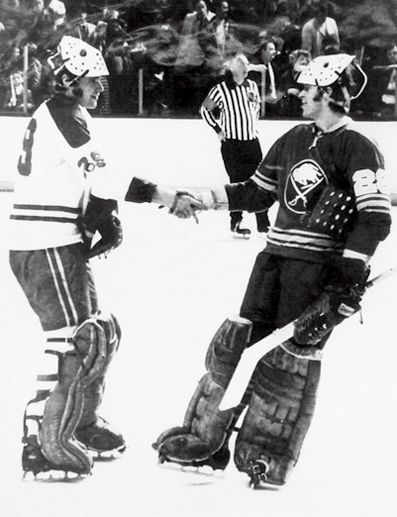
During that 1970-71 season, Dryden was hoping to get to play against the Montreal Canadiens, where his younger brother Ken was playing. On March 20, 1971-- the game was to happen, but the Canadiens started Rogie Vachon over Ken Dryden; so the Sabres played Joe Daley over Dave. However, Vachon got hurt, with allowed Ken to play-- to which, Sabres coach Punch Imlach immediately replaced Daley with Dave-- marking the first (and only) time two brothers have faced off against each other in goal in a NHL game. After the Canadiens won, the Drydens met at center ice and shook hands in a sign of respect.

Dave Dryden would be back in Buffalo in the 1971-72 season, playing in 20 games and going 3-9-5. However, Dryden started to come out of his shell in the 1972-73 season, playing in 37 games and putting together a 14-13-7 record, but going 0-2 in the playoffs. The starting role of the Sabres would go to Dryden in the 1973-74 season; playing in 53 games and finishing with a solid 23-20-8 record with a stellar 2.97 GAA.

As Dryden's stock was on the rise, the WHA came calling with the Chicago Cougars plucking Dryden away from the NHL for the 1974-75 season, going 18-26-1 in 46 games with the Cougars. The new Edmonton Oilers would claim Dryden in the WHA Dispersal Draft, as he would take the starting gig in Edmonton, going 22-34-5 in 62 games of the 1975-76 season. It would be a topsy-turvy 1976-77 season for Dryden, playing in 24 games with Edmonton, going 10-13-0 for this troubles. However, Dryden would be traded to the New England Whalers in January 1977, but refused to report to the Whalers and subsequently suspended. Dryden's refusal paid off, as the Whalers traded him back to Edmonton in September of 1977, and Dryden would going 21-23-2 for the 1977-78 season.

It was a banner year for Dryden in the 1978-79 season, for good and bad reasons. Of course, the WHA was the starting point for Wayne Gretzky, who scored his first professional goal in the WHA on Dryden-- when Gretzky was part of the Indianapolis Racers. Gretzky would then be dealt to the Oilers, which helped Dryden's career season-- as he would go 41-17-2 for the powerhouse Oilers, even though they would lose in the AVCO Cup finals. That season, Dryden won the Ben Hatskin Trophy for Best Goaltender, as well as the Gordie Howe Trophy for WHA MVP of the season.

The Oilers would move over to the NHL for the 1979-80 season, but Dryden almost didn't make the trip over. The Buffalo Sabres claimed Dryden prior to the Oilers' Expansion Draft, but the Oilers reclaimed him as a priority selection in the Draft. Yet, Dryden would only see 14 games, with a 2-7-3 record in those games before retiring.

However, before he retired; Dryden created an innovation in goaltending equipment, which would be a godsend for today's keepers. Dryden created the first fiberglass mask with a cage; which was a primitive look at what we see today in the NHL. It provided full protection to the head, while allowing a clear sight with the cage element to it.

After retiring, Dryden would go to coach the OHL's Peterborough Petes for two seasons, then being the goaltending coach of the Detroit Red Wings for the 1983-84 season. Currently, Dryden is the chairman for Sleeping Children Around the World, a charity providing bed kits and clothing to children in developing nations. This charity was started by Dryden's father, Murray.

While he had to live in the shadow of his overly successful brother, Dave carved a niche out for himself in a solid fashion. He was never put into the most flattering positions, the fact he stuck it out through the lean years and actually knew where he wanted to be and not accepting anything less, he showed the winning instinct that seemed to be a family trait, regardless of personal achievement.

Monday, February 21, 2011

Absurd Goalie Monday: Warren Skorodenski

This week, we'll take a look at a guy who was at the Heritage Classic, but not used. In fact, it seems that for most of his career, his mask would get the most attention in the career rather than what he did while he was playing. And while he had a few moments in the sun, his skull mask shall forever live on. This week, the profile of Warren Skorodenski.

Skorodenski started off playing in Midget AAA with the West Kildonan North Stars in Manitoba before moving to the Western Hockey League with the Calgary Wranglers. In his first season with the Wranglers in 1977-78, Skorodenski played the bulk of games, but only had a dismal 8-22-10 record out of his 52 appearances. Things got drastically better in the 1978-79 season, with Skorodenksi playing in 66 games compiling a 26-31-5 record, then going 7-8 in the playoffs; losing in the division finals. After that season, Skorodenski was signed by the Chicago Blackhawks, but remained in Calgary for the 1979-80 season, where he would put up his best numbers, going 39-23-2 in 66 games, but a 3-4 playoff mark would have him bow out in the first round.

The 1980-81 season would see Skorodenski take the pro route, playing with the Flint Generals of the IHL for 41 games (sadly, no record available), while getting two games up with the AHL's New Brunswick Hawks, going 0-1-0. Skorodenski would stay in New Brunswick for the 1981-82 season, seeing 28 games, finishing with a 16-8-4 record, while going 0-2 in the playoffs. Along with Dan Janeyck; they won the AHL's Hap Holmes Award for fewest goals against. He also got a call-up to the Blackhawks for one game, which was a loss. The 1982-83 season would see him split between the AHL's Springfield Indians for 13 games (3-6-0), as well as being sent down for the bulk of the season to the Central League's Birmingham South Stars, where he would go 11-11-1 in 25 games, while going 0-4 in five playoff appearances. The 1983-84 season was a dicey one, as Skorodenski started out with the Sherbrooke Jets for 19 games (5-10-2), but an incident on November 20th of 1983 would see Skorodenski get suspended by the AHL for 20 games, as he assaulted referee Dave Lynch. When he return, Skorodenski would play 14 games with the Indians, going 3-11-0, then 0-2 in two playoff appearances.

Skorodenski played hard enough in training camp to win a spot on the Blackhawks main roster for the 1984-85 season, backing up Murray Bannerman. Skorodenski would going 11-9-3 in 27 games, with a solid .903 save percentage; highest in the league. Skorodenski played one game with the Blackhawks in the 1985-86 season, a loss, but a logjam in net relegated him to the AHL with the Nova Scotia Oilers, playing 32 games and having a 11-14-2 record to show. The majority of the 1986-87 season had Skorodenski back in Nova Scotia, appearing in another 32 contest with a 10-15-0 record, while receiving a call-up from the Blackhawks for three games, going 1-0-1. Skorodenski also saw time in the IHL with the Saginaw Generals, going 4-1-0 in six games; but then going 3-2 in six playoff contests.

The Edmonton Oilers liked what they saw in Skorodenski when he was in their minor league system, that they signed him before the 1987-88 campaign. Granted, he spent the majority of the time with Nova Scotia, playing 46 games with 25-15-5 record; Edmonton called him up for three games-- but all came in relief and wouldn't allow him a record. Skorodenski had one more kick in the Oilers' organization in the 1988-89 season, but it would be with the Cape Breton Oilers of the AHL, where he would go 11-13-1 before leaving the team.

Skorodenski finished out the 1988-89 campaign with the Canadian National Team, seeing 22 games of action and finishing with a 8-9-1 record. Skorodenski would stay with the National Team for the 1989-90 season, going 18-17-0 in 41 appearances traveling around the globe. One last gasp in the 1990-91 season had Skorodenski play only two games-- both wins-- for the National Team before he would hang-up the pads for good.

Sadly, I was unable to catch up with Skorodenski at the alumni game to see what he is up to, as he seems to have fallen off the map in the hockey world. While he did have a sweet mask, he could have been a lot more. He had flashes of brilliance, but at the same time-- never seemed to get the attention he needed to work on those flashes.